At a Glance
- Narrator: Joanna Carpenter handles the shifts between historical narrative and cocktail culture with easy fluency - the tone is informed and conversational without overselling the material.
- Subjects: the intertwined history of medicine and alcohol, how scientific progress and drinking culture shaped each other, the unexpected origins of beloved cocktails
- Tone: Curious and delighted, like a well-researched bar conversation with someone who actually knows things
- Bottom line: One of the most genuinely surprising food-and-drink history books in recent years - the research is deep, the argument is coherent, and it makes your next Old-Fashioned feel considerably more meaningful.
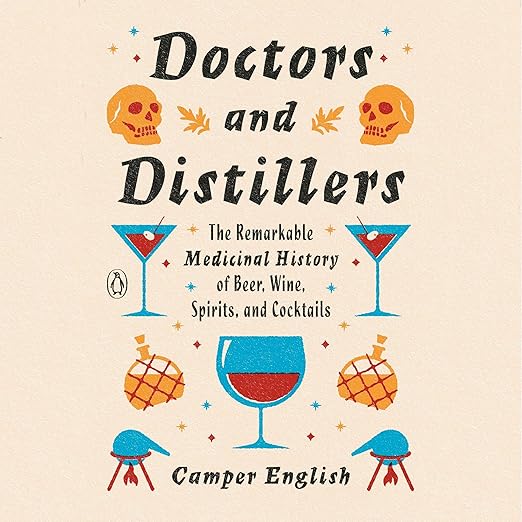
I started listening to Doctors and Distillers on a Friday evening, glass of something botanical in hand, and found myself telling my husband about beer-based wound care and deworming with wine before I had finished the first chapter. That is not a summary I expected to be delivering over drinks, but it is a precise description of how this book operates: it takes what you thought you knew about the separation between medicine and pleasure and quietly demolishes it, one historical example at a time.
Camper English is a spirits and cocktails writer who has spent years digging into the documented history of alcohol and medicine, and Doctors and Distillers is the synthesis of that research. The premise is that the contents of your medicine cabinet and your liquor cabinet were, until surprisingly recently, the same thing - and the book makes that case with such thorough documentation that by the end it feels less like a surprising thesis and more like an obvious truth that was always there.
Your Gimlet Began as Scurvy Prevention
The historical scope is genuinely enormous. English begins in ancient times, when beer and wine were used for nutrition, hydration, and as solvents for healing botanicals, and moves through alchemists distilling elixirs designed to cure all diseases, monastic apothecaries developing mystical botanical liqueurs, traveling physicians concocting dubious intoxicating nostrums, and eventually the emergence of the drinks we recognize today. Along the way, the invention of the germ theory of disease, the development of anesthetics, and the discovery of elemental gases all intersect with fermentation and distillation in ways that English documents with what one reviewer called deeply researched content - pairing it down to easily digestible sections without losing the density of evidence beneath.
The payoff is in the cocktails. English demonstrates that the Old-Fashioned, the Gimlet, and the Gin and Tonic were not invented as pleasures but as medicinal delivery systems - the Gimlet for scurvy prevention on British naval vessels, the Gin and Tonic for quinine in the fight against malaria. This is the kind of history that transforms the way you experience what is in your glass, and it does so through evidence rather than cocktail-party mythology.
Carpenter Delivers the Chuckles, Huhs, and Ewws
Joanna Carpenter's narration suits the material well. English's prose has an engaged, slightly marveling quality - he is a writer who is genuinely delighted by what he has found, and that delight is contagious - and Carpenter preserves that energy without overdoing it. The medical and scientific historical sections, which could easily become dry, maintain momentum because Carpenter keeps the tone consistent with the popular history mode rather than shifting into textbook register.
Reviewer William W. Garretson described it as a book you will find yourself making audible chuckles, huhs, and ewws about - and that inventory is accurate. The ewws are particularly dependable in the pre-modern medical sections, where the treatments English documents are simultaneously horrifying and entirely logical given what practitioners of the era understood. The humor is never cheap; it arises from genuine historical absurdity rather than from English winking at his audience.
Fills a Gap Other Drinks Books Miss
Garretson also noted finding it impossible to retain more than a small fraction of the facts after one reading, and recommending it for re-reading. This is worth flagging for audio listeners specifically: the book is dense with specific historical detail, and the audio format makes some of it harder to absorb on a single pass than the print version might be. Listeners who want to retain the specific dates, treatments, and connections may benefit from listening in shorter sessions or with the print edition alongside.
Reviewer WikiWiki noted that the book specifically fills a gap not covered by other drinks books - the medical, alchemical, and scientific history rather than production, culture, or cocktail recipes. If you are already saturated with cocktail history from other sources, this occupies a genuinely distinct lane. If you are new to spirits literature, you may want to pair it with something more focused on contemporary production and taste to get the full picture.
Pairs Naturally With The Drunken Botanist
Spirits enthusiasts and cocktail culture readers who want the full historical picture beneath what they drink. Food history listeners more broadly - this is in conversation with books like Amy Stewart's The Drunken Botanist (which provided an endorsement quote) and would pair naturally with histories of tea, coffee, or the spice trade. The Alton Brown endorsement note - acknowledging that English's case for alcohol's historical medical role does not quite mean it is actually good for you now - sets the right expectations about the book's honest acknowledgment of its own limits.
Medical history readers who do not typically follow spirits literature will find this one of the more unusual entry points into both fields simultaneously. The research is serious, the writing is accessible, and the subject genuinely deserves the treatment it receives here.
Questions Listeners Ask
Does Doctors and Distillers include cocktail recipes, or is it purely historical?
Primarily historical. Reviewer Kindle Customer noted that English provides several recipes for drinks along the way, so there are occasional recipe inclusions, but the book's core is narrative and historical rather than instructional. Listeners looking for a cocktail recipe guide should pair this with a dedicated cocktail book; those looking for the history behind why those cocktails exist will find this essential.
How does Joanna Carpenter's narration handle the balance between medical history and cocktail culture?
Competently and with consistent tone. The book shifts frequently between pre-modern medical practice, scientific history, and drinks culture, and Carpenter maintains a single engaged, popular-history voice across all of it rather than switching registers. This prevents the medical sections from feeling clinical and keeps the cocktail sections from feeling frivolous.
Is the research in this book primarily anecdotal or is it documented from historical sources?
The research is documented and deep. Reviewer WikiWiki specifically praised English for providing deeply researched content on early medicine, alchemy, and science. The book draws from historical medical texts, apothecary records, and documented correspondence rather than relying on cocktail mythology. Garretson recommended re-reading specifically because of the density of verifiable historical detail.