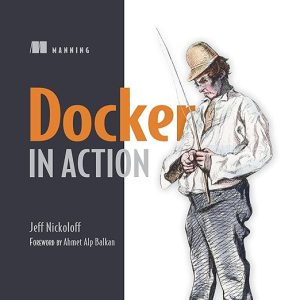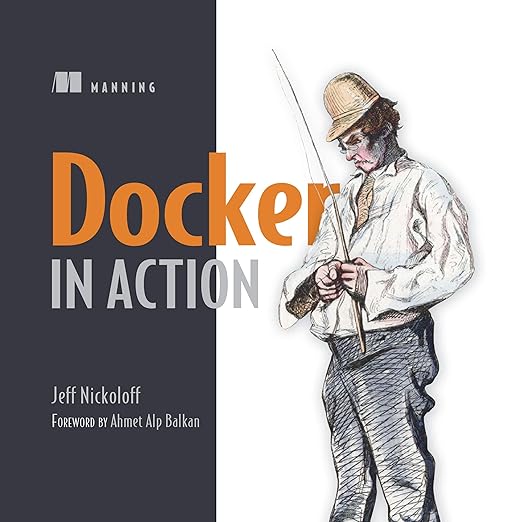
Docker in Action, written by Jeff Nickoloff and narrated by Aiden Humphreys, opens with a question that every developer working in containerized environments has faced at some point: why does the application work on my machine but not in production? The core idea of Docker, creating a tiny, portable environment that holds exactly your application and its dependencies, is the audiobook's answer to that question, and Nickoloff takes the time to explain not just how Docker works but why the problem it solves is significant. That orientation serves the audiobook format better than a purely procedural approach would.
The 10-hour-and-12-minute runtime covers Docker from first principles through multi-container orchestration, following a structure that moves from fundamentals, running containers, managing images, and network exposure, through packaging for distribution, working with Docker Hub, and into the more complex territory of multi-host environments, Swarm, and declarative configuration. For a book that carries the name Docker in Action, the emphasis on foundational understanding before operational practice is notable and, for audio learners especially, essential.
Nickoloff's explanatory approach rewards the listener who comes with a working knowledge of Linux but no prior Docker experience. The book's stated prerequisite is exactly that, Linux familiarity without containerization background, and it delivers consistently at that level. The conceptual framing is strong. The distinction between virtual machines and containers, the explanation of how Docker uses the host OS's namespaces and cgroups to isolate processes without the overhead of full virtualization, is handled with enough clarity that the model becomes intuitive rather than abstract. Reviewer jc's note about right-sizing containers relative to full VM solutions captures the particular insight Nickoloff delivers well.
Aiden Humphreys's narration is technically competent and paced for comprehension. Technical audiobooks live or die on whether the narrator can deliver density without either rushing or becoming soporific, and Humphreys finds a stable middle pace. The challenge the book poses for audio format is structural rather than performative. Docker is a hands-on technology, and the sections that cover specific commands, flag syntax, and configuration file structures lose significant practical value in audio delivery. Listeners who use the companion PDF, available in the Audible library alongside the audio, will get considerably more utility from those sections than those relying on audio alone.
Humphreys's Deliberate Pace Beats a Speed-Read
The audiobook's strongest sections are its conceptual and architectural ones. The explanation of volumes and persistent storage, the overview of network exposure and port mapping, and particularly the later material on clustering and multi-container environments are topics where Nickoloff's prose is dense enough with ideas that reading too quickly misses important relationships. At Humphreys's deliberate audio pace, those relationships become clearer than a speed-read might allow. Reviewer Abhishek Srivastava found the book got them started quickly with exhaustive coverage, which reflects the dual value of conceptual clarity and broad scope that makes this a strong foundation text.
The practical structure of the book, organized into three major sections covering personal development environments, packaging for distribution, and multi-host environments, creates natural break points that work well in audio sessions. Each section has a coherent scope, which makes it easier to listen in focused chunks and return to a clear starting point rather than needing to track progress through a single continuous arc. For developers who are incorporating the audiobook into their regular commute or exercise routine, that structural clarity matters.
Concepts Age Better Than Specific Commands
Reviewer Michael Vilain's note about technical books going out of date applies directly here. Docker as a technology evolves rapidly, and some specific commands, workflows, or third-party integration details covered in this audiobook may have changed since publication. The conceptual foundation Nickoloff provides, the why of containerization and the architecture of how Docker achieves it, ages better than the specific how-to sections. Listeners should treat this audiobook as a strong conceptual grounding rather than a current operational reference, and supplement with current documentation for hands-on implementation.
The 3.9 rating across 36 reviews reflects a narrower audience than general business or memoir audiobooks typically reach. Technical reviewers are more precise in their assessments and more sensitive to the specific limitations of the audio format for code-adjacent material. That rating is not a signal that the book is weak. It is a signal that the format has genuine limits for this kind of content and that engaged readers of technical material approach it with calibrated expectations.
Building the Mental Model Behind Documentation
This audiobook is for developers who want to understand Docker's architecture and philosophy before, or alongside, their hands-on practice. It is not a substitute for working through Docker documentation with a terminal open. It is the kind of audiobook that builds the mental model that makes documentation make sense, that converts a sequence of commands into a coherent picture of what you are doing and why. Listeners with that goal in mind will find the 10 hours well spent.
Listeners who are not developers or who do not have Linux familiarity will find the content inaccessible almost immediately. The book requires its stated prerequisite and does not try to teach Linux alongside Docker. Senior engineers already deeply familiar with Docker will find the foundation material redundant, though the orchestration and multi-host sections may still offer consolidation of concepts that were learned piecemeal. For the developer who is Docker-curious with a Linux background and wants a structured introduction, Docker in Action remains a reliable starting point despite its age in a fast-moving technology space.
Questions Listeners Ask
Can I learn Docker effectively from an audiobook, or does this material require visual/hands-on learning?
The audiobook is most effective for building the conceptual mental model of how Docker works, which is a genuine and necessary foundation. The hands-on command syntax and configuration file details lose significant utility in audio format. The companion PDF helps with those sections, but treating this audiobook as conceptual grounding to accompany practical lab work will produce the best outcomes.
Is Docker in Action audiobook current enough to be useful, given how fast Docker evolves?
The conceptual content, Docker's architecture, containerization philosophy, and multi-container design patterns, ages well and remains accurate. Specific command syntax, third-party integrations, and some operational details may have changed. Treat this as a foundational text to understand Docker's model rather than a current reference for specific commands.