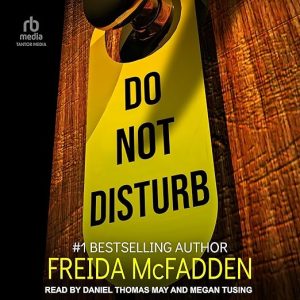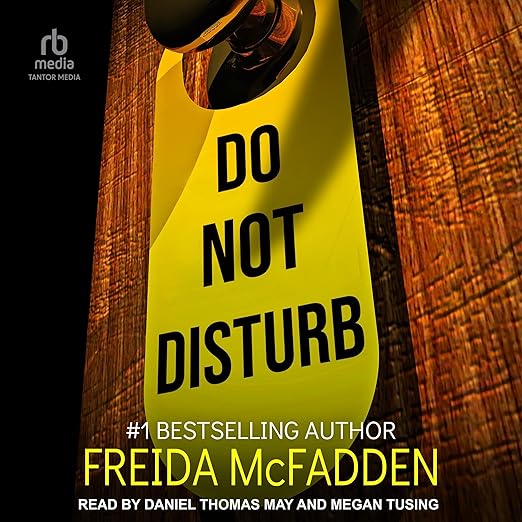
I started Do Not Disturb on a Friday evening when I had specifically set aside two hours for something I did not have to think too hard about. Freida McFadden is a reliable choice for exactly that kind of evening, a thriller writer with a clear grasp of how to pace a narrative, when to withhold information, and how to construct a final act that justifies the journey. Do Not Disturb, in this re-recorded edition with Megan Tusing as lead narrator, delivered on that expectation and then added something I had not anticipated: a fairly pointed structural argument about the distance between creative influence and genuine invention.
The premise is compressed and efficient. Quinn Alexander has committed an unthinkable crime. She is running for the Canadian border before the police discover what she has done. A snowstorm forces her off the road and into the Baxter Motel, remote, broken-down, run by a handsome man with an ailing wife always visible at the window of a dilapidated house across the way. She just needs to survive the night. Readers of a certain vintage will recognize the architecture immediately.
A Closer Look at Do Not Disturb
One review in particular raised the Hitchcock comparison directly, and it is worth taking seriously. The reviewer noted that the first third of the book borrows from Psycho, an ordinary person running from something arrives at an isolated motel, charming proprietor, something wrong in the nearby house, and the second third from Rear Window, a figure always visible through a window, watched, surveillance as menace. The reviewer gave three stars specifically because of the heavy reliance on Hitchcock's work instead of creating a unique premise from the start.
That is a fair critique and an honest one. McFadden does not hide the debts, she leans into them, and readers who come to Do Not Disturb without prior exposure to Psycho or Rear Window will simply experience it as a clever thriller rather than a variation. But for readers who know the sources, the first two-thirds of the book operates as a kind of structural echo chamber. The question of whether that is homage or limitation depends entirely on what you bring to the listening.
What Makes Do Not Disturb Worth Hearing
The Hitchcock-aware reviewer made a specific and generous concession: not until the last third of the book does Freida make this story her own. And it is in that final third where McFadden's characteristic plotting instincts take over. The twist, when it arrives, is not one the Hitchcock blueprints prepared the reader for. It reframes what has come before in a way that rewards the listener who paid attention to small inconsistencies and creates the specific kind of satisfaction that McFadden has built a readership on.
One reviewer who described it as six sides to the story spent real energy tracing the plot's revelations about Quinn's marriage to an abusive husband named Derek, the way the courtship differed from what followed, and the specific event that set Quinn running. That detail-forward review suggests the plotting is intricate enough to reward listeners who are actively tracking the mechanics alongside the atmosphere. The backstory that emerges through the novel's structure is doing more work than the snowbound motel setting alone suggests.
The Caveats
This edition of Do Not Disturb is explicitly flagged as a re-record with a new lead narrator and minor text edits from the previously released version. The decision to re-record with Megan Tusing suggests the publisher found the original narration insufficient for the material, and Tusing's performance here is strong enough that the reasoning is plausible. She handles Quinn's guilt-saturated interiority, the voice of someone who knows what she did and cannot stop knowing it, with a controlled tension that holds for the full seven hours and twenty-five minutes.
Reviewers consistently noted the pacing as an asset: slow at first, then building. That build is where Tusing earns the role. The motel's atmosphere, Nick Baxter's slightly-too-helpful hospitality, and the silhouette at the window all become more oppressive under her reading as the night progresses. The performance is calibrated for the long game, which is exactly what this kind of atmospheric thriller requires.
Who Should Listen to Do Not Disturb
McFadden has a large and loyal readership, and Do Not Disturb sits comfortably within the range of what they expect from her. It is not her most original work, reviewers who know her other titles well note that the Hitchcock scaffolding takes up more real estate than usual here, but the final third delivers the payoff that keeps readers returning to her. For listeners who are coming to McFadden for the first time, this re-recorded edition is a reasonable introduction to her plotting instincts. For fans who want her at her most inventive, other titles may serve better. Available as a free audiobook, it is a low-stakes way to decide which category you fall into. The structural Hitchcock debts are real, and the final third is where McFadden earns the runtime independently. Whether that ratio works for you depends on your tolerance for scaffolding that you can see. For listeners who find the genre pleasurable even when they recognize its mechanics, and many do, Do Not Disturb delivers the experience it promises with more craft and control than its premise initially suggests.
Before You Press Play
- Narrator: Megan Tusing brings Quinn's fractured interiority to life with a performance that handles both the guilt and the mounting dread without tipping into over-dramatization.
- Subjects: Guilt and flight, isolated settings as pressure chambers, twist-dependent domestic suspense
- Tone: Propulsive and tightly confined, a snowbound motel that keeps getting smaller
- Bottom line: McFadden working in familiar territory with practiced efficiency, satisfying for fans of the genre who enjoy twist-dependent structure, though some will recognize its Hitchcock debts before the author claims them.
Before You Listen
Is this a standalone thriller or part of a Freida McFadden series?
Do Not Disturb is a standalone novel. It is not connected to McFadden's other titles by recurring characters or continuous plot, each of her books functions independently.
What is different about this re-recorded edition compared to the original Audible release?
This edition features Megan Tusing as the new lead narrator and incorporates minor text edits from the previously released version. The publisher's note explicitly identifies it as a re-record, which suggests the original narration was considered less effective for the material.
How graphic is the content, specifically the crime Quinn has committed at the start?
McFadden handles the crime with strategic opacity for much of the book, revealing it incrementally as part of the thriller's information structure. The subject matter involves domestic abuse and violence, but the treatment is not gratuitously graphic. It is appropriate for adult thriller readers rather than general audiences.
Does the twist in Do Not Disturb work for listeners who have already read or watched Psycho and Rear Window?
The Hitchcock-familiar reviewer who identified the structural debts explicitly noted that the final third breaks from those blueprints and delivers a twist that is McFadden's own. So yes, listeners who spend the first two-thirds recognizing the Hitchcock architecture will find the twist lands with more surprise precisely because they had mapped the territory they thought they understood.