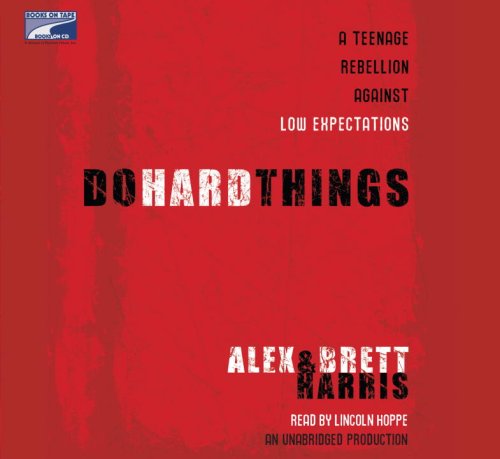
Picture a teenager sitting down to record an audiobook about why teenagers should stop treating their years as a waiting room - and then delivering that argument well enough that adults find themselves taking notes. That image captures something real about the Do Hard Things audiobook experience. Alex Harris, one half of the Harris twins who wrote this book as teenagers, narrates his own work, and the self-narration carries a weight that no adult voice actor could replicate. The argument lands differently when the person making it has personal stakes in whether you believe them.
The central premise of Do Hard Things is both simple and genuinely counterintuitive given the cultural moment it addresses: the idea of adolescence as a protected vacation from responsibility is a relatively recent invention, and it has produced a generation of young people who have been told, systematically, to expect less of themselves than they are capable of delivering. The Harris twins call this the 'myth of adolescence,' and they trace it with a combination of biblical history, cultural critique, and genuine data about what teenagers have accomplished throughout most of human history when they were not insulated from consequence and challenge.
Alex Harris's narration serves the argument particularly well. He is not performing authority he does not have; he is speaking from inside the experience he is describing. When he talks about the low expectations that teen culture imposes, he speaks as someone who lived inside those expectations and chose differently. That autobiographical grounding is not stated constantly - it does not need to be - but it gives the delivery an earnestness that avoids the trap of adult condescension. This is not a book by a forty-year-old lecturing teenagers about how things used to be harder. It is a book by someone who was a teenager when he wrote it, and who is a young adult now, narrating his younger self's call to action.
The 'rebelution' framing - a rebellion against low expectations, not against authority itself - is one of the more elegant rhetorical moves in the book. It channels the energy that teenagers naturally bring to resistance and redirects it toward something constructive. The five pathways the book maps out for responding to this call are specific enough to be actionable: doing hard things that go beyond what is expected, that go beyond your comfort zone, that are too big to accomplish alone, that do not seem spectacular, and that challenge the world's definition of success. That taxonomy gives structure to what might otherwise feel like inspirational generalization.
Why Do Hard Things Works as an Audiobook
The self-narration is the primary argument for the audiobook format. Alex Harris's voice has a quality that is unusual in this genre - he sounds genuinely persuaded by what he is saying rather than paid to perform persuasion. For a book aimed partly at skeptical teenagers who have strong radar for adult performance, that authenticity matters enormously. The new introduction, which reflects on the decade-plus since the original publication and what the 'rebelution' movement became, is particularly valuable in audio form because Harris's current perspective on his teenage work comes through in the pacing and register.
The study guide and list of 100 Hard Things included in this edition make the audiobook more than a passive listen. The 100 Hard Things list, read aloud, functions almost like a call-to-action catalog - specific, varied, ranging from the personal (have a hard conversation you have been avoiding) to the communal (organize something that benefits your neighborhood) to the spiritual. Listeners who engage with it actively will find more than they expect from what could easily have been a generically inspirational teen book.
The historical and biblical examples are well-integrated rather than decorative. Harris does not simply assert that teenagers have always accomplished great things; he walks through specific cases with enough detail to make them vivid. The argument builds cumulatively, and the audio pacing supports that building structure better than a skimmed print reading might.
Weak Spots in Do Hard Things
The theological framing is present throughout. Do Hard Things is a Christian book that treats biblical authority as a primary source for its argument about human capability and obligation. Secular listeners will find most of the cultural argument accessible - the critique of low adolescent expectations does not require faith commitments to evaluate - but they should know that scripture is woven through the reasoning rather than used as isolated proof-text. This is not a secular self-help book with a Christian veneer; it is a book written from a specific faith position that happens to make arguments accessible to broader audiences.
The book was written when the Harris twins were teenagers and published in 2008. Some of the cultural references and examples have dated, and the new introduction acknowledges this. The core argument holds; some of the surrounding texture is a product of its moment. Listeners who encounter anachronistic examples should note that the second edition does include updated material, so the ratio of fresh to dated content is better than in the original.
The five-pathway framework is useful but schematic. Real hard things do not sort cleanly into categories, and the taxonomy occasionally feels like it is doing organizational work that the examples do not fully require. This is a minor structural complaint about a book that is genuinely useful in its prescriptions.
The Right Listener for Do Hard Things
The primary audience is teenagers - particularly those who feel the tension between what they know they are capable of and what the people around them seem to expect. The self-narration by Alex Harris makes this a peer-to-peer recommendation in a way that is rare in motivational literature. A teenage listener who is skeptical of adult authority figures telling them to try harder will encounter something different here: someone who was sitting where they are sitting, made a different choice, and is reporting back from the other side.
Parents who want to share a book with their teenagers without it reading like assigned homework will find Do Hard Things more likely to land than most options in this space. The tone is not preachy; it is direct. The argument respects its audience's intelligence. And the audio format - Harris reading his own words - gives it a quality of conversation rather than lecture.
Youth group leaders, educators in faith-based contexts, and anyone working with adolescents who are navigating the gap between their potential and their immediate environment will find this a resource worth returning to. The study guide included in this edition makes it particularly suited to group settings where the 100 Hard Things list can become a shared project.
I would also recommend this to adults who work in youth ministry or education and want to understand the 'rebelution' framework as a cultural phenomenon. The book launched a movement that has had real effects on how a generation of Christian teenagers thought about their obligations and capabilities, and Harris's narration of his own earlier work gives you access to both the original argument and its retrospective evaluation in a single listen.
- Read by: Alex Harris self-narrates with genuine conviction - peer-to-peer authenticity that no outside voice actor could replicate
- At its heart: Adolescent potential, low cultural expectations, faith and responsibility, the rebelution framework
- Vibe: Earnest, energetic, quietly urgent
- Short version: A teen-authored, teen-narrated call to action that avoids the adult-condescension trap - strongest for faith-based audiences but accessible well beyond that
Is Do Hard Things audiobook appropriate for non-Christian teenagers?
The cultural critique of low adolescent expectations is accessible regardless of faith background, and many secular readers find the core argument persuasive. The theological framing is woven through the reasoning rather than isolated, so secular listeners should expect biblical references throughout, not just as occasional proof-texts.
Why does Alex Harris narrate his own audiobook and does it work?
Harris co-authored the book as a teenager and narrates it now as a young adult. The self-narration gives the argument an autobiographical grounding that a professional narrator could not provide - he speaks from inside the experience he is describing, which matters enormously for an audience with strong radar for performed authority.