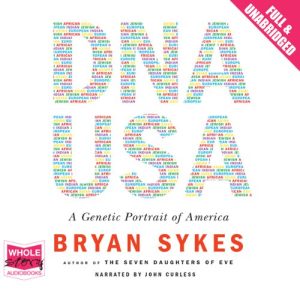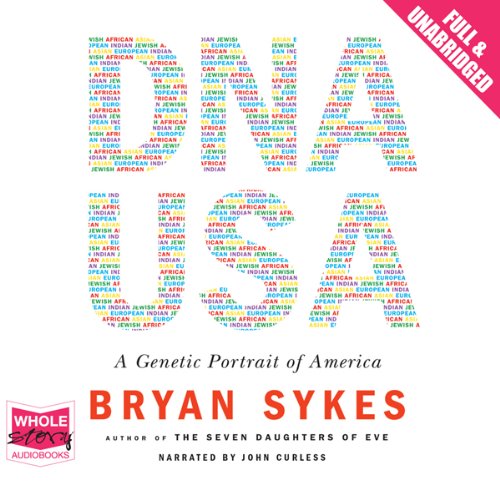
I first read Bryan Sykes' Adam's Curse and The Seven Daughters of Eve years before audiobooks were part of my regular reading life, and they left a strong impression: here was a geneticist who understood how to make population genetics legible to a general reader without falsifying the science. DNA USA applies the same sensibility to American genetic history, and the result is the kind of book that spends 13 hours dismantling certain assumptions you didn't know you were carrying and replacing them with more accurate and more complicated ones.
Sykes was a professor of human genetics at Oxford, and he came to America with a specific project: to use the tools of genetic genealogy, Y-chromosome analysis, mitochondrial DNA, autosomal testing, to examine the genetic complexity of a country defined by extraordinary demographic diversity and layered migration histories. He interviews geneticists, genealogists, anthropologists, and ordinary Americans who have undergone genetic testing, and the book moves between the technical and the personal with the ease of someone who has done this kind of work for a long time.
New England's DNA Contradicts Its Own Family Trees
The structural choice to organize the book around genetic tours of specific communities rather than a single analytical argument is both the book's greatest strength and its most significant limitation. Sykes takes us from the WASP enclaves of old New England, where he traces the genetic legacy of colonial families, to the tribal lands of the Navajo, where questions about genetic identity and cultural identity come into tension in ways he handles with some care. The variety is genuinely interesting. No two communities produce the same set of surprises.
The New England sections are full of the kind of detail that makes genetic genealogy disorienting in the best way: families who believe themselves to be purely of English descent carrying genetic signatures of earlier migrations; individuals whose Y-chromosome ancestry tells a story their family trees have carefully forgotten. The history encoded in genomes is not the history people have constructed about themselves, and the gap between those histories is where Sykes does his most interesting work.
Curless Narrates the Navajo Chapters with Care
The Navajo sections are the most careful in the book, which is appropriate given how politically and ethically charged questions of genetic identity have been for Native American communities, the use of genetic data to challenge or confirm tribal membership has been deeply contested, and Sykes acknowledges that complexity without resolving it. His interviewing approach, talking with community members rather than simply analyzing their DNA, gives those chapters a human texture that the more purely analytical sections occasionally lack.
John Curless's narration is steady and documentary in register, well-suited to a book that moves between scientific explanation and personal interview. The 13-hour runtime reflects the book's ambition to cover genuinely diverse genetic terrain, from the genetic legacy of the African slave trade in current American DNA to the surprisingly complex Indigenous ancestry of many Americans who identify as white, and Curless maintains consistent engagement throughout.
2012 Science, Since Overtaken by Better Data
DNA USA was published in 2012, and genetic genealogy has advanced substantially in the decade since. The consumer testing landscape Sykes describes, companies like 23andMe were still relatively new, and autosomal ancestry testing was just becoming widespread, looks different now. Some of the methodological assumptions the book takes as current would be challenged by subsequent research, and the databases available to Sykes for reference population comparison were considerably smaller than those available today.
This is not a fatal limitation, the book's analytical framework and the questions it raises about American identity remain genuinely interesting, but listeners who want current genetic science should supplement with more recent material. Sykes is also occasionally more confident in his interpretations than the uncertainty inherent in genetic genealogy warrants, a tendency that specialists in the field have noted in his work generally.
Family Secrets, Migration Trails, and Racial Complexity
This is an excellent listen for anyone interested in American history through an unusual lens, genetics as a tool for recovering migration histories, family secrets, and the biological complexity underlying the racial categories Americans have used to organize their social world. Fans of Sykes' earlier books will find the American subject an interesting application of his methods. Listeners with existing knowledge of population genetics may find the science simplified, but the interview-based sections and the community portraits provide genuine interest even for specialists. Those looking for a current account of the genetic ancestry testing industry should know this is a 2012 document and calibrate accordingly.
Questions Listeners Ask
How has the field of genetic genealogy changed since DNA USA was published in 2012?
Substantially. Consumer testing companies have expanded their reference databases enormously, autosomal testing has become the standard approach, and the interpretation of ancestry percentages has become both more refined and more contested. Sykes' 2012 account reflects an earlier stage of the field. The scientific framework is still valid, but specific methodological claims should be treated as historical rather than current.
Does DNA USA focus on specific ethnic or regional communities, or does it attempt to cover all of American genetic diversity?
It covers specific communities through a series of genetic tours, old New England WASP families, Navajo tribal lands, and other genetically significant communities, rather than offering a comprehensive survey. The selective approach generates more depth than a panoramic treatment would allow.
Is the book sensitive to the contested politics of genetic testing in Native American communities?
Relatively so. The Navajo sections are the book's most careful, and Sykes acknowledges the political and ethical dimensions of using genetic data to question tribal identity without fully resolving the tension. The treatment is more thoughtful than the scientific sections' analytical tone might suggest.
Does Bryan Sykes reach specific conclusions about American genetic identity, or is the book more exploratory in its approach?
Primarily exploratory. The book's structure, following genetic evidence through communities and individuals, generates insights rather than arguments. Sykes draws interpretive conclusions in each section, but the overall arc is a genetic travelogue rather than a thesis-driven history.