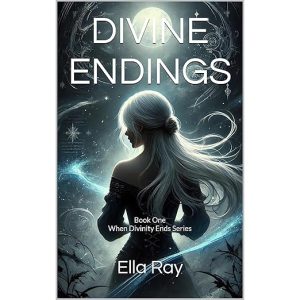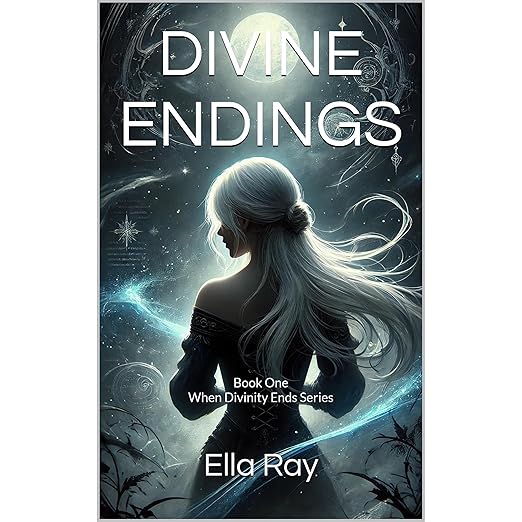
Romantasy has a structural problem that nobody in the genre pretends to have solved: the reader wants four relationships developed properly and a kingdom saved properly, in one book, and something has to give. Ella Ray's opener gives on the kingdom, deliberately and fairly early. Luna dies on Earth, wakes in a realm of gods and monsters carrying divine magic she never asked for, gets captured by demons, and is dropped into a political game she has no equipment to read. The audiobook runs a little over nine and a half hours, and the balance it strikes between romance and quest is the single fact that decides whether this is for you.
Is Divine Endings Worth Your Time?
Ray's setup moves fast and borrows cleverly. A human protagonist pulled out of one world and installed in another with a job to do is a structure with a long pedigree, most recognizable now from isekai manga and anime, and the opening chapters lean into it without apology. The furniture is familiar: three kingdoms, gods playing unseen games, a crumbling world, a heroine whose power arrives as both gift and curse. What Ray does with it is less about invention than about pressure. Luna is captured before she understands the rules, suspected of spying, and forced to earn standing among people who have every reason to kill her, which turns the fish-out-of-water setup into something with actual stakes attached.
Character over plot is the trade this book makes, and its most enthusiastic response says so without complaint. A five-star account filed in May 2025 calls it more character driven than plot driven while noting the political scheming still running underneath, and points out that all the principals carry deep-set trauma, which is what allows them to bond in the first place. That is an accurate diagnosis. The three love interests are drawn as distinctly different temperaments rather than as three angles on the same man, and Luna's history on Earth is felt by the others before it is ever explained to the reader. If you read why choose romance for the group dynamic rather than for the individual pairings, this is exactly the register.
The Best Parts of Divine Endings
The world itself is more inventive than the marketing copy suggests. One of the five-star responses lays out the machinery: a realm holding demons, witches and shapeshifters; a land called Terra being poisoned; the poison blocking the gods from reaching their own people; and Luna sent in to find the source. Captured and taken for a spy, she pleads her case before Hunter, the king of the demons, who believes her and trains her instead of executing her. Jax, a warrior, and Kai join her from there. It is a better engine than most romantasy openers bother with, and the political scheming that grows out of it gives the middle stretch something to do besides pair everyone off.
This file was voiced by software, and the credit line says so plainly. That matters here more than it would in a memoir, because the book is built on four principals in constant conversation and a reader has to tell three love interests apart in scenes where the dialogue tags thin out. Add the intimate material a why choose romance is bought for, and the demands on delivery are considerable. Play the sample on a group scene rather than the first chapter, and check whether Hunter, Jax and Kai stay distinguishable when the exchange gets fast.
Before You Commit to Divine Endings
Two of the five visible responses disclose that they did not buy the book. One arrived as an ARC, which the reviewer notes had not been fully edited, with grammatical errors and typos still in place, and another came free through a review service. Neither disclosure is improper and both are stated openly, but they change what a 4.0 average across 190 ratings is telling you, and the ARC point raises a specific question: the text that response describes is not necessarily the text you would be hearing. Worth a note as well that the copy sets an expectation the book only half keeps, promising a deadly game of politics and power on the same line as three dangerously alluring demon males.
Pacing is the recurring complaint, and it comes from the responses that liked the book. A September 2025 verdict at three stars describes loving the concept, being genuinely interested in the poison plot, and then watching that plot get pushed aside for relationship development. A separate four-star response is blunter still, calling it a 3.5 rounded upward and admitting the story took a long time to hook, though the second half earned the ride. Both note the characters fall into shapes anyone who reads this subgenre already knows. The other absence is on the record itself: no heat level, no content note and no advisory of any kind, on a book sold on desire and morally ambiguous men.
Should You Listen to Divine Endings?
Readers who already live in why choose romantasy will be at home immediately, particularly anyone who wants the found-family bond to be the emotional payload rather than a subplot. It also suits listeners who like a heroine learning a world from zero, since Luna's ignorance is the reader's, and the explanations arrive because she needs them rather than because a prologue demanded them. As a trilogy opener it does the job trilogy openers exist for: it establishes four people you will follow for two more books.
Anyone allergic to instalove pacing, or hoping for a tightly plotted political fantasy with a romance attached, is being sold the wrong book here, and the responses that flagged it were doing prospective buyers a favor. Listeners who need a resolved ending should also be warned that this is book one of three and behaves like it. Plot-first listeners should walk past this one, because in this book the relationships are the plot.
At a Glance
- Subjects: Why choose romance, isekai-style displacement, divine magic as a burden, found family, political scheming among demons and gods
- Tone: Warm, escalating, more bonded than dangerous
- Bottom line: A relationship-first opener to a trilogy that will satisfy why choose readers and frustrate anyone who came for the poisoned kingdom.
Good to Know
Does the audiobook stand alone or do I need the rest of the trilogy?
It is Book One of the When Divinity Ends trilogy and reads like a first act. The poison threatening Terra and the gods' broken connection to their people are established rather than settled, so expect character arcs to advance and the larger plot to remain open.
Does the listing say how explicit the audiobook gets?
It does not. The copy promises an emotionally charged fantasy romance with morally ambiguous men and desire in the mix, but no heat level, content note or advisory appears anywhere on the record. Assume adult content and sample before buying if that matters to you.