The Short Version
- Narrator: Emma Galvin carries eleven hours anchored to one teenage protagonist, which makes consistency of voice the thing to sample for.
- Subjects: Chosen identity versus inherited family, conformity and its enforcement, initiation and fear, difference treated as danger.
- Tone: Propulsive, anxious, physically charged.
- Bottom line: The dystopian YA benchmark of its decade, still worth eleven hours, provided you take the faction system as metaphor.
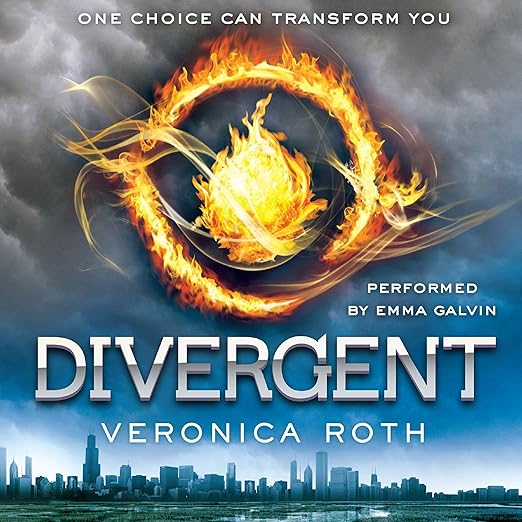
Fifteen years after Beatrice Prior picked her faction, this audiobook is still being sold with the film attached. The description leads with Shailene Woodley, Theo James and Kate Winslet, promises fans of the movie the same emotional depth and action, and then closes by steering you toward an entirely different Veronica Roth series. What sits between those two pieces of marketing is eleven hours and eleven minutes read by Emma Galvin, and the novel has held up rather better than the page selling it.
What holds up best is the central idea, a school-cafeteria question raised to the level of civic architecture. Society is split into five factions, Candor for the honest, Abnegation for the selfless, Dauntless for the brave, Amity for the peaceful and Erudite for the intelligent, and at the appointed age you choose one and give up the others. Beatrice chooses against her family, is renamed Tris, and carries a secret that makes her dangerous rather than special. That last inversion is the reason the book outlasted its imitators: difference here is a liability first and a gift second. That single choice is one of the cleanest opening hooks in the genre, because it makes an entire society hang on a decision a teenager makes once, with no way back. Everything that follows is the cost of that minute.
One five-star describes a rating method worth borrowing: start every book at five stars and deduct from there, and this one gave no reason to deduct. The same reader came to the series because of a daughter, and mentions appreciating a YA novel that carries its violence without leaning on swearing or sexual content. For a parent deciding whether to hand this to a fourteen-year-old, that is more useful than any amount of publisher copy about emotional depth.
Galvin Carries an Eleven-Hour First-Person Voice
An eleven-hour first-person teenage narration is a real assignment, and Emma Galvin holds the credit on this 2011 recording. The book stays close to Tris throughout: the choice against her family, the life she enters afterward, and the secret she has to keep from the people around her. A reader has to keep that voice believable through the action the copy promises and through the quieter stretches between, without tipping into either flatness or performance. That balance is what a sample will tell you within five minutes.
The comparison everyone reaches for gets addressed on this very page. One response, written in Italian, argues at length that the book is commonly dismissed as a poor copy of The Hunger Games and that the two have almost nothing in common beyond a shared shelf, that they are entirely different texts, and that this series became the writer's favorite of the two. The same response reckons the films are watchable but that the story gets distorted from the second one onward, and lands on the oldest verdict in publishing: the book is better.
Structurally the novel is built for audio. The world arrives through what Tris does rather than through explanation, the escalation runs from one decision to its consequences, and the copy's promise of exhilarating action is where the pacing spends its energy. The dystopian machinery creaks if you press it, but the pacing never asks you to press it. The frame stays simple too: five named factions, one choice, and the consequences of it. In audio that legibility matters more than in print, since a listener cannot glance back at a map, and this book never asks for one.
Half-Star Opinions With Nowhere Left to Go
Careful reading shows up in the four-star, which comes with a curious wrinkle: the body of the response awards four and a half out of five while the star field records four. That reader re-read the novel before writing in order to be accurate, calls it an excellent dystopian, and notes the crowding in the genre at the time. Half-star opinions have nowhere to go in a five-point system, and this is what that looks like from the inside. Take the written verdict over the field, as the person who wrote it clearly intended.
The listing itself needs more caution than the book. Three of the five written responses arrived in languages other than English, one of them a two-line note about a present that pleased its recipient, so the readable reception of an English recording is thinner than the badge of 4.5 across 80 ratings suggests. Then the description ends by pushing The Fates Divide, described as the sequel to Carve the Mark, which belongs to a separate series entirely. Cross-promotion inside the description of a different book is the sort of thing that leaves a buyer unsure which title they are about to order.
Fast, Physical, and Morally Loaded for Teens
Teen listeners who want a fast, physical, morally loaded story remain the primary audience, and the copy is right that readers of The Hunger Games and the Maze Runner books are the natural crossover. Adults who missed the wave will find a competent, propulsive novel with a genuinely good central idea, and anyone who saw the films first will discover how much interior reasoning the adaptation had to drop. Listening suits the action particularly well, since those passages are written for momentum rather than for description. It also holds up as a reread in audio for anyone who first met it as a paperback in the last decade.
Skip it if you want your dystopias to survive scrutiny of their politics, because the faction system is a metaphor rather than a functioning society, and the questions it raises about how such a place feeds itself go unanswered. Skip it too if a love plot in the middle of a revolution irritates you. Otherwise, start at book one, ignore the promotional line at the bottom of the description, and take the eleven hours in the order they were written.
Frequently Asked Questions
Is this audiobook the first book in the Divergent series?
Yes. The record lists it as entry one, and the description names Insurgent and Allegiant as the sequels that follow. The closing line about The Fates Divide refers to a different Veronica Roth series and has no bearing on the reading order here.
How long is the audiobook, and who publishes it?
Eleven hours and eleven minutes, released by HarperCollins in May 2011 with Emma Galvin narrating. That places the recording between the novel's first publication and the film adaptation whose cast the current description spends its opening paragraph promoting, some three years later.
Is the content suitable for younger teenagers?
The book is shelved for teen and young adult readers, and the copy promises exhilarating action in a society where being different is treated as dangerous. It handles those without explicit sexual content or heavy language, so the deciding factor for a younger listener is tolerance for sustained peril rather than anything else.
Do I need to have seen the film first?
Not at all, and the order barely matters. The description sells the movie cast heavily, but the novel gives you Tris's reasoning at a length no adaptation can carry, so coming to the audio first generally makes the film feel thinner rather than the other way around.