
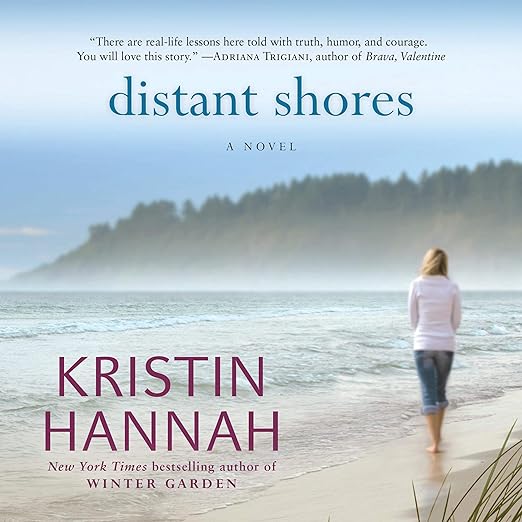
I came to Distant Shores knowing it was an early Kristin Hannah novel, which is to say I came with calibrated expectations. Hannah's career divides into two distinct periods: the emotional but sometimes slightly schematic early work, and the more fully realized later novels like The Nightingale and Firefly Lane that made her one of the most widely read authors of the past decade. Distant Shores belongs to the earlier period, but it is not a minor work. It is doing something specific about a specific kind of marital dissolution, quiet, accumulated, nearly invisible until it isn't, that Hannah has not quite returned to in the same way.
I listened on two consecutive evenings when I needed something that would sit with me rather than carry me away. Bernadette Quigley's narration is exactly that kind of company: unhurried, emotionally present, comfortable with silence. She does not push the sadness of the story. She lets it accumulate.
How Distant Shores Holds Up
Elizabeth and Jackson Shore married young, which Hannah portrays not as a mistake but as a fact with long, slow consequences. Jack was the star quarterback; Elizabeth was the art student with ambitions. His career absorbed hers. By the time their daughters leave home and the marriage is left alone with itself, there is less there than either of them admits. Hannah is careful not to villainize Jack, though she also does not let him off the hook. He makes decisions that prioritize his career and his comfort in ways that read, from Elizabeth's perspective, as chronic disregard. Whether that constitutes genuine negligence or simply a failure of imagination is one of the questions the novel is asking.
The beach house sequence, where Elizabeth retreats after her father's death and begins uncovering the story of her parents' marriage, is the novel's best material. She finds, in her mother's things, evidence of a devotion that makes her own marriage feel even more inadequate by contrast. One reviewer made the observation precisely: both Elizabeth and Jack had to find themselves before they could find each other. That double arc is what makes the book something more than a straightforward examination of marital drift.
Why Distant Shores Works as an Audiobook
Hannah's particular strength, present here even in her early work, is her ability to render the interior experience of women who have organized their identities around someone else's needs without fully recognizing what they have given up. Elizabeth's disorientation at the novel's opening, who is she when she is not actively supporting Jack's career and raising the daughters, is written with the specificity of someone who has thought carefully about how that loss of self actually feels rather than how it looks from the outside.
The decision Elizabeth makes, the terrifying risk she takes at the novel's end, arrives organically from everything that precedes it. It does not feel sudden or unearned, which is a tribute to Hannah's control of her character's emotional logic across the full length of the book.
Weak Spots in Distant Shores
This is clearly not Hannah at her most polished. Readers who come from The Nightingale or The Great Alone will find the prose slightly less textured and some of the emotional beats slightly more telegraphed. One reviewer noted it is not among Hannah's best, which seems accurate. But that framing also undersells what it is doing well. The marital specificity, the beach house as emotional reckoning, and the honesty about what Elizabeth's nickname costs her are all evidence of a writer in the process of developing something she would later deploy with greater precision.
Jack's arc drew some reader resentment, which is worth noting. He does not become a villain, but his behavior across the middle of the novel requires some sympathy-testing for those who feel protective of Elizabeth. Hannah is not interested in easy assignments of blame.
The Right Listener for Distant Shores
This is for women's fiction readers who want an emotionally honest examination of what a long marriage looks like when it has been quietly starved, and who are willing to sit with ambiguity rather than demand resolution. Hannah fans who have read her later work will find this interesting as an early version of concerns she returned to repeatedly. Readers new to Hannah should start with The Nightingale or Firefly Lane rather than here, not because this book is weak, but because those later novels better represent what she became. Come back to Distant Shores afterward, and you will likely appreciate it differently.
Good to Know
Does Distant Shores end with Elizabeth and Jack's marriage resolved, or is the conclusion ambiguous?
The ending is deliberate and earned but not neatly tied. Elizabeth makes a decision that risks everything for a second chance at happiness, and the novel closes on that choice rather than its complete aftermath. There is genuine resolution, but Hannah does not resolve every thread with convenient clarity.
How does Bernadette Quigley's narration suit the tone of this novel?
Very well. Distant Shores is an interior, contemplative story, and Quigley narrates with an unhurried intimacy that lets the emotional accumulation build naturally. She does not push the sadness or announce it. She inhabits the story's quiet register, which is exactly what this material requires.







