Quick Take
- Narrator: Gabrielle Union delivers a controlled, unhurried performance that gives this short audiobook more emotional density than its runtime would suggest.
- Subjects: Mother-son estrangement, housing displacement, the cost of the American dream
- Tone: Quietly devastating, compressed
- Bottom line: A short but genuinely affecting release that rewards listeners willing to sit with under an hour of real weight.
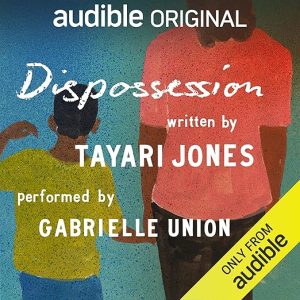
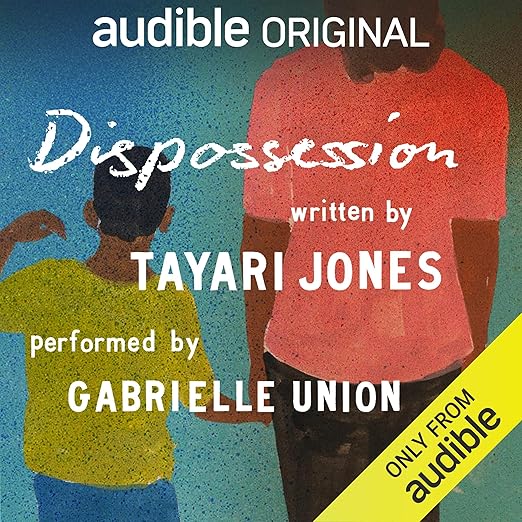
Dispossession carries two meanings by the time this fifty-seven-minute audiobook ends, a mother's slow loss of her son and a family's literal eviction from their home, and Tayari Jones spends the entire runtime letting those meanings rhyme without ever stating the connection outright.
The Review
Cheryl sent her son Javonte to an exclusive Vermont boarding school a decade ago, desperate to get him away from the violence of Atlanta's streets, and the gamble mostly worked: he's married now, well employed, thoroughly settled in New England. It also cost her the relationship itself. When Javonte cancels a planned MLK weekend visit at the last minute, Cheryl takes a moving job in her own old neighborhood instead, cheered by the idea of watching another Black family move up in the world, only to learn on arrival that the home's occupants aren't moving by choice at all.
Jones, author of the National Book Award finalist An American Marriage, works in miniature here, and the compression is the point. A novel would have room to dramatize the eviction, the boarding school years, the slow drift between mother and son as separate extended sequences. In under an hour, Jones instead lets one ordinary work shift force Cheryl to confront all of it simultaneously, without flashback scaffolding or explanatory narration doing the connecting work for the listener.
Audio releases at this length occupy a strange position in the wider audiobook market: priced and marketed alongside full novels, but built on completely different structural rules. Where a novel has room for subplot and digression, a fifty-seven-minute release has to make every scene do compound work, and Jones's background writing longer literary fiction shows in how confidently she trusts a listener to fill in backstory from a handful of precise details rather than full explanation.
The moving-company detail carries its own quiet irony once you sit with it: Cheryl earns her living helping other people relocate, professionally skilled at the logistics of upheaval, while her own emotional life has stayed frozen in the exact moment she sent her son away a decade earlier. Jones never states that parallel outright, trusting the listener to notice it forming across the story's back half.
Gabrielle Union narrates, and one listener review calls her performance 'beautifully narrated,' specifically praising the control she brings to a story that could easily tip into melodrama in less careful hands. Union, named one of Time's 100 Most Influential People in 2020, brings recognizable star power to the project, but what actually lands is the restraint: she lets Cheryl's exhaustion and denial surface gradually rather than announcing them.
Another reviewer, Jessica Madden, describes the experience as a listen that is short, and yet makes you feel like you have a full, deep story, and that's a fair summary of why this format works. Short-fiction audio releases like this one are often treated as minor or disposable next to full-length novels, but Dispossession uses its density efficiently: every scene is doing at least two jobs at once, advancing plot while quietly building the mother-son wound underneath it.
Gabrielle Union has built a production career alongside her acting work in recent years, developing and producing projects centered on Black women's stories rather than simply appearing in them, and that behind-the-camera sensibility arguably informs how she approaches narrating someone else's short fiction here. She isn't just performing Cheryl's voice; she's shaping the emotional pacing of a story she clearly understands on a structural level, not merely a line-reading one.
Weak Spots in Dispossession
Go in with accurate expectations about length. Fifty-seven minutes puts this at short story or novella territory, not a full novel, and listeners expecting An American Marriage-level scope will find a much narrower canvas here. That's a format choice, not a shortcoming, but it changes what you should expect to pay attention to: a single sustained mood rather than a sprawling multi-year plot.
The content itself carries real emotional weight despite the brevity: grief over a distant child, the specific indignity of watching a family lose their home, and Cheryl's own unresolved guilt about choices she made a decade earlier. One reviewer, EricaLenise, notes the story is rooted specifically in Southwest Atlanta, mentioning Stewart Avenue and Metropolitan Parkway by name, and that neighborhood specificity gives the eviction plotline a lived-in authenticity rather than a generic backdrop.
The ending resists a clean resolution, in keeping with the rest of the story's refusal to spell out its own connections. Listeners expecting the eviction plotline and the Javonte plotline to collide in an obvious dramatic climax should recalibrate; Jones is more interested in the accumulated weight of parallel losses than in a single unifying twist, and the final minutes ask you to sit with that ambiguity rather than resolving it neatly.
Who It's For
This suits fans of An American Marriage wanting more of Jones's voice in a bite-size format, commuters looking for a single-sitting listen with real substance, and anyone drawn to literary fiction rooted specifically in Atlanta's Black neighborhoods and their ongoing displacement pressures.
Skip it if a full novel-length immersion is what you're after, or if the runtime feels thin relative to the cost of a typical audiobook credit; this is priced and scaled like a short story, not a novel, and going in with that math already settled will make the listen land better.
Anyone building a reading or listening list around contemporary Black women's fiction beyond the most heavily marketed titles will find this a worthwhile addition alongside Jones's longer novels, since it demonstrates a different muscle, compression rather than expansion, that her full-length work doesn't get to show off in quite the same way.
It also suits listeners who specifically favor dense, single-sitting literary fiction over sprawling series commitments, since the entire emotional arc resolves inside one uninterrupted hour rather than asking for a return visit across multiple listening sessions.
How long is this audiobook, and is it a full novel?
At fifty-seven minutes, this is a short story length release, not a full-length novel, so plan accordingly.
Do I need to have read An American Marriage to follow this audiobook?
No, Dispossession is a standalone story that shares thematic concerns with Jones's novel but doesn't require prior familiarity.