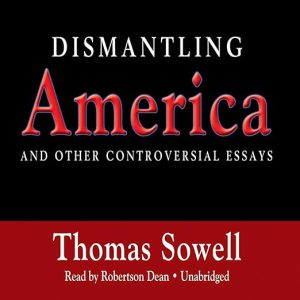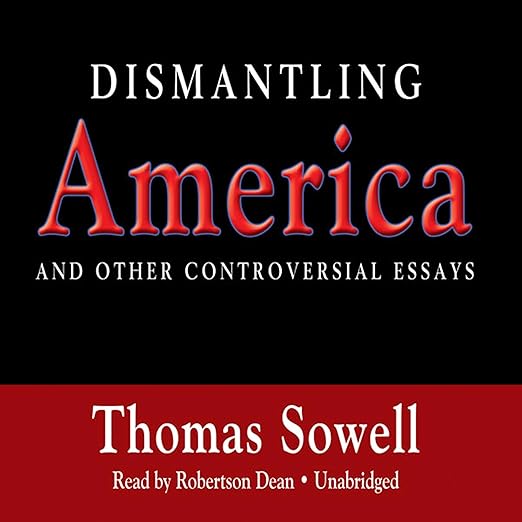
- Performance: Robertson Dean brings a measured, authoritative delivery to Sowell's syndicated essays that suits the argumentative register; his controlled tone neither editorializes nor flattens the force of Sowell's positions.
- What it covers: American institutional decline, conservative political analysis, individual versus collective authority
- Feel: Pointed and deliberate, with accumulated argumentative weight
- Our call: Robertson Dean's controlled narration makes Sowell's essay collection coherent as an audiobook; essential listening for Sowell readers, challenging and useful for listeners across the political spectrum who want a rigorous conservative argument.
Thomas Sowell's essay collection landed on my desk during a period when I was working through several political anthologies, and the format, syndicated newspaper columns gathered under a unifying thesis, presented a structural question that audiobooks handle less gracefully than they handle narrative. Robertson Dean's narration of Dismantling America answers that question by treating each essay as a self-contained argument delivered with the same measured authority, so the audiobook accumulates force through repetition and variation rather than building toward a single climax.
The unifying claim Sowell makes across these essays is precise: that the decline of American values and institutions is not gradual erosion but deliberate dismantling by people who believe their superior wisdom justifies overriding democratic traditions. Whether the specific topic is financial bailouts, immigration policy, Duke University's rape case, or national security, Sowell returns to that structural argument about who has the authority to override established norms and on what basis.
Sowell's essay format is particularly well-suited to audio in one sense and poorly suited in another. Well-suited: each essay is a complete argument with a clear premise, evidence, and conclusion, which makes it possible to absorb individually during short listening periods without losing the thread. Poorly suited: the cumulative repetition of the central thesis across the collected essays, each arriving at a version of the same conclusion, can become monotonous without the visual breaks that print provides. Dean handles this by maintaining consistent vocal authority without inflating the performance for individual essays, which preserves the integrity of the collection format even as it manages the repetition problem.
Reviewer B. Brigg, who has read extensively in Sowell's catalog, called this collection the best Sowell available and specifically praised his incisive mind cutting through progressive talking points to the heart of the matter. That characterization is accurate to Sowell's method: he builds his arguments from empirical observation and statistical evidence rather than ideological assertion, and his challenges to progressive orthodoxy carry analytical weight even for readers who disagree with his conclusions. The Duke University case analysis is a useful example, where Sowell uses a specific institutional failure to argue a point about the displacement of legal standards by progressive social pressure that holds regardless of one's political sympathies. The financial bailout essays are similarly constructed, using the specific mechanics of how bailout decisions were made to argue a broader point about technocratic authority displacing democratic accountability. Dean delivers these analytical pivots with the same neutral precision, keeping the listener's attention on Sowell's argument rather than on the narrator's performance.
Why Listen to Dismantling America
At eight hours and seven minutes, the audiobook is compact for the breadth of material it covers. The essays span economic policy, immigration, legal standards, cultural norms, and foreign policy, and Sowell's consistent framework for analyzing each provides a unified argument across what could otherwise feel like a miscellaneous collection of political commentary. Reviewer DrProactive Randy Gilbert, who described Sowell as motivating and educational, is representing a particular kind of reader, someone who already agrees with the framework, but the audiobook is also genuinely instructive for listeners approaching from different starting points because Sowell's argument-from-evidence approach is worth engaging with on its own terms.
Robertson Dean's voice carries the seriousness the material requires without tipping into performance. He narrates Sowell's more pointed observations, including the book's warning that the next election may be the last chance to stop certain changes before they become irreversible, with the same measured delivery he applies to the statistical analysis. That tonal consistency is valuable because it prevents the most politically charged statements from sounding like partisan rhetoric and keeps them inside the analytical register Sowell constructs throughout. For listeners who find much political commentary too reliant on emotional appeal, Sowell's empirical grounding, and Dean's refusal to perform it theatrically, makes the audiobook a different kind of listening experience from most political audio content.
What to Watch For in Dismantling America
The political argument in this collection is clearly conservative in orientation, and listeners should approach with that framing understood rather than assumed. Sowell argues from a position that American traditional values and institutions represent tested wisdom that should not be discarded by those convinced of their superior insight. That premise is contested, and the audiobook does not present it as contested; it presents it as analytically obvious. Listeners who disagree with that premise will still find the specific empirical arguments worth engaging with, but the overall rhetorical frame is not neutral.
The essay-compilation format also means the audiobook does not build a sustained argument the way a book-length treatment would. Individual essays can be very sharp, but the collection's persuasive power is more about density and repetition than systematic philosophical development. Readers who have come to Sowell for his full analytical framework might find his book-length works a stronger introduction than this collection.
Who Should Listen to Dismantling America
Sowell readers who want his political commentary in consolidated audio form will find this collection a strong representation of his syndicated work. Listeners interested in conservative political philosophy who want argument-from-evidence rather than rhetorical polemic will find Sowell's method instructive regardless of their own political position. Those looking for a balanced multi-perspective treatment of the topics covered should seek supplementary material, as the collection argues a specific position consistently. Robertson Dean's narration makes the eight-hour audiobook comfortable to complete in a few concentrated listening sessions, and the self-contained essay format suits non-continuous listening particularly well for commute or travel use.
A Few Questions About Dismantling America
Is the Dismantling America audiobook a coherent listening experience or does it feel like disconnected essays?
Robertson Dean's consistent narration style and Sowell's unifying thesis about institutional decline give the essay collection a coherence that prevents it from feeling miscellaneous. Each essay addresses a different topic but returns to the same analytical framework, so the audiobook accumulates argumentative weight rather than feeling scattered.
How does Robertson Dean's narration suit Sowell's political essay style in the audiobook?
Dean's measured, authoritative delivery suits Sowell's analytical register well. He maintains consistent vocal authority across all the essays without editorializing or inflating the more pointed political observations, which keeps the material inside the analytical frame Sowell constructs throughout.