From Four Humours to the Birth of Germ Theory
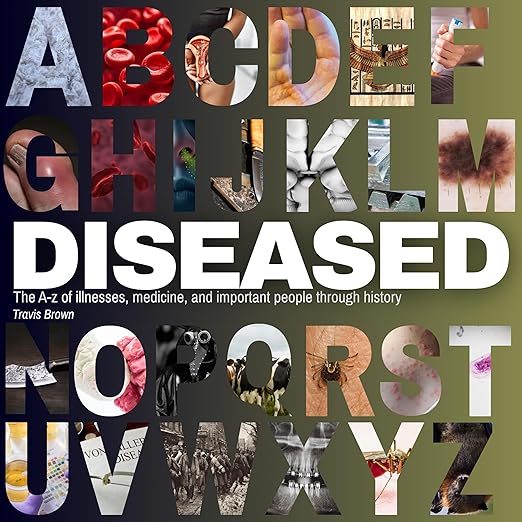
Blood, phlegm, and bile once explained every fever, every plague, every mysterious death that swept through ancient villages, and Travis Brown's Diseased audiobook opens exactly there, with the four humours theory the Greeks used to make sense of a body they could not see inside. From there the book moves fast: gods and priest-healers in early civilizations, humoral medicine giving way to germ theory, and finally the eighteenth-century turn toward observation and experiment that produced the medicine we recognize today. At three hours and twenty-two minutes, this is not a comprehensive medical history so much as a guided tour through the moments when human understanding of illness lurched forward.
What makes Brown's approach appealing is the framing device stated plainly at the outset: every disease has a story, and some of those stories are funny, some tragic, some outright absurd. That premise sets up a book built on anecdote rather than strict chronology, which suits an audio format better than a straight timeline would. Listeners get vignettes rather than one unbroken argument, closer in spirit to a well-researched anthology than to a university lecture course. It works as an accessible entry point for someone curious about medical history who has never picked up a proper academic account of epidemics, and it does not pretend to be more rigorous than it is.
Steve Davis's Unhurried Register for Podcast-Style Chapters
Steve Davis narrates in a clear, unhurried register that suits anecdote-driven nonfiction better than it would suit a thriller. No extensive catalog of prior credits comes attached to this listing, which makes him hard to benchmark against comparable narrators, but the delivery here does what the material needs: steady pacing through unfamiliar terminology like humoral theory and germ theory, without rushing past vocabulary a listener needs a beat to absorb. Medical history depends on this kind of patience, since a mispronounced or hurried technical term breaks trust with an audience faster than almost any other genre.
The subject matter travels well in audio specifically because of that anecdotal structure. Each disease gets its own compact narrative arc rather than a paragraph buried inside a denser academic chapter, so a chore, a commute, or a walk breaks naturally between one condition and the next. Readers who enjoyed the narrative-medicine lane carved out by writers like Lindsey Fitzharris or Mary Roach will recognize the appeal, though Brown's scope is broader and shallower than either of those two, trading depth on any single disease for breadth across many. That trade-off is worth naming upfront, since listeners expecting Fitzharris-level surgical detail on one topic may find Diseased has moved on before that curiosity is fully satisfied.
The chapters also carry a podcast-adjacent quality in how they are built, each one landing on a specific illness with its own beginning, complication, and resolution before moving on to the next. Listeners already in the habit of queuing up history or science podcasts during errands will slot this in easily, since no single episode-length chapter demands the sustained attention a novel or a tightly argued nonfiction thesis would require. That structural choice is arguably the smartest thing about the production, even more than any single fact inside it.
Zero Reviews for a Three-Hour History Primer
One thing to flag honestly is that this listing carries no rating and no reviewer feedback at the time of this review, leaving no crowd-sourced signal to weigh against the publisher's own description. That is not automatically a concern for a health-wellness title from a smaller press, but it does mean going in with realistic expectations about production polish rather than assuming bestseller-level editorial vetting. Prospective listeners should also know this is a popular-history primer rather than a clinical or diagnostic resource, useful for satisfying curiosity about how medicine evolved but not a substitute for a doctor, a nurse, or an actual textbook if the goal is technical accuracy on one specific disease.
The book's own timeline compresses a lot of ground into a short runtime: from god-appeasing priest-healers to humoral theory to the birth of modern scientific medicine in barely over three hours total. That pace works in the book's favor as an overview, but listeners hoping for deep engagement with any single era, whether medieval plague response or the specific personalities behind germ theory's acceptance, should expect summary rather than immersion. Chapter transitions move briskly from disease to disease, which keeps momentum but occasionally sacrifices the connective tissue a longer, more academic treatment would spend more time building.
Built for Commutes, Not for History Specialists
Diseased suits listeners who want an easy, story-driven entry point into medical history without committing to a fifteen-hour academic doorstop. It works well for a commute, dishes, or a walk, taken in three or four sittings rather than one long binge, since the anecdotal structure does not build toward a single climax that rewards uninterrupted listening. Health and wellness listeners who enjoy the human-interest side of medicine, the specific stories behind specific diseases rather than the policy or clinical side, are the natural audience here. Homeschooling parents and curious teenagers looking for an accessible bridge into how science actually developed could get real value out of it too.
Listeners after rigorous scholarship, footnoted sourcing, or a deep dive into one disease at a time should look toward historians who specialize rather than survey. Readers already well versed in the history of medicine, who have already worked through Fitzharris, Roach, or a proper academic history of epidemics, will likely find the ground here familiar rather than revelatory. But for the specific job it sets out to do, offering accessible, well-organized stories about how humanity came to understand disease, Brown's book and Davis's narration handle that job competently over a short and reasonable runtime.
Questions Listeners Ask
How long is the Diseased audiobook?
The audiobook runs three hours and twenty-two minutes, organized as a series of short, story-driven vignettes rather than one continuous historical argument.
Who narrates the Diseased audiobook?
Steve Davis narrates, with a clear and unhurried delivery suited to unfamiliar medical vocabulary, though his public narration history remains limited at the time of this review.