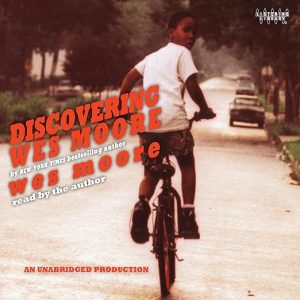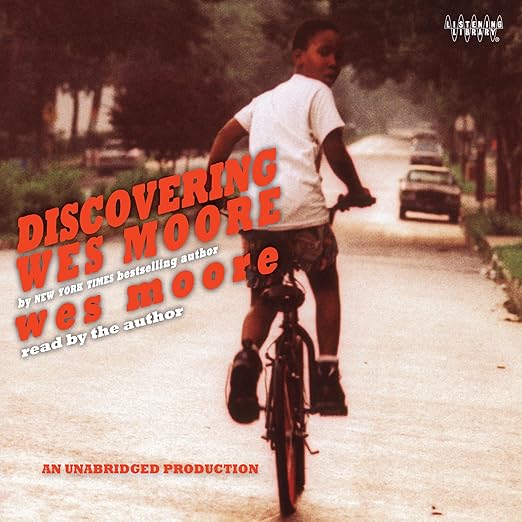
Wes Moore's Discovering Wes Moore (The Young Adult Adaptation) is an audiobook that opens with one of the stranger premises in memoir: two men share a name, grew up two years apart in the same Baltimore neighborhood, and their lives diverged so completely that one became a Rhodes Scholar and army veteran while the other received a life sentence for murder. Moore narrates his own story across just over four hours, and the decision to have him read it himself is what makes this recording work as distinctly as it does. This is not a polished performance voice. It is Moore speaking directly, and that directness is the whole point.
The Verdict, Briefly
The adaptation from Moore's bestselling adult memoir, The Other Wes Moore, is aimed at young readers but it does not condescend. Publishers Weekly noted that Moore wisely opens the door for teens to contemplate their own answers while laying out his own experiences honestly. That honesty is load-bearing here. Moore does not present himself as the inevitable success story or the other Wes as the inevitable cautionary tale. He is consistently careful about the role of randomness, the weight of circumstances that neither boy chose, and the moments where intervention from adults, from mentors and institutions, bent the trajectory of a life. Kirkus Reviews observed that Moore argues earnestly and convincingly that young people can overcome obstacles when they accept the support of caring adults, and that argument lands not as a slogan but as a documented case study in Moore's own experience. The Baltimore he describes is specific and textured. The friendship that grew from those initial letters between the two men is genuinely strange and worth sitting with. The dual narrative structure, tracking both Wes Moores through childhood and adolescence toward their eventual diverging outcomes, keeps the implicit comparison present throughout without turning it into a simple morality exercise.
The Best Parts of Discovering Wes Moore (The Young Adult Adaptation)
Self-narrated memoir in the young adult space is relatively rare, and Moore's particular voice carries qualities that would be lost in a professional narrator. There is a cadence to how he tells the Baltimore sections that signals embodied memory rather than crafted prose performance. When he recounts his own early choices, his time in military school, his resistance and eventual transformation, the audiobook functions more like sitting with someone who has genuinely processed their experience than listening to someone perform it. For classroom use, this recording has obvious utility, but it holds up equally well for individual teenage listeners who have no assigned context. The four-hour runtime keeps the listening commitment manageable, which matters for readers who might not yet have the patience for longer memoir formats. Moore's alternation between his own story and the other Wes's accumulates its impact gradually. By the time the two men exchange letters and eventually meet, the weight of those parallel arcs has been built carefully enough that the confrontation with what divergence actually looks like is genuinely affecting.
Points to Consider
The dual-timeline structure, tracking both men simultaneously rather than presenting one story then the other, requires a moment to settle into. Moore manages the transitions clearly in the narration, but the constant implicit comparison between two paths is intentional and accumulates pressure over the runtime. It is worth sitting with the discomfort that creates rather than pushing past it. The rating of 5.0 from a single reviewer is not a useful data point at that sample size. What is more useful is the consistent critical attention from Publishers Weekly and Kirkus, both of which engaged with the substance of the adaptation rather than simply praising it. Moore's framing is explicitly about the role of choice in a context of constrained circumstances, which is a more nuanced argument than simple individual agency or simple determinism. The book earns that nuance by being honest about both forces.
Moore's decision to write a letter to the other Wes and the fact that a reply came is the hinge point of this entire project, and it is worth sitting with how unusual that correspondence is. Most people who read about someone sharing their name in a news story do not reach out. The friendship that grew from those letters, and eventually the visits between the two men, is not a device the book invented. It is the documented origin of Moore's sustained engagement with what divergence actually looks like when you can speak to both sides of it directly. That specificity, the fact that Moore knows this other Wes not as a symbol but as a person he has sat across from multiple times, gives the parallel narrative a quality of genuine moral seriousness that a more hypothetical comparison would lack. The audiobook format captures that seriousness without the preachy register that might have emerged from a less honest narrator.
Who Should Pick Up Discovering Wes Moore (The Young Adult Adaptation)
Teenage listeners navigating questions of identity, environment, and their own sense of agency will find this recording meets them where those questions live. Educators and parents looking for memoir that takes young adult readers seriously without flattening complexity will find Moore's framework genuinely useful. Adults who never read the original memoir will also find this adaptation complete and rewarding on its own terms. Listeners who want straight narrative momentum without the reflective pauses and structural comparisons may find the dual-timeline approach slow. For anyone willing to sit with the core question Moore is asking, about what actually explains divergence between two lives, this audiobook earns its four hours fully.