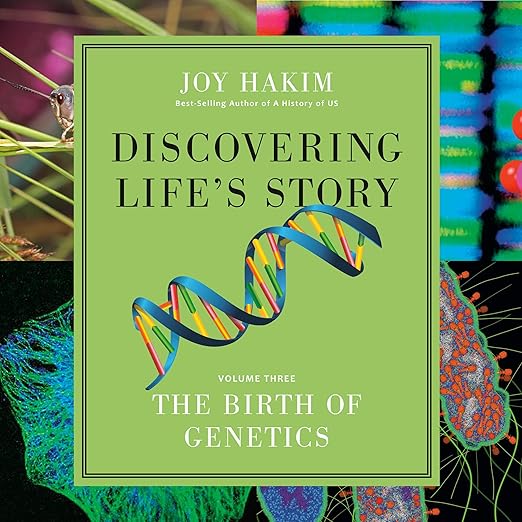
I have a long-standing interest in the history of science, specifically in how discoveries that seem inevitable in retrospect were actually made by specific people under specific pressures, often in competition with each other and sometimes in spite of the institutions around them. Discovering Life's Story: The Birth of Genetics by Joy Hakim works in exactly this territory. At just under four hours, it covers the dawn of the twentieth century's genetic revolution from Mendel's mathematical formulas through chromosomes, DNA structure, and the famous Watson-Crick-Franklin triangle, and it does so with genuine narrative momentum.
This is the third volume in Hakim's Discovering Life's Story series, published by Listening Library and narrated by Erin Tripp. The series is designed for young adult listeners but operates at a level of intellectual seriousness that does not condescend.
Hakim structures the book as a race: Darwin has laid the theoretical groundwork, Mendel has provided the math, and now, with new microscopes and X-ray technology, scientists are competing to find the physical mechanism behind heredity. The question driving the narrative, is it proteins or DNA that carry life's blueprint?, is not a mystery to most listeners, but Hakim makes the process of arriving at the answer compelling. She shows the false starts, the competing hypotheses, the moments when the evidence was present but the interpretation was wrong.
The treatment of Nettie Stevens, who discovered the X and Y chromosomes that define biological sex, and of Rosalind Franklin, whose X-ray crystallography work was essential to understanding DNA's structure, is appropriately serious. These are not token inclusions, Hakim integrates their contributions into the narrative rather than appending them as corrections. Stevens and Franklin were doing foundational science that the field could not have progressed without, and the book is honest about the ways in which recognition did not follow contribution in either case.
The Best Parts of Discovering Life's Story: The Birth of Genetics
Erin Tripp handles the scientific nomenclature without stumbling, no small thing in a book dense with names like Sutton, Stevens, Franklin, Watson, and Crick alongside terms like chromosomes, DNA double helix, and protein synthesis. Her narration is well-paced for the material: quick enough to feel engaged, deliberate enough to allow the concepts to register. The sole review praises the illustrations and timeline contextualization, which speaks primarily to the print companion, but the audio experience benefits from Tripp's ability to keep the historical timeline clear.
At three hours and 43 minutes, this is a single-session listen for motivated students. The brevity is a feature rather than a limitation, Hakim does not inflate the runtime with summary or repetition. The book covers what it covers and stops. For educators using it in a classroom or homeschool setting, the tight runtime makes it easy to sequence with other materials.
Before You Commit to Discovering Life's Story: The Birth of Genetics
This is volume three of a series, and while the book functions reasonably well as a standalone, the genetics story has its own internal arc, listeners new to the series may notice that Hakim assumes some familiarity with the broader evolutionary context from earlier volumes. The opening sections, which situate Darwin and Mendel in relation to what follows, are compact rather than introductory. Listeners coming in without prior context on evolutionary theory may want to revisit those sections.
The book has only one Audible review at the time of writing, which limits the ability to draw broader listener response. What exists is enthusiastic and specific, praising Hakim's pedagogical approach, but a sample of one is not a pattern.
The Right Listener for Discovering Life's Story: The Birth of Genetics
High school students studying genetics or the history of science. Homeschooling families who want science taught through narrative rather than textbook structure. Curious adults who want a compact, well-written account of how genetics went from a speculative field to a foundational science in less than a century. Those interested in the stories of Nettie Stevens and Rosalind Franklin specifically will find their work contextualized here more meaningfully than in many popular science books that treat them as footnotes.
Questions Listeners Ask
Does The Birth of Genetics work as a standalone listen if you have not heard the earlier volumes in the Discovering Life's Story series?
It works reasonably well as a standalone. The genetics story has its own narrative arc from Mendel and Darwin through Watson, Crick, and Franklin, and Hakim provides enough context at the opening to follow the progression. However, listeners without prior background in evolutionary theory may find the early sections compressed. Starting with volume one provides a stronger foundation.
How does Hakim handle the Rosalind Franklin story, does she address the controversy around her contribution to the DNA structure discovery?
Based on the synopsis and the book's structure, Hakim treats Franklin's contribution as scientifically foundational rather than as a story of victimhood. Her X-ray crystallography work is positioned within the competitive race narrative rather than as a separate corrective chapter. The framing is one of scientific history rather than polemical redress, though the inequity of recognition is acknowledged.
Is this audiobook appropriate for a middle school student, or is the content more suitable for high school?
Hakim's series is designed for young adult audiences, and the content is appropriate for strong middle school readers through high school. The scientific concepts, chromosomes, DNA structure, genetic inheritance, are presented accessibly rather than technically. Advanced 7th or 8th graders who enjoy science will handle this comfortably; the primary audience is 9th-12th grade.
At under four hours, does the audiobook cover DNA structure and the double helix discovery, or does it stop earlier in the timeline?
Yes, the book extends through the Watson-Crick-Franklin DNA structure work, which culminated in the 1953 double helix model. That discovery is positioned as the climactic answer to the central question driving the narrative, is it proteins or DNA that carry the blueprint of life? The book does not go further into the molecular biology that followed, keeping its scope to the foundational genetics era.