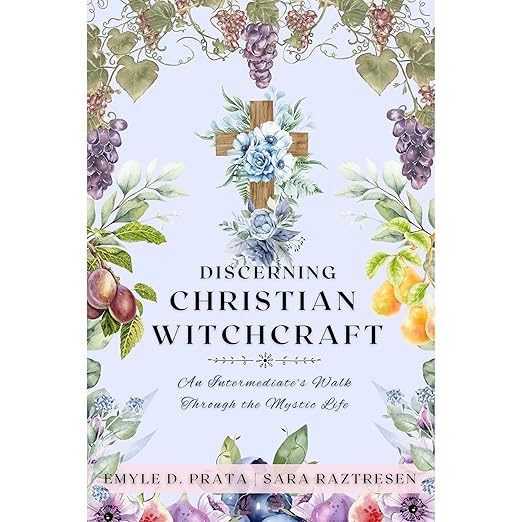
- What it covers: Christian mysticism alongside witchcraft practice, the inner journey, transfiguration, the saints as teachers
- Feel: Contemplative, earnest, slow on purpose
- Our call: Ten hours of mystical reading for people already inside the practice, on a page that cannot manage to name both of its authors.
Christian witchcraft is a phrase that stops most readers in one of two ways, and this audiobook, ten hours and twenty-five minutes of it, is the second volume of a guide written for the people it does not stop. Sara Raztresen and Emyle D. Prata take the mystical tradition, with St. Teresa of Avila and St. John of the Cross among the names invoked, and read it alongside contemporary practice, which will strike a buyer as either the most interesting thing on this page or the most objectionable.
Quotation is where the description starts, and not a helpful one. Its opening paragraph is a passage from The Interior Castle in which Teresa of Avila describes begging for words and being handed an idea to build on. As an epigraph it is lovely; as a summary it is useless, because a shopper reading the top of this listing meets a block of classical mysticism before meeting a single sentence about what the book contains. The sentence that follows is broken as well: this is the inner journey of the soul is one where the Witch and the Mystic meet at a crossroads.
The byline names one author. The description names two, Sara Raztresen and Emyle D. Prata, and then, a paragraph later, refers to Sara and Mimi's personal experiences, which is a third name attached to somebody who is already only half-credited. Volume two of a series called A Complete Guide to Christian Witchcraft should not leave a buyer working out who wrote it from context clues.
No person read this file. The reader field says Virtual Voice, and the consequence on this title is specific rather than general. The method of the book is interleaving: saints quoted at length, scholars cited, and two practitioners' own experience running alongside both. In print, quotation marks and indentation tell you at a glance which of the three you are inside. Across ten hours and twenty-five minutes of audio a synthetic reading marks no change of speaker at all, and a listener has to hold the line between a canonized mystic and a contemporary practitioner unaided.
What Stands Out
The subject is the reason to be here. Christian witchcraft is usually approached from one side or the other, either as devotional practice with an apologetic attached or as folk magic with the Christianity treated as decoration. What the copy promises is neither: a guided inner journey toward self discovery, transfiguration and a deepening relationship with the Divine, assembled from sources a seminary would recognize. The two traditions do not have to be reconciled for the reading to hold, and the copy never claims that they have been; it describes a crossroads where the Witch and the Mystic meet, which is a considerably more modest and more honest proposition than a synthesis would be.
One written response exists, a five-star filed on 19 February 2026, calling this one of the best books read in a long while and adding that the first one was loved too. That response landed roughly three weeks after the January 2026 release and is the only text anywhere on the page. What it establishes is that the series holds its readers from one volume to the next. What it cannot establish is anything else.
Ten hours and twenty-five minutes is long for a book of this kind, and the length is defensible. The mystics being drawn on wrote in stages, and stages take time to lay out; a compressed version would turn a journey into a summary of one. The runtime is doing the subject a favor here, even as it turns the file into a genuine commitment.
Weak Spots in Discerning Christian Witchcraft
Arithmetic disposes of the badge. A 4.6 average across three ratings is not something three whole-star votes can produce: they can average 4.3, or 4.7, and nothing in between. Whatever that figure is measuring, it is not the plain mean of three stars, which is reason enough to treat a rating base this small as decoration rather than as evidence about the book itself.
This is volume two, and the copy says so in its opening line by naming the sequel relationship to Discovering Christian Witchcraft. Series metadata is filled in properly for a change: A Complete Guide to Christian Witchcraft, number two, which is more than most listings manage. What the page never says is how much of volume one a reader needs, and on a book framed explicitly as a journey with stages, arriving at the second stage first is a real question.
Plenty of listeners will find the premise incoherent, and the book is not written to persuade them. It addresses people who already hold both identities and want to stop apologizing for one of them. Anyone arriving to have the theology argued out will meet testimony and mystical reading instead, which is a different sort of book from a defense and should be judged as one.
Best Suited For
Volume one is close to a prerequisite. The copy positions this as the deeper water beyond the introduction, with the saints and the scholars arriving on the assumption that the basic case has already been made and accepted. Readers who own the first book and want the mystical material developed at length are the audience, and ten hours is a generous amount of development.
Anyone curious rather than committed should start with the earlier volume instead. Anyone who wants quoted material clearly separated from personal testimony should keep a printed copy within reach, since the audio draws no such line. Count the votes sitting behind that rating before letting a badge decide anything; it takes one glance.