Quick Take
- Read by: Graham Halstead brings a steady, grounded voice to Ed and the ensemble of Charleston survivors, avoiding melodrama while maintaining the undercurrent of dread that the series depends on across its nearly nine-hour runtime.
- At its heart: survival ethics, community versus isolation, reclaiming civilization from within
- Vibe: Persistent and morally weighted, with human threat escalating alongside the zombie one
- Short version: The third installment of The Infected Dead earns its series position with genuine escalation, particularly in how it treats the human threats as at least as dangerous as the infected dead.
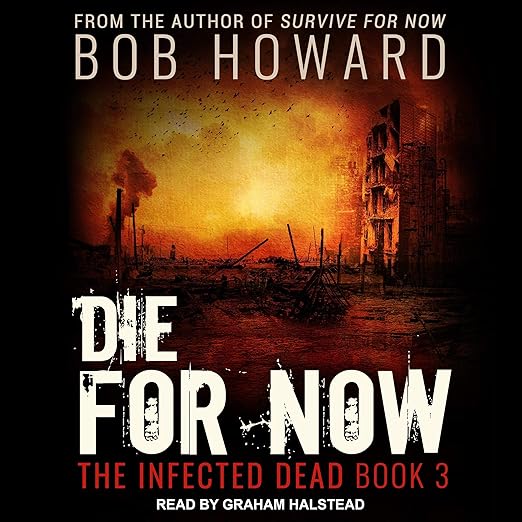
Die for Now, the third book in Bob Howard's The Infected Dead series narrated by Graham Halstead, is not the audiobook that introduces you to Ed and his band of survivors on Mud Island in South Carolina. It is the one that tests whether what they have built is actually worth defending and worth expanding. This audiobook opens with the group already established in their island shelter, already past the initial survival scramble that drove the earlier volumes, and now facing the harder question: whether to remain safe in relative isolation or to venture into the ruins of Charleston harbor and try to reclaim something of the world they lost. The massive shelter they discover in Charleston, described as dwarfing their own island base, reframes that question as both opportunity and obligation.
Howard's approach to the zombie survival genre has consistently prioritized human organization and ethics over the infected themselves, and this third volume commits fully to that priority. The Charleston harbor setting gives the audiobook a specific and historically resonant geography: a once-beautiful city now populated by the wrong kind of life, its familiar architecture and waterways transformed into a landscape that the survivors must navigate with the same caution they learned on Mud Island but now at much larger scale. Halstead's pacing through the exploration sequences gives the city the silence it deserves, moving through spaces that carry the memory of what they were alongside the reality of what they have become.
Ed, described by a returning reviewer as an ordinary guy in an extraordinary circumstance, remains one of the genre's more persuasive protagonists because Howard has never made him exceptional in the ways the genre usually requires. He does not do all the right things to survive; he survives in part through the people around him and in part through luck that is distributed honestly rather than narratively convenient. The reviewer who noted this specifically praised the series' believability: the characters feel real because they are built from realistic capabilities rather than heroic ones. Die for Now maintains that commitment in its third volume even as the scale of what the survivors are attempting expands significantly.
The Charleston shelter discovery is the novel's central structural move, and Howard uses it to introduce the question of what the survivors owe to civilization itself rather than just to each other. Taking one small step closer to giving the world back to the living is how the synopsis frames it, and that framing captures the thematic shift the third volume makes: the story has moved from survival as an immediate problem to survival as a project with a moral dimension. Halstead's narration captures this shift with a vocal quality that carries forward momentum without losing the weight of what the decisions cost.
What Works
One reviewer described the series as one of their favorites in the genre specifically because of the balance between human nature, military considerations, and survival logistics, and Die for Now maintains all three threads while adding the fourth: the moral complexity of what the group owes to other survivors they encounter in the ruins. The choice to hang onto humanity while evolving to match the brutality of the new world, stated directly in the synopsis, drives specific plot decisions rather than functioning merely as thematic statement. The audiobook is explicit about these choices being hard in ways that go beyond tactical difficulty into ethical territory.
The balance between infected dead and living antagonists shifts significantly in this third volume. By the time Die for Now reaches its major conflicts, the living threats have become at least as significant narratively as the zombie hordes. This is the more interesting direction for a series that has always been more concerned with what survival does to people than with zombie mechanics, and Howard handles the escalation without abandoning the infected as a constant environmental pressure. Halstead navigates the two threat categories with tonal differentiation, keeping the human antagonist sequences tighter and more morally complex than the action sequences against the infected.
Before You Commit to Die for Now
Series readers will find the third volume rewards the accumulated investment in the group's relationships. The people who would take from the survivors what they have built carry substantially more menace when the listener has been with the group long enough to understand exactly what is at stake, not just materially but in terms of the specific relationships and individual histories that make the community worth protecting. Howard does not extensively recap the earlier volumes, which is appropriate for series readers but creates a steeper entry curve for newcomers. The emotional architecture of Die for Now is designed for sequential listening, not standalone access.
A reviewer who was explicitly not a zombie genre fan before starting the series described their gradual conversion across all three volumes: they initially thought the island shelter would provide everything the story needed, and they were wrong. The escalation from shelter to city, from island survival to the project of giving the world back to the living, is the structural arc that makes Die for Now more than a competent third entry in a competent series.
Who It's For
Fans of post-apocalyptic survival fiction who have followed The Infected Dead from the first volume will find this audiobook delivers the escalation and ethical complexity the series has been building toward. Listeners who prefer zombie fiction that treats moral questions with the same seriousness as physical survival, and who want an ordinary protagonist whose capabilities are never inflated beyond credibility, will find Ed's continued story in this volume worth the investment. This series demands sequential listening; the third-installment entry point is not the right one, and the emotional stakes depend on the context built across the first two audiobooks.
Questions Listeners Ask
Is Die for Now the right starting point for The Infected Dead audiobook series?
No. This is the third book in the series and does not recap the earlier volumes in detail. The character relationships, the significance of the Mud Island shelter, and the emotional stakes of the Charleston decision all require the context built across books one and two to carry the weight Howard intends.
What kind of protagonist does this audiobook center on?
Ed is deliberately written as an ordinary man rather than a survival expert. He makes mistakes and survives partly through luck and group support rather than individual heroism. Reviewers consistently cite this credibility as what distinguishes the series from more conventional post-apocalyptic audiobook entries.
Does Graham Halstead's narration work for an ensemble survival audiobook?
Yes. Halstead maintains a steady, grounded register across the ensemble cast without theatrical voice differentiation that would feel mismatched to Howard's realistic tone. The narration keeps the focus on the story's moral texture and forward momentum.