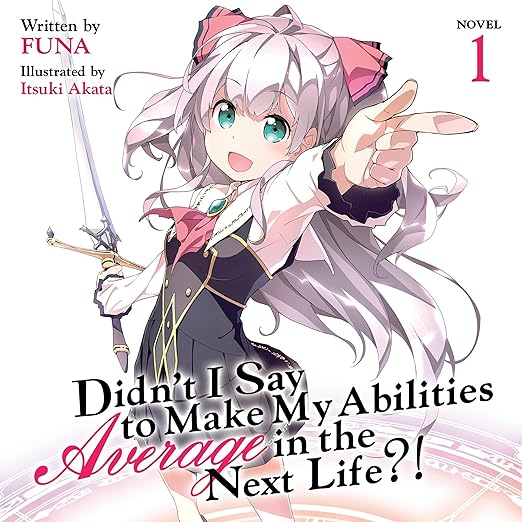
Quick Take
- Narration: Kara Oates keeps a ten-year-old girl's voice consistent across a full volume without making her sound younger or slighter than her adult memories suggest she should.
- Themes: Reincarnation and misinterpreted wishes, found family in a new world, coming-of-age inside a body that does not match your actual age
- Mood: Light, funny, and warm rather than dark
- Verdict: A gentler, funnier entry point into isekai for listeners tired of the genre's usual overpowered-protagonist formula.
Misato Kurihara dies exactly once, in the ordinary sense, and then negotiates her own reincarnation terms with a god. Her request sounds almost humble: make my next life average. This audiobook, adapted from FUNA's light novel and narrated by Kara Oates, spends its first volume proving just how badly that wish gets misinterpreted. Reborn as a ten-year-old girl in a magic-filled world, Misato quickly discovers that the god's idea of average and hers are nowhere close to the same thing.
One listener review offers a specific, useful detail that the marketing copy leaves out: the magic system is explained through nanotech rather than pure fantasy handwaving, so the power Misato ends up wielding is framed as explainable rather than arbitrary. That grounding matters for an isekai story, since it gives her overpowered new abilities an internal logic instead of leaving them as a plot convenience, and it is the kind of detail that separates a thoughtfully built series from a generic one.
The god who grants Misato's wish gets real comic mileage out of misunderstanding her intent, and that opening negotiation, less a solemn afterlife tribunal than a mismatched exchange between two very different definitions of a good life, sets the tone for everything that follows. Rather than treating the reincarnation premise as an excuse for straightforward wish fulfillment, FUNA plays the setup for its built-in absurdity first and its adventure second, which is a large part of what makes the first volume feel distinct from a more generic isekai opener.
Misato Kurihara's name itself follows Japanese surname-first convention preserved in this English-language adaptation, a small but telling localization choice that keeps the light novel's origins visible rather than fully Americanizing the text. That choice matters for a story explicitly about someone straddling two very different lives and, in a sense, two different cultural frames of reference for what an ordinary or average existence even looks like.
Highlights
A reviewer using the handle Cactus calls this a breath of fresh air within isekai as a genre, and the specific reason given is worth repeating: the setup avoids the tired power fantasy where an overpowered protagonist wins everything without friction. Misato's whole arc is built on the comedy of an accidental god's-eye miscalculation, and that comic premise gives the first volume a lighter, funnier register than most reincarnation fantasy manages this early in a series.
Kara Oates carries a ten-year-old girl's voice across eight-plus hours without letting the character read as younger or slighter than she is, a real technical challenge given that Misato's adult memories and outlook have to coexist with a child's body and social position. Reviewer Leif specifically calls the book more oriented toward younger listeners and, in Leif's words, girls, then admits to re-reading the entire series on every new release regardless, which says as much about the material's actual reach as any marketing description would.
FUNA has built a career on this specific style of isekai, prolific enough in the genre that fans arrive at a new title with real trust in her comic timing and pacing already established. That established trust matters for a story built on a single sustained joke, a god's genuine miscalculation about what average even means, since a comic premise like this one lives or dies on whether the author keeps finding fresh angles on it across a full volume rather than exhausting it in the first chapter.
P. Sleijpen's review adds one more useful clarification: the nanotech-based magic system means this sits closer to science-fantasy hybrid than pure high fantasy, a genre distinction that matters for listeners choosing between this and more traditional sword-and-sorcery isekai titles.
Where FUNA Loses Some Ground
This is Volume 1 of an ongoing light novel series, and the pacing reflects that structure: reviewer P. Sleijpen notes the story builds slowly around a misinterpretation gag before opening into the wider magic-filled setting, which means listeners expecting immediate high-stakes conflict should adjust expectations for a slower, character-first opening chapter.
The genre tag here is teen-young-adult, and the tone leans toward comedy and coming-of-age material rather than dark fantasy, so listeners coming from grittier isekai series may find the stakes and humor pitched younger than expected. With only a single rating on file for this specific audio edition, the strong 4.7 average reflects a small but clearly enthusiastic sample rather than a broad consensus.
This is the first book of an ongoing series, and light novel adaptations in this genre typically run for many volumes, so listeners should expect a long-term commitment if the first book hooks them rather than a contained trilogy. The series' Japanese origins are handled with a light touch in this English-language adaptation, honorifics and culturally specific details mostly smoothed over for an English-speaking audience rather than preserved in a way that would demand prior familiarity with light novel conventions.
Listeners who bounce off villain-free, low-stakes isekai comedy should recalibrate expectations here: this book leans toward warmth over tension throughout its first volume, and readers hoping for the genre's more common high-stakes political or combat plotting from page one may find the early chapters, focused on Misato adjusting to childhood and family life, quieter than expected before the wider fantasy world fully opens up.
Is This One for You?
This suits isekai fans who want something gentler and funnier than the genre's usual power-fantasy default, younger listeners easing into fantasy audiobooks, and anyone who appreciates a magic system with an actual explanation behind it rather than pure convenience.
Skip it if you specifically want dark, high-stakes isekai with real danger behind every choice. Didn't I Say to Make My Abilities Average in the Next Life?! plays its reincarnation premise for warmth and comedy first, and listeners going in expecting grim stakes will be looking at the wrong series.
This also rewards listeners who enjoy found-family dynamics layered inside a fantasy setting, since Misato's new circumstances put her in the orbit of a household that has no idea who, or what, she really is yet, and watching that gap slowly close is part of the first volume's quieter pleasure.
Common Questions
Do I need to have read the light novel before starting this audiobook?
No. This is the first volume of the series, narrated by Kara Oates, and it works as a starting point for listeners new to the story.
Is this audiobook appropriate for younger listeners?
Yes. The teen-young-adult classification fits; the tone favors comedy and coming-of-age themes over graphic violence or dark stakes.
How does the magic system work in this audiobook?
One listener review notes the power system is explained through nanotech rather than open-ended fantasy magic, giving her new abilities an internal logic instead of leaving them unexplained.
Does this audiobook end on a cliffhanger since it is Volume 1?
It closes its own arc while leaving the wider series open, consistent with an ongoing light novel adaptation rather than a single self-contained story.