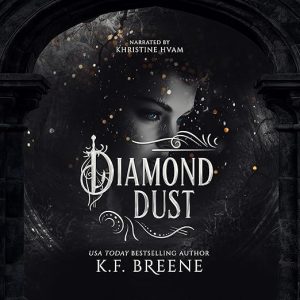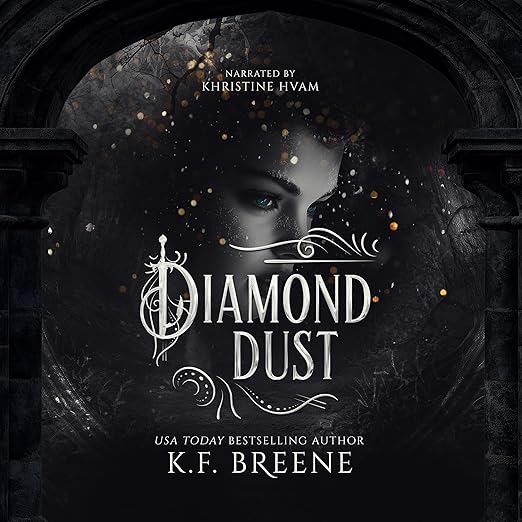
Everything on this page speaks in the first person except the credits. Daisy does the talking, in clipped fragments: the fae royalty think she is their toy, her odds of survival are slim, her resolve is unbreakable, and when they push too far they will learn what a cornered human can do. Publishers write blurbs in the third person for a reason, so choosing the protagonist's own voice here is a decision about tone, and it has a direct consequence for the audiobook. All twelve and a half of those hours belong to Khristine Hvam, the only reader credited on the release, put out by Hazy Dawn Press on the first day of 2026.
Daisy Brings Carnage, Not Magic, to Court
One thing the copy is careful about is the shape of the trap. Tarian enters Daisy into the court games to buy time, which the publisher calls a bloodsport for the bored and cruel, and the terms are stated flatly: no allies, no protection, monsters wearing crowns who smile while they watch her fall. A magicless human dropped into a fae tournament is not a new idea, but the framing does something specific with it. Daisy is not the chosen one who discovers hidden power. She is the one thing standing between two worlds, and the copy is quite clear that what she brings to the fight is carnage where magic would be.
Anyone arriving cold should know the architecture, which the reviewers explain more clearly than the publisher does. This is the second and final book of a duet, picking up exactly where Obsidian left off, and the duet itself is a spin-off from the author's Demigods series. One reviewer recommends reading Demigods first, on the grounds that returning players appear here and the payoff is better if you recognize them, while adding that the duet can be read on its own. The series fields on this record are correct, naming Shadowbound Fae and volume two, which a surprising number of spin-offs get wrong.
Hvam Alone Carries Daisy's Furious Wit
Where the audio format earns its keep is precisely in that first-person voice. A book narrated by a sarcastic, furious, frightened human inside a court of aristocratic monsters puts most of its personality into delivery: the timing of a joke made under threat, the difference between Daisy's register and the fae one, the drop when the banter stops. One credited narrator has to hold both sides of that, the human and the court, and Khristine Hvam is the name on it. Nobody in the column discusses the reading, which on a book this dependent on voice is worth noting and not shrugging off.
Two things the reviewers agree on tell you what the twelve hours contain. The first is banter, described by one reader as wickedly perfect and by another as Daisy being hilarious and entirely true to herself even inside the games. The second is the romance, which one reviewer says finally takes off here after a long slow burn, with Daisy fighting as Tarian's champion. Add fast pacing, court politics described as savage, and a revenge line one reviewer calls earned, and the register is clear enough. Another describes the revelations arriving like a dreaded but irresistible trail of breadcrumbs, which is a better sentence than most publishers manage.
Darker Than Book One, Reviewers Warn
None of the enthusiasm here comes without a caveat, and one reviewer states it directly: this book is darker than the first, and readers are advised to check their triggers before starting. That warning arrives from a five-star review, which makes it more useful, not less. The synopsis backs that up with bloodsport, cruelty as entertainment and a promised carnage, so anyone sensitive to torture, humiliation or graphic violence should treat the second half of a duet as an escalation more than a continuation.
Readers who weigh review columns closely will notice something odd about the only four-star entry. It reads like jacket copy: explosive conclusion, dark and brutal and emotionally charged, unbreakable resolve, a thrilling read for fans of dark fantasy romance. Several of those phrases are lifted straight from the publisher's own description, including explosive conclusion and unbreakable. Whatever its origin, it adds no independent information, which leaves four genuinely personal reviews doing the work. Two of those four went up on January 1, the release date itself, from readers who had evidently been counting down. One of them calls Daisy the FMC without pausing to expand the abbreviation, which tells you which corner of the readership this column comes from.
By the categories on this record, you would never guess what the book is. The single tag reads Horror. The genre slots list literary fiction and romance, with no fantasy heading anywhere, despite a plot made entirely of fae courts, magic and a human trapped in another realm. Horror is not absurd given the bloodsport, but anyone browsing that shelf expecting dread instead of a slow-burn romance will be surprised. One of the five reviews was filed from Canada, which is worth knowing only because it means the column is not a single market's opinion.
A Well-Signposted Finale Under the Wrong Tag
For readers already inside this world, the decision was made two books ago, and the column will reassure them: the conclusion lands, the romance pays off, Daisy stays herself. Past that group, it is aimed at anyone who wants dark fae fantasy built on a human protagonist who has no powers and refuses to behave, court politics with real cruelty in them, and a romance that takes its time before arriving. The duet structure is a genuine advantage over a longer commitment: two volumes and out. One reviewer's advice is to collect the whole set, hide away somewhere and work through it, which is a fair description of how this kind of book gets read.
Most people who should skip it will know why from the paragraphs above. If graphic cruelty is a hard no for you, the reviewers have flagged it in advance and you should believe them. If you need your fantasy romance light, the copy opens on burning everything down and does not soften. And starting here would mean twelve hours of resolution for a story whose first half ended on the cliff this one steps off.
Whatever else it is, this is a well-signposted finale with an unusually clear content warning attached, sitting under a tag that describes an altogether different genre. Twelve hours belongs to one voice, and by the description's own design, that voice is Daisy's.
- Narration: Khristine Hvam is the sole credited reader across a twelve-and-a-half-hour recording, carrying both a first-person human protagonist and an entire fae court, with nobody else named in the credits.
- Themes: a powerless human in a fae court, bloodsport as entertainment, slow-burn romance, vengeance, a duet reaching its end.
- Mood: Dark, furious and fast, with the banter sharpened by the threat and never softened.
- Verdict: Finish the duet here if you started it, and read the content warning first, because a five-star reviewer bothered to write one.