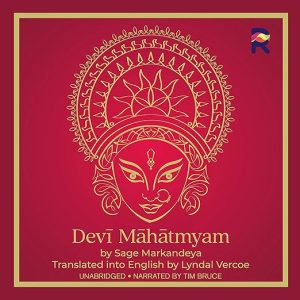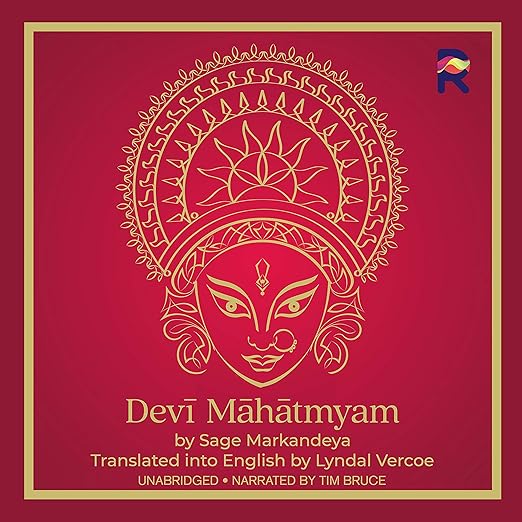
Sage Markandeya's Devi Mahatmyam stands as one of the most venerated texts in the Hindu spiritual canon, and the audiobook narrated by Tim Bruce brings its ancient power into strikingly immediate focus. Recorded at just over two hours and thirteen minutes, this is a production that rewards a quiet room and an open disposition toward sacred verse. Arriving at this text in audio form, rather than in the silence of reading, is itself a return to its original nature: the Devi Mahatmyam was composed to be recited aloud, its syllables carrying devotional energy as much as semantic content.
For those arriving without prior context, the Devi Mahatmyam is a devotional epic poem composed around 550 CE as part of the Markandeya Purana. It praises the Mother of the Universe through the narrative of her three great battles against demonic forces, and its 700 verses, collectively known as the Shri Durga Saptashati, are recited across India during the nine holy nights of Navaratri. Its cultural weight within Sanskrit literature places it alongside the Bhagavad Gita and the Mahabharata, and listeners from diverse backgrounds will recognize the grandeur of the source even if the specific theology is unfamiliar.
A Closer Look at Devi Mahatmyam
Tim Bruce's narration carries this text with a measured, respectful cadence that serves the material well. His voice does not attempt the theatrical flourishes of a dramatic novel; instead, he reads with a kind of ceremonial clarity that matches the psalm-like structure of the verses. Praise poems of this scale can become monotonous in lesser hands, but Bruce paces the rising intensity of the three charitas with enough tonal variation to hold attention across the full runtime. Each charita, the section describing the Devi's victories over Madhu and Kaitabha, over Mahishasura, and over Shumbha and Nisumbha, carries a distinct emotional register, and Bruce's delivery reflects that arc rather than flattening it into uniform reverence.
The Kavach of the Devi and the Shri Siddha Kunjika Stotram that close the recording add further texture. The Kavach, or armor prayer, is a protective invocation that devotees traditionally recite before the main text, and hearing it in sequence gives the full recording a liturgical shape that a reading of the central poem alone would lack. The Sanskrit singing that closes the production is brief but striking, a reminder that this tradition was built around sound as much as meaning, and that transliterated English necessarily loses something of the sonic and energetic character that Sanskrit carries. That contrast, between the English narration and the Sanskrit song at the end, is itself instructive about the nature of sacred translation.
The synopsis makes a specific claim worth examining: that listening to this text stimulates the sternum bone, activates the Heart chakra, and produces measurable immunological benefits. Listeners who bring a scientific rather than devotional lens may find this framing reductive or overstated. I would gently set that language aside and engage with what the text actually offers, which is an experience of concentrated devotional beauty. One reviewer describes it as a wonderful way of connecting with and worshipping the Mother, which is the more honest and useful framing. Whether or not the physical claims hold, the emotional and meditative effects of sustained sacred recitation are real, and this production facilitates them effectively.
The production bundles three distinct elements that together form a complete devotional arc. The Devi Mahatmyam itself takes up the majority of the runtime and moves through its episodes with narrative purpose: the battles are allegorical rather than dramatic, but they accumulate devotional weight progressively. The Kavach heard in sequence before the main text functions as preparation rather than appendix, and the structuring choice to include it in its traditional position before the Saptashati is thoughtful rather than merely comprehensive.
For listeners who have studied Sanskrit scholars such as Wendy Doniger or David Kinsley on the goddess traditions of South Asia, hearing the source material voiced is genuinely illuminating. The Devi's victories carry theological significance that is not available to the reader who approaches them as secular myth, and Bruce's tone signals that significance without over-explaining it. His reading is annotated not with commentary but with restraint, which is the appropriate interpretive posture for a text that has been guiding devotion for fifteen centuries.
It is worth noting that one negative review in the collection complained about the product format as an audio purchase rather than the content itself, a distinction that does not reflect on Bruce's performance or Markandeya's text. The overwhelming response from those who came to it with devotional intent or open curiosity has been strongly positive, and the 4.6 rating across nearly sixty reviews suggests it is meeting its audience well.
Things to Know Before Starting Devi Mahatmyam
Listeners new to Hindu sacred texts should know that this is not structured like a modern narrative. The three episodes of divine battle are allegorical, and the demons represent forces that function as spiritual archetypes rather than dramatic antagonists. The Devi's victories carry theological weight rather than dramatic surprise, and the text rewards a contemplative rather than plot-hungry mode of listening. Approaching it as you might approach a Bach cantata, aware that the form is devotional rather than representational, will produce a more satisfying experience than arriving with genre-fiction expectations.
The brevity of the runtime, just over two hours, means this production can be absorbed in a single sitting. It works beautifully as a companion to Navaratri observance or meditation practice, but also functions as a standalone encounter with a sacred text that most Western listeners have never had access to in audio form. For students of comparative religion, of world literature, or of Sanskrit traditions specifically, this audiobook fills a genuine gap in the English-language audio catalogue of sacred texts.
Who Sage Markandeya Is Writing For
This audiobook is for listeners drawn to Hindu devotional traditions, students of world religion and sacred poetry, meditators seeking a structured focal text, and anyone curious about a foundational work of Sanskrit literature that rarely appears in English-language audio form. Those seeking dramatic narrative entertainment, or who are put off by a devotional register throughout, will likely find it slow. But for the right listener arriving with genuine curiosity or reverence, it is a rare and meaningful production in a category that English audiobooks have historically underserved.
A Few Questions About Devi Mahatmyam
Does the Devi Mahatmyam audiobook include Sanskrit portions, or is everything in English?
The main text and the Kavach of the Devi are read in English. Only the closing Shri Siddha Kunjika Stotram is performed in Sanskrit as a sung piece, giving the production a ceremonial close that the English narration alone could not achieve.
Is this audiobook appropriate for listeners who are not Hindu or familiar with Vedic traditions?
Yes, though it helps to approach the text with openness rather than expecting a conventional narrative. The allegorical battles and devotional praise structure will be unfamiliar to many Western listeners, but the beauty of the verse translates across traditions, and Bruce's restrained narration does not demand prior theological knowledge.
At just over two hours, is this audiobook long enough to feel complete as a devotional text?
Yes. The Devi Mahatmyam is a defined sacred text with a clear three-part shape, and the production includes two additional companion pieces, the Kavach and the Siddha Kunjika Stotram, that round out the runtime with the full traditional structure devotees would recognize.