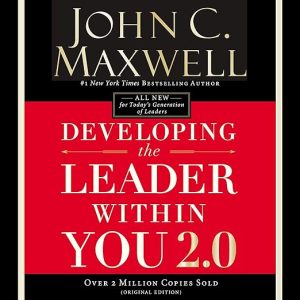
- Narration: John C. Maxwell reads his own revision, so the emphasis across seven and three quarter hours is the author's rather than an interpreter's.
- Themes: Influence over position, character and self-leadership, service, casting a vision others can picture
- Mood: Brisk, instructional, unembarrassed about being inspirational
- Verdict: A solid first leadership book for new managers, and largely redundant if you know the 1993 original.
Five people have written about this audiobook, and the counter beside the stars says three ratings. Those two numbers cannot both be right, and the average settles which one is wrong: 4.8 is unreachable across three whole-star votes, which can only land on 4.7 or 5.0, while the five written grades on the page, four fives and a four, total twenty-four and average exactly 4.8. The average belongs to five voters. The counter is undercounting them.
Maxwell Audits His Own Advice From 1993
Leadership books age badly, which makes the 2.0 on this cover more interesting than a marketing decimal usually is. The original came out in 1993. Maxwell revised it thoroughly and added two chapters covering what he had learned in the decades between, so what you get here is an author auditing advice he published twenty-five years earlier. Very few writers in this category submit themselves to that, and the ones who do are worth listening to for the revisions alone.
Maxwell organizes everything around four words: influence, character, service and vision. Influence gets the Five Levels of Leadership as a roadmap. Character covers ethics, self-leadership and the practice of actually valuing people. Service arrives as eight questions you ask yourself. Vision arrives as eight components you supply so that the people following you can picture what you are describing. The structure is tidy enough to hold across seven and three quarter hours without a printed page in front of you.
Nothing in the description pretends this is a book for executives only. The copy names church leaders, teachers and parents alongside business leaders, and the four pillars are general enough to survive the stretch. A four-star from January 2026 puts the demand precisely: the difficulty is not comprehension, it is being asked to challenge the inner you. That is the correct warning label for a book of this kind, and it is more useful than the copy's promise of transformation.
A Delivery of What Maxwell Decided Stayed
Influence is where the argument starts, and it is the part that survives repetition best. Maxwell's claim is that position grants you nothing except the chance to earn something, and the Five Levels exist to show you which rung you are actually standing on rather than the one your title implies. Anybody who has watched a newly promoted manager discover that their team does not have to cooperate will recognize the diagnosis immediately.
Eight questions about service and eight components of vision sound like filler until you notice what they are for: both lists convert an abstraction into something you can do this week. A five-star from July 2025 describes the effect in blunter terms, calling the book an investment and crediting it with a change of direction. That response is short on specifics, but the enthusiasm is consistent with a book people return to rather than finish.
Seven hours and forty-four minutes is a working length, and Maxwell narrates it himself. On a book assembled from principles the author has been teaching since the early nineties, the reading is not an interpretation of the text so much as a delivery of it by the person who decided what stayed and what went in this edition. The emphasis you hear is the emphasis he chose.
One Response Runs to Just Seven Words
Repetition is the format's tax. A book built on numbered lists, five levels here and two sets of eight there, assumes a reader who can glance back at the previous page. A listener cannot. Expect to rewind, or to accept that you will retain the four headline words and perhaps half the sub-points, which is arguably what the book wants anyway given how often it restates its own framework.
Buyers who already own the 1993 edition face the more awkward question, and the page does not answer it. Two new chapters and a thorough revision is what the description promises, without specifying how much of the original survives verbatim. If you have read the first version recently, a meaningful share of these seven hours will be familiar, and the page never quantifies the overlap.
One written response here runs to seven words in total, and two others are barely longer. That brevity is worth registering before you weigh the enthusiasm, because what those grades establish is that people liked the book, not what they found in it. A listener choosing between this and a dozen similar leadership titles gets very little to work with, and rather less than the average alone suggests.
An Honest Package From a Page That Can't Count
New managers in their first year get the most from this, and especially anyone who has just discovered that authority and influence are different currencies. It also works as shared material: a five-star from January 2026 mentions a group at work going through it together, which suits a book divided into four named areas and full of questions designed to be answered rather than admired.
Owners of the earlier edition should think twice, and so should listeners who want evidence rather than principle. This is a practitioner's book, built on decades of speaking and coaching rather than on studies, and the copy never pretends otherwise. Anybody allergic to the inspirational register this kind of leadership writing runs on will know within the first hour whether the remaining six are for them.
Treat it as a course rather than as a book and it earns its length. Four areas, two revised decades of thinking, and an author reading his own corrections is a more honest package than most of this shelf offers, even if the page around it cannot count its own ratings.
Frequently Asked Questions
Is any printed summary bundled with the audiobook?
The listing mentions none. That matters more than usual here, because the book runs on numbered frameworks: five levels of influence, eight questions on service, eight components of vision. Without a page to glance at, plan on taking your own notes or accepting that the four headline areas are what you keep.
Does the audiobook assume you already manage people?
No. The copy explicitly extends the frame to church leaders, teachers and parents, and the four pillars are pitched at anyone with influence over others rather than at anyone with direct reports. A first-time team lead will get the most concrete use out of it, but the material does not require a title.
Is this audiobook part of a series?
The listing attaches it to a series called Developing the Leader and then leaves the number blank, so the page cannot tell you what else belongs there or in what order. Treat it as a standalone, which is how the description presents it, and ignore the series field entirely.