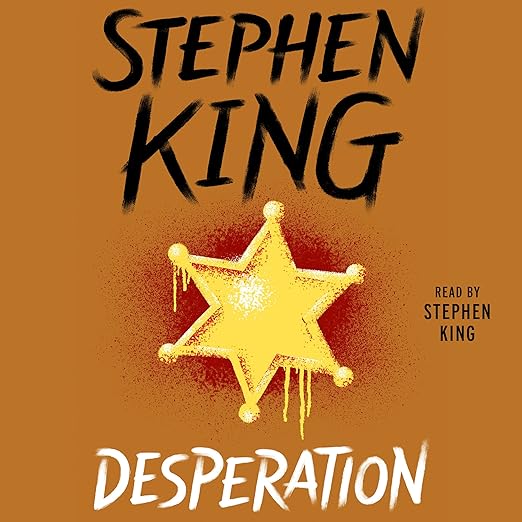
One name fills both the author line and the narrator line of this audiobook, and it belongs to a man who wrote a twenty-one-hour novel about a police officer pulling cars off an empty highway. Stephen King reads Desperation himself. Collie Entragian, chief law enforcement of a small Nevada mining town, has taken to stopping vehicles on Interstate 50 with unusual ploys and abducting whoever is inside. That is the first thing that happens, and the author of it is the voice telling you about it.
The Verdict, Briefly
Two decades separate the oldest entry in the review column from the newest. N. Flowers wrote in September 2004. A reader in India wrote in August 2024. Victor the Reader wrote in June 2025. That spread tells you something no star count can: people keep arriving at this novel and keep arguing about the same two things, the religion and the town. Katy G. calls the focus on God a little strange and unexpected. N. Flowers describes the premise as an ancient god with one limitation, unable to walk the earth on its own.
Most useful of the five entries, for anyone arriving cold, is the one from Katy G., who read The Regulators first. The two novels carry the same characters and families through different personalities, ages and lives, which that reviewer calls unusual and also kind of fun. Nothing in this listing mentions the companion book. Go in expecting a standalone and you get one; arrive already knowing the other novel and you get a second layer the record never advertises. That is a genuine gap in the description.
Both the horror and the theology come from the same source, and the description is honest about it. Something is embedded in the landscape around Desperation, an evil the blurb compares to a viral hot zone, and young David Carver is the one who understands what is being summoned against it. That is the structure: a monster with a metaphysics. If you want your King secular, that is where the friction will be, and Katy G. flags it before saying the story and the characters carried the book anyway.
Why Desperation Works as an Audiobook
By the simplest measure this is the reason to choose the recording: the writer is doing the reading. Twenty-one hours and fifteen minutes is a substantial commitment, and what you are committing to is Stephen King's own pacing of his own sentences, his own decisions about where a scene slows and where a line should land flat. No actor is interpreting him. Whatever the book sounds like in his head is, presumably, what it sounds like here. That is a rarer proposition than it seems, and it cuts both ways.
At the level of plot the novel is a chase with a religious argument bolted to it, and the pace shows. The setup is the best idea in the book: an officer with no visible motive, a highway with no traffic, a set of ploys that keep working. Victor the Reader summarizes the shape usefully, a couple stopped on a Nevada highway, taken to the station, survivors scattering into a town with something in its mines. What the description withholds is how much of the twenty-one hours goes to the argument instead of the chase.
On the evidence of the column, nobody who wrote about this book was listening to it. Five entries, twenty-one years, and never a mention of a voice, a pace, a performance. One is titled as a Kindle review outright. That silence is worth noting here more than almost anywhere, because the single most distinctive fact about this edition is who is holding the microphone, and the people best placed to tell you whether it works have all been reading instead. The recording is, in that sense, entirely untested.
Points to Consider
In the rating you will find seven votes and five written entries, which means two people graded without saying anything. The 4.5 badge sits on a convention rather than a calculation you can reconstruct, so I would not build much on it. The written grades are one four and four fives, and the four belongs to the entry that reads most like a synopsis. Enthusiasm and precision are not always the same reviewer. Two silent votes are ordinary; a badge built on them is not worth arguing with.
For a listener who has never taken on a King novel of this length, the thing to know is that the middle stretches. The town gets explored, the survivors split up, the theology gets its innings, and the momentum of that first highway sequence does not return in the same form. Kindle Customer, writing in 2013, describes coming back to it sixteen years after a first read and understanding why it stuck. That is a book that rewards a second pass. It is not a book that hurries.
If the same display name catches your eye twice, you are not imagining it. Kindle Customer appears in December 2013 and again in August 2024, the second time from India, and nothing in the record tells you whether that is one reader returning more than a decade later or two strangers sharing a default label. The 2024 entry is unqualified enthusiasm about horror and emotions rolled into one epic novel. The 2013 entry is a small memoir of a reading life, with Dreamcatcher and Just After Sunset named as the point where that reader drifted away.
Should You Listen to Desperation?
When I recommend this one, it is usually to two groups. Longtime King readers working through the back catalog, for whom hearing the writer read his own book is the draw and twenty-one hours no obstacle. And listeners who like horror built on a genuine idea instead of a body count, since the ancient god in the description from N. Flowers is a real conceit and the novel takes it seriously. Anyone who needs their horror kept secular should look elsewhere, and should know that going in. The theology is not decoration here.
Listeners new to King should probably start somewhere shorter, and anyone who already owns the paperback should weigh whether hearing King read it justifies a second purchase. My own answer is yes, on the strength of the credit alone: whatever else this recording is, it is the writer telling you his own story at his own speed. Twenty-one hours is a long time to spend in a town this small, and the voice reading it belongs to the man who built the town.
How does the audiobook differ from reading Desperation in print?
The credit is the difference. Stephen King is listed as narrator of his own novel, so the pacing, the emphasis and the timing of every scare are the author's decisions and nobody else's. The printed book leaves all of that to whatever voice runs in your own head. Twenty-one hours and fifteen minutes either way.
Is The Regulators required reading first?
Not required, but one reviewer read it first and found the overlap rewarding. Katy G. notes that the two books reuse one cast across altered ages, lives and temperaments, and calls the effect unusual and kind of fun. This listing never mentions the connection, so you would only know if someone told you.
Why do the reviews of this audiobook say nothing about the recording?
Because none of them appears to be about the recording. The five entries span September 2004 to June 2025, one is titled as a Kindle review, while no line anywhere addresses a voice or a pace. On a recording whose whole distinction is that the author reads it, that gap is the one worth noticing.
Would a newcomer to Stephen King be better off starting elsewhere?
Probably, on length alone. Twenty-one hours and fifteen minutes is a commitment, and one reviewer flags a turn toward religion that the description does not prepare you for. Readers already deep in the back catalog treat that turn as the appeal. Newcomers may want something shorter before spending most of a week here.