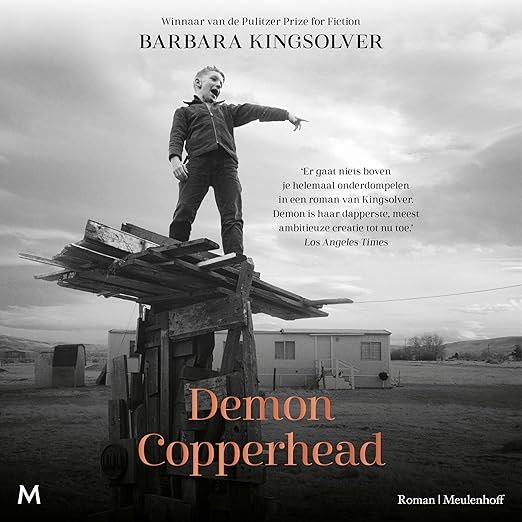
Check the language field before anything else here, because this audiobook is in Dutch. The title displayed is the English one, Demon Copperhead, the author credited is Barbara Kingsolver, and the entire description is written in Dutch under the imprint J.M. Meulenhoff. What is being sold is a Dutch-language recording of a translated text, running twenty-one hours and fifty-nine minutes. No translator is credited anywhere in the record, which for a translated novel of this length is a significant omission and the second thing any buyer should register. Everything visible in the header, the cover, the title, the author's name, points an English speaker in precisely the wrong direction.
What We Made of It
Barbara Kingsolver won the Pulitzer Prize and the Women's Prize for Fiction 2023 for this novel, both of which the description states, and the book has the shape those awards tend to reward: a single life followed from birth through catastrophe with no shortcuts taken along the way. Damon Fields is the son of a teenage single mother, living in a trailer in the southern mountains, and he inherits from a father he never met the copper-colored hair that gives him the nickname of the title. Beyond good looks, a biting sense of humor, and an unusual drive to survive, very little in his life goes right.
Damon Fields moves through the machinery that catches children when a parent stops being able to hold on. His mother struggles with an addiction to painkillers, and after an overdose puts her in the hospital he passes from one foster placement to the next, meeting child labor, neglect, and abuse in turn. Kingsolver situates all of it inside the opioid crisis affecting large parts of the country, which is the structural argument running under the personal story: none of what happens to this boy is bad luck, and the book is careful to show the systems that make each step likely. Carrying an argument like that inside a novel without reducing the protagonist to an illustration is difficult, and the description indicates Kingsolver keeps him a person throughout.
Why Listen to Demon Copperhead
Poverty, foster care, and painkillers form the spine, but the description does not present a case study, and the difference is tone. The qualities it leans on are precisely the ones that make material like this survivable: a biting humor and a will to survive that outlasts everything aimed at it. Twenty-two hours of unrelieved misery would be intolerable in any format and worse in audio, where a listener cannot skim ahead. Twenty-two hours in the company of someone funny about his own catastrophe is a different proposition entirely, and it is the reason this novel found the readership it did.
Kingsolver gives him one route out, then takes it away. American football is the talent that briefly changes the trajectory, and the description is blunt about how short the reprieve turns out to be: an injury, heavy painkillers prescribed to treat it, and the addiction cycle that ran through his family starting to repeat in him. That structure is the novel's cruelest and most honest move. The escape and the trap arrive through the same door, and a reader watches the mechanism close well before the character standing inside it can see what is happening. Anyone who has watched an addiction move through a family will recognize the shape of it, and that recognition is what gives the later stretches their weight.
What Might Not Land
Dutch is not a footnote on this listing. It is the product. Anyone arriving through the English title, the English author name, or an English-language recommendation needs to understand that the recording is in another language from beginning to end. The absence of a translator credit compounds the problem, because a translated novel of this length is substantially the work of two people and only one of them appears anywhere on the page. For a buyer who reads Dutch none of this is an obstacle at all. For everyone else it is the entire story.
Chris Kijne is credited for a Dutch reading of twenty-one hours and fifty-nine minutes, one of the longest single-narrator assignments a catalog like this offers. The credit shape points to a conventional production: one voice, no cast, no dramatization, and a continuous commitment across nearly twenty-two hours. What the record cannot tell you is anything about register, which matters more than usual for a book whose power depends on a particular voice surviving particular material. With the rating fields empty as well, that credit line is the only evidence the page provides. A purchase of nearly twenty-two hours normally deserves more than a name to go on, and here sampling matters more than it would on a shorter title.
Who Should Pick Up Demon Copperhead
Native and fluent Dutch listeners are the audience this edition was built for, and for them the proposition is straightforward: a Pulitzer-winning novel, a major Dutch publisher, and a runtime matching the scope of the book. Readers who want the opioid crisis rendered through one life rather than through statistics will find that this is exactly what Kingsolver constructed. It is also a reasonable choice for anyone reading in Dutch who has avoided the original because of its length, since audio makes a book of this size easier to carry through a busy stretch than print does.
Language is the field that decides everything here, and it is easy to miss on a page headed by an English title. Stop here if you do not read Dutch, because nothing about the title, the author name, or the cover copy prepares an English speaker for what actually plays. Stop here too if you need content warnings before committing, since the record supplies none and the material covers addiction, child neglect, and abuse in sustained detail. For a Dutch-reading listener this is a serious novel in a serious production, and the only genuine complaint is that whoever translated it appears nowhere at all. Naming a translator costs a publisher nothing and would tell a buyer whose Dutch prose they are about to spend a full day inside.
- Performance: Chris Kijne reads in Dutch, and nothing on the page indicates whether the register matches a book that depends on one.
- What it covers: Childhood poverty, the foster system, the opioid crisis, addiction repeating across generations, survival as character.
- Feel: Bleak and propulsive, carried by a humor that never turns sentimental.
- Our call: Essential if you read Dutch, and mislabeled enough that everyone else should check the language field twice.
Before You Listen
What language is the Demon Copperhead audiobook in?
Dutch. The language field, the full description, and the publisher J.M. Meulenhoff all confirm it, even though the title and the author name are displayed in English. The recording runs twenty-one hours and fifty-nine minutes in Dutch throughout. Nothing on the page flags the language before checkout, so the field itself is the only warning a buyer gets.
Are there ratings or reviews on this audiobook listing?
None whatsoever. No score, no count, and nothing posted underneath, which leaves the description and the credit line as the only information available before purchase. Nothing on the page independently describes how the reading performs, so a sample is the only way to judge a recording running close to twenty-two hours.