The Short Version
- Performance: Amy Hall handles the multiple love interests with confidence, maintaining individual character energy across a large ensemble cast.
- What it covers: Rewriting a colonial past, chosen loyalty, dark romance and forbidden history
- Feel: Propulsive and emotionally charged, with spice balanced against genuine mythology
- Our call: A satisfying conclusion to a series that takes its Salem universe seriously, though it only works if you have read the first two books.
I started Demise knowing I was coming in at the end. The Gallows Hill trilogy is the kind of series that rewards readers who have been there from the beginning, and Katelyn Taylor builds something genuinely specific across her three volumes: a reimagined Salem where the witch trials of 1692 were not a moral failure but a deliberate suppression, and where the descendants of that suppression are finally in a position to push back. By the time you reach Demise, you are not a new reader. You are part of an ongoing story that has earned its finale.
The opening resolves a stalker plotline from the previous book within the first section, which one reviewer initially worried meant the novel had run out of conflict. It had not. Taylor layers in new revelations about Salem's past, the history books, as the synopsis suggests, got it wrong, and the mythological stakes of the third act are considerably larger than anything the earlier books attempted. The series has been building toward a reckoning, and Demise delivers one.
The Review
The reverse harem dynamics are more fully realized here than in the earlier books, simply because the relationships have had time to develop. Sky's connections to Asher, Liam, Vincent, Wesley, and Ronan are no longer being established; they are being tested, and the testing produces some of the trilogy's most emotionally resonant scenes. The oath sequence where five men, one by one, swear to protect her works because Taylor has spent two books making those relationships feel specific rather than interchangeable.
The spice level increases substantially in this concluding volume, which several reviewers flag as a positive feature and one flags as the dominant quality over plot. Both assessments have merit. Demise is generous with its intimate scenes, and those who come for that element of the series will not feel shortchanged. Those who want the historical mythology to carry equal weight may feel the balance tips slightly in the other direction during the middle section.
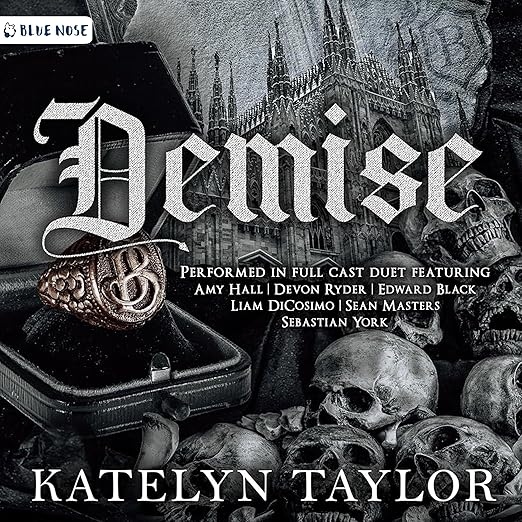
Amy Hall has narrated the series consistently, and her work here reflects a familiarity with the characters that accumulated narration produces. She knows who these people are, and it shows. The ensemble is large enough that maintaining distinct voices for five love interests is genuinely difficult, and Hall manages it without the kind of voice-blending that plagues some multi-character narrations.
At over 13 hours, this is the longest entry in the trilogy, and the runtime feels earned. Taylor is not padding: she is closing out a world she built across three books, and that requires space.
Things to Know Before Starting Demise
The most consistent observation from reviewers is that Demise is more romance-dominant than some readers wanted from a finale that had built considerable plot mythology. If you came to the Gallows Hill trilogy primarily for the Salem historical angle, be prepared for the spice to take significant time in the second act.
There are also some character arc questions worth noting. Wesley's integration into the central group feels less fully realized than Ronan's or Vincent's, and the novel's pacing in his chapters is slightly uneven. These are minor frictions in an otherwise satisfying conclusion, but they are worth knowing for readers who have particular attachment to his storyline.
Who It's For
This is the right listen if you have read or listened to the first two Gallows Hill books and are ready for resolution. The Salem mythology payoff is real, the emotional stakes are high, and Taylor brings the trilogy to a close with genuine ambition. Existing fans will not be disappointed.
If you are new to the series, do not start here. Demise assumes complete familiarity with its world, its characters, and its mythology. There is no onboarding. Start with Book 1 and work forward, and you will arrive at this finale having earned the right to enjoy it.
Is Demise accessible as a standalone, or is the full trilogy required?
The full trilogy is required. Demise opens mid-story with character relationships, ongoing conflicts, and a complex mythology that has been built across two previous books. There is no exposition for new readers.
Is Demise the final book in the Gallows Hill series?
Yes, Demise is the third and concluding volume of the Gallows Hill trilogy. Reviewers confirm it provides resolution for the central relationship and the series mythology, though the universe may continue through related works.
How mature is the content in Demise compared to the earlier Gallows Hill books?
Reviewers consistently describe Demise as the most explicit entry in the trilogy, with a higher density of intimate scenes. It is adult dark romance with mature themes and explicit content throughout.