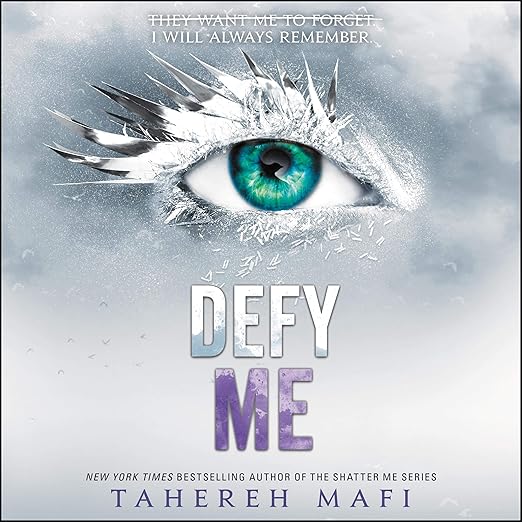
Tahereh Mafi's prose in the Shatter Me series has always operated at a pitch that most YA dystopian fiction cannot sustain. Defy Me, the fifth installment, arrives at a moment in Juliette Ferrars's story where the personal and the political have become inseparable in ways the early books only hinted at, and Mafi's decision to narrate across three perspectives shapes this audiobook into something more dimensional than a straight continuation. Kate Simses carries the audiobook through seven-plus hours of revelations, and the performance is one of the stronger entries in the series' audio catalog.
The central premise of this volume is a kind of psychic siege. Juliette has begun unraveling what she thought she knew about her own identity, and that unraveling is both plotted externally, through the Reestablishment's continuing assault, and internally, through her own memory and self-concept. 'She has to remember who she was' is the synopsis's phrase, and the book's real territory is the gap between the self you were told you were and the one you actually are. Mafi writes this with enough emotional specificity that it does not feel like mere YA trope, and Simses grounds the more interior passages in a voice that conveys vulnerability without sentiment.
The Strengths
The triple-POV narration is where this audiobook earns particular attention. Simses distinguishes each perspective clearly enough that listeners rarely lose track of whose interiority they are occupying. Juliette and Warner have been dual narrators before in the series, but Kenji's addition here is a tonal gift. His perspective, more grounded, more sardonic, more concerned with the practical logistics of revolution, offsets the emotional intensity of the central romantic relationship and gives the narrative room to breathe. Simses has evident affection for Kenji's voice and it shows in the lighter register she brings to his chapters.
Reviewer Conflicted writes that Mafi 'sucked me in with this series' and that they were 'blown away' despite initial skepticism about YA. That trajectory is common among readers of this series. The stylistic intensity of Mafi's prose, the fragmented sentences, the italicized emotional asides, reads differently in audio than on the page. Simses understands Mafi's rhythms and honors them, including the pauses and the repetitions that in another narrator's hands might feel excessive but here create genuine accumulative tension.
Reviewer Kora Alessandrini captures something true about the series' tonal register: 'I always felt like it needed more.' That observation is fair but also, in a way, the point. Mafi writes Juliette's world in a state of perpetual emotional saturation, where the need for more, more clarity, more safety, more love, more identity, drives the narrative engine. Defy Me is a book about wanting more, and the audio format, where you cannot skim through discomfort, makes that sustained wanting particularly immediate and effective.
The book holds a 4.6 rating across 14 reviews, which is strong for a mid-series installment often burdened by the task of advancing plot toward a conclusion without being able to deliver it. Mafi manages the balance between forward momentum and emotional depth with the consistency that has kept readers loyal to the series across five volumes.
Things to Know Before Starting Defy Me
This is book five in a six-book series, and it is not designed as a point of entry. Listeners who have not followed Juliette's story through the previous four volumes and the novellas that intersect with them will find significant narrative context missing. Mafi does not recap extensively; she assumes you have been there all along. If you are new to the series, start at the beginning and work forward.
The revelations in this volume, which include significant disclosures about Juliette's parentage and the true nature of her abilities, are structured to shock and disorient before they clarify. Some readers find this approach satisfying; reviewer Diana K. Cedillo notes loving the ending while acknowledging it was predictable in places. Others, particularly those who have been building their own theories across five books, may find the specific shape of the reveals either gratifying or anticlimactic depending on how closely their predictions matched.
The romantic intensity that has defined the series continues here at full pitch. Warner and Juliette's relationship, with all its history of harm and healing, is at the center of this volume in ways that may feel disproportionate to readers more invested in the plot's revolutionary dimensions. Mafi's priorities are always emotional first and political second, which is a legitimate artistic choice but one that should be understood before you arrive at this point in the series.
The decision to add Kenji as a narrator is the most significant structural change from the earlier dual-POV installments, and it pays off in ways that are especially apparent in the audio format. Where Juliette and Warner's perspectives tend toward emotional intensity and psychological interiority, Kenji brings an observational humor and practical awareness that function as a kind of ballast. His chapters give the audiobook pacing variety that a purely romantic and dramatic focus would not achieve, and Simses's facility with his voice, looser and more offhand than her performances as either of the primary protagonists, is one of the production's genuine pleasures. For listeners who have followed the series through its earlier volumes, the addition of Kenji's interior life is one of this installment's most rewarding developments.
Who Should Listen to Defy Me
Readers who have followed the Shatter Me series from the beginning and are invested in Juliette and Warner's arc will find this installment delivers on the emotional and narrative questions that previous volumes raised. Kate Simses's narration rewards listeners who respond to Mafi's particular stylistic voice and its intensity across seven hours.
Those new to the series, or those who find the intensity of Mafi's prose overwhelming in sustained doses, should approach carefully. This is a book that rewards prior investment; it does not manufacture entry points. Come with your loyalties already established, and Defy Me will give them somewhere meaningful to land.
Quick Take
- Performance: Kate Simses navigates triple POV with genuine distinctiveness, particularly in the tonal shift between Warner's brooding register and Kenji's sardonic groundedness.
- What it covers: Identity and memory, revolution and personal cost, love as witness to transformation.
- Feel: Emotionally saturated and propulsive, with high-pitch revelations that demand full attention.
- Our call: A strong fifth chapter in the Shatter Me series, best approached with the emotional and narrative context of the previous four books in hand.
Questions Listeners Ask
Can I listen to Defy Me as a standalone audiobook without the previous Shatter Me books?
No, this would not work as a standalone. Defy Me is the fifth book in the series and assumes full knowledge of the preceding four volumes and their novellas. Key revelations about character and plot will be incoherent without that foundation.
How does Kate Simses handle the three different POV characters in this audiobook?
Very well. Juliette's intense interiority, Warner's controlled emotional register, and Kenji's wry sardonic voice are each distinctly rendered. Listeners who have followed the series in audio will recognize the characterizations immediately.
Does this audiobook resolve the major plot threads from earlier in the Shatter Me series?
It advances them significantly and delivers several major revelations, but as the fifth book in a six-book series it is designed to set up the conclusion rather than fully resolve it. The emotional arcs get meaningful development; the political ones escalate toward the final volume.
Is Mafi's stylistic prose, with fragmented sentences and italicized internal thoughts, as pronounced in this audiobook as in earlier entries?
Yes. Mafi's signature voice is present throughout, and Simses performs it naturally. If you found the style challenging in earlier books, it remains at similar intensity here. Fans of the prose style will find it well-served by the narration.