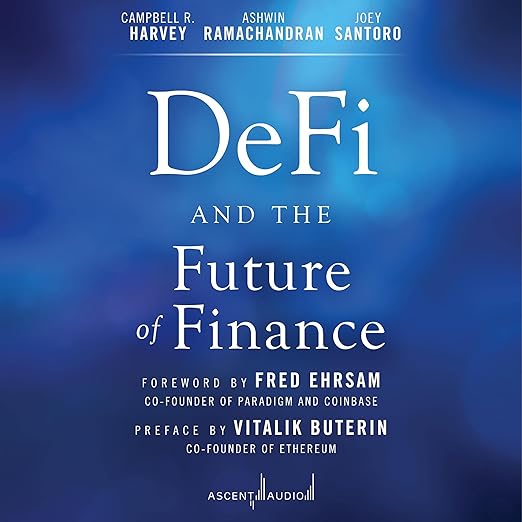
The 2008 Global Financial Crisis serves as the opening premise of DeFi and the Future of Finance, and Campbell R. Harvey uses it with precision rather than as mere rhetorical backdrop. The argument is specific: when the infrastructure failed, governments bailed out the institutions that had caused the failure, and the entire episode demonstrated structural vulnerabilities that no amount of regulatory adjustment fully addressed. This audiobook, narrated by David de Vries and running three hours and fifty-four minutes, is Harvey's case, co-authored with Ashwin Ramachandran and Joey Santoro, that decentralized finance represents a genuine architectural alternative rather than a speculative novelty. Harvey is a finance professor at Duke's Fuqua School of Business and has been researching DeFi since its earliest serious protocols. The book carries that authority clearly, and it benefits from having three co-authors whose complementary backgrounds span academic finance, protocol development, and applied DeFi engineering.
What distinguishes this from the large body of cryptocurrency-adjacent popular writing is the level of protocol-specific depth. Harvey, Ramachandran, and Santoro conduct detailed examinations of Uniswap, Compound, MakerDAO, Aave, Yield Protocol, dYdX, and Synthetix. These are not name-checks or illustrative gestures. The book walks through how each protocol functions mechanically, what problems in traditional finance each addresses, and what risks and limitations each carries. One reviewer accurately describes the experience as equivalent to a 300-level course on DeFi, which is both an accurate characterization of the depth and a fair warning about the assumed knowledge base: this is a book for listeners who already understand traditional finance well enough to appreciate what the protocol-level differences mean.
Algorithms Replace Intermediaries in Savings and Lending
The book's central structural claim, that DeFi removes intermediaries by replacing them with algorithms, is stated early and then built out through each protocol examination. Savings and lending are reinvented because the collateralization and liquidation logic runs in code rather than through institution discretion. Trading occurs through automated market makers rather than order books managed by brokerages. The fees, delays, and counterparty risks embedded in traditional financial infrastructure are stripped out, or replaced with different and arguably more transparent risks. Harvey is careful not to present this as a solved problem. He discusses smart contract risk, oracle manipulation risk, and governance token concentration risk with the same directness he brings to the advantages. That evenhandedness is one of the book's consistent strengths and what separates it from more promotional DeFi writing.
The treatment of Uniswap's automated market maker design is one of the audiobook's most instructive sequences. The constant product formula that governs Uniswap liquidity pools is counterintuitive when you first encounter it, and Harvey's explanation builds from first principles in a way that de Vries's narration handles well: step by step, no shortcuts, with enough conceptual patience that a listener engaging seriously with the material can follow the logic rather than simply accepting the conclusion. That pedagogical care distinguishes this book from much of the DeFi literature, which tends to assume either too much or too little.
De Vries Never Dramatizes the Liquidity Math
David de Vries brings a clean, analytical delivery to the narration that suits technical financial content well. He doesn't dramatize the material or impose enthusiasm on concepts that are best understood through careful attention. The audiobook format works reasonably well for this content, though the protocol-specific material, particularly the algorithmic mechanics of the liquidity pool designs, is dense enough that many listeners will benefit from having the print version available for reference. The book comes in at under four hours, which is a genuine advantage for a busy professional audience: this is content that can be absorbed in a focused session and then revisited for specific protocols.
The book's publication date means the specific protocol examples it uses have evolved substantially since printing. DeFi protocols move fast, and several of the companies featured have changed significantly in market position and governance structure. Harvey acknowledges this implicitly by framing the protocol discussions as illustrative of principles rather than definitive descriptions of current-state systems. Listeners should approach the specific protocol details with that understanding and use the book's conceptual framework as the durable take-home rather than the specific numbers or governance structures described.
Assumes You Already Grasp the 2008 Crisis
The book sits at an assumed knowledge level that will exclude some listeners. If you don't know what collateralization ratios are in traditional lending, what a liquidity pool does relative to a traditional market maker, or what the 2008 crisis actually involved at a structural level, you will find this audiobook moving faster than you can follow in places. Harvey does not spend significant time on foundational finance concepts. He enters at a level that assumes financial literacy and builds DeFi architecture on top of it. For that audience, the book is exactly the right level of challenge. For listeners without that background, foundational blockchain and finance resources would serve better as preparation before attempting this one.
Four Point Two Rewards Careful Preparation
Finance professionals, investment analysts, and technically literate investors who want to understand the architectural logic of decentralized finance rather than just its speculative potential will find this audiobook the most rigorous short-form option in its category. MBA students and fintech professionals evaluating DeFi's implications for traditional financial services will find the protocol-by-protocol framework directly applicable. The 4.2 rating from 434 listeners reflects a technically demanding book that rewards preparation. Listeners who want a general introduction to cryptocurrency or blockchain technology without assuming prior financial expertise should look elsewhere: this book assumes you already understand the system it's proposing to disrupt, and it is more useful once that foundation is in place.
In Brief
- Narrator: David de Vries brings a measured, business-presentation authority to the material, appropriate for content aimed at financially literate listeners.
- Subjects: Decentralized finance protocols, failure modes in traditional financial infrastructure, peer-to-peer trading and lending
- Tone: Analytical and forward-looking, with the urgency of someone who believes the window for understanding this is closing
- Bottom line: Listeners already conversant in traditional finance who want a structured introduction to DeFi protocols will find this audiobook the most substantive short-form option available.