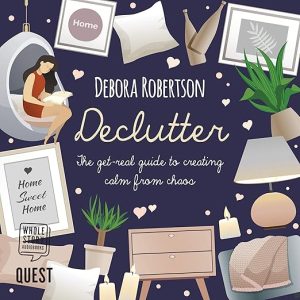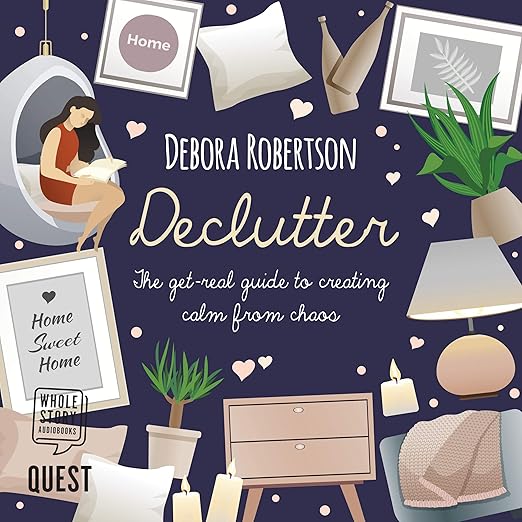
I tried Marie Kondo's method once. I held a pair of jeans to my chest, waited for a feeling of joy that did not arrive, and eventually put them back in the drawer. I am not the audience for the spiritual approach to home organization. So when I picked up Debora Robertson's Declutter, I was cautiously hopeful; the marketing positioned it as an antidote to exactly that approach, and the book mostly delivers on that positioning. Robertson is a writer and journalist who has written about homes and interiors for years, and she brings a columnist's practical sensibility to what is, at its heart, a very simple problem: most of us have more stuff than space, and we lack a system for doing anything about it.
The audiobook runs just over four hours, which is the right length for this material. Robertson is not trying to write a philosophical treatise on ownership and identity. She is trying to give you tools you can use this weekend, and she knows the difference. Julie Maisey's narration suits the book well; her voice carries Robertson's cheerful, self-deprecating energy without flattening it into radio-presenter brightness. The listening experience has the quality reviewer AfroDizzy described perfectly: like a good friend sharing their best house-related tips all at once. That warmth is not accidental; it is Robertson's deliberate positioning against the colder, more judgmental end of the decluttering spectrum.
Robertson's organizing framework is her ten decluttering commandments, which she introduces early and returns to throughout the book. These are not revelations, and Robertson does not pretend they are. They are permission structures: rules that help time-poor people stop treating decluttering as an all-or-nothing project that requires a free weekend and an empty skip. The commandment that tasks should be dealt with in achievable goals rather than marathon sessions is the most practically useful, because it addresses the real reason most people never start: the task feels too large to be worth beginning.
What Robertson does well is break down specific domestic categories, kitchens, cupboards, wardrobes, paperwork, with concrete suggestions for each. She does not move through these categories quickly or superficially; she accounts for the psychology of attachment, the particular difficulty of dealing with other people's belongings, and the fact that some items genuinely are hard to part with regardless of your organizational philosophy. The chapters on managing sentimental items are handled with more empathy than the subject often gets in this genre, and that quality distinguishes Robertson from the more clinical decluttering guides on the market.
Digital Clutter Gets the Thinnest Chapter
The three-star review from the reviewer identified as lovino is not wrong. Robertson's advice is well-written and easy to absorb, but it does not go significantly beyond what attentive readers of home organization blogs and similar books will already know. The book's value proposition is primarily one of tone and accessibility rather than novelty. If you have already read and applied several books in this space, or if you have spent time with the more rigorous organizing literature like Fumio Sasaki's Goodbye, Things, you may find Robertson's commandments confirm what you know rather than extending it. The book is a gateway text, not a comprehensive resource, and it works best for people whose relationship with decluttering is defined more by avoidance than by failed attempts at more serious systems.
The digital decluttering section, which covers social media and email management, is shorter and more general than the domestic sections. Robertson is clearly more comfortable with physical spaces than virtual ones, and the advice in this portion does not have the same practical specificity. It reads as an acknowledgment that the subject should be addressed rather than a genuine guide to addressing it, which is the book's one significant gap given how central digital clutter has become to daily life.
Seventeen Mugs Survive Without Any Guilt Attached
The most distinctive thing about Declutter is its refusal to moralize. Robertson does not suggest that a cluttered home reflects a cluttered mind or that simplicity is a virtue. She treats the problem as practical rather than spiritual, which is a genuine service to readers who are exhausted by the wellness framing that has attached itself to home organization in recent years. The humor is consistent without being forced: this is a book that acknowledges the absurdity of keeping seventeen mugs because you might need them, without making you feel judged for having seventeen mugs. Reviewer Porter, who had been watching Robertson's blog Licked Spoon, noted her wisdom, humor, and the wonderful sense she brings to the subject; that combination is exactly what makes Declutter work as a listening experience even when the individual advice is familiar.
Maisey Narrates a Book Meant for Motion
There is something appropriate about hearing Declutter as an audiobook rather than reading it on the page. Robertson's voice, as channeled by Maisey's narration, is meant to accompany you while you are doing something: cooking, folding laundry, sorting through a drawer while the book plays in the background. This is not a text that demands your full attention and a highlighter. It is a text that works best when you are already in motion, which makes audio the natural home for it. At just over four hours, you can finish it in a single afternoon and begin applying what you heard before the day is out. That quality of immediate usability is Robertson's real gift to her reader, and Maisey's narration delivers it intact.
At a Glance
- Read by: Julie Maisey delivers Debora Robertson's cheerful, unpretentious voice cleanly; her tone matches the book's anti-holier-than-thou positioning perfectly.
- At its heart: Practical home organization, anxiety and productivity, digital decluttering
- Vibe: Friendly and energizing, like advice from someone who has actually lived through the mess
- Short version: A genuinely unpretentious alternative to more mystical decluttering guides, though experienced minimalists will find the ground familiar.