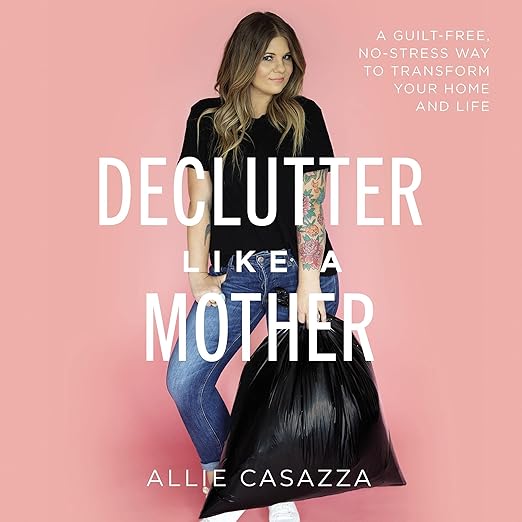
I picked up this audiobook on a Sunday morning when my apartment felt like it was closing in on me. Not the dramatic chaos of a hoarder's house, just the low-level, persistent weight of too much stuff: stacks of books I would never re-read, kitchen gadgets I used once, a drawer that fought back whenever you opened it. I had read enough minimalism content online to understand the theory. What I needed was someone to talk me through the practice, room by room, without making me feel guilty for having accumulated so much in the first place. Allie Casazza does exactly that, and she does it in a voice that makes you want to start immediately.
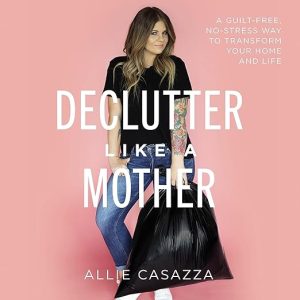
Declutter Like a Mother is a Wall Street Journal bestseller read by its author, and at just over four hours, it is a tight, purposeful listen. The title telegraphs her approach: this is not the stark, Instagram-worthy minimalism of bare white walls and a single potted plant. Casazza is a mother of multiple children speaking directly to other mothers who are drowning in the material debris of family life, and she brings both pragmatism and genuine compassion to a subject that, in lesser hands, risks becoming either overwhelming or condescending. She opens the book by distinguishing her approach from the stark minimalism aesthetic, acknowledging directly that with young children in the house, that particular style is simply not livable. This moment of permission, arriving on the first few pages, does something important: it signals to the listener that this is a book written by someone who understands their actual life.
There is a meaningful difference between listening to a narrator interpret someone else's words and listening to the person who lived the experience. Casazza's voice has a quality that reviewers repeatedly described as feeling like she is sitting in the room with you, guiding you through simple choices. She is not performing warmth or professional polish. She is talking to you like a friend who is also a little too honest, who will tell you the junk closet is stealing hours from your life every week without you realizing it. The exclusive commentary she recorded specifically for the audiobook version adds genuine value here, providing context and reflections that readers of the print edition do not get. For a book whose core message is about creating space for what actually matters, the conversational audio format turns out to be its natural home. When Casazza describes the sensation of purging an entire room and feeling the tension leave her body, it carries the weight of personal testimony rather than professional advice.
Why Declutter Like a Mother Works as an Audiobook
What separates this book from the sea of organizing and tidying guides is its insistence on the psychological dimension. Casazza draws on research that links the volume of physical possessions in a home directly to stress levels and anxiety, and she makes that case personally rather than academically. Her own story, of recognizing that the mountains of toys and laundry and accumulated things were not just a logistical problem but an emotional one, gives the material its backbone. One reviewer described the book as providing great analogies about how much of our time our things steal from us, noting that seconds and minutes add up to something genuinely significant. Another described it as a book that lit a fire they did not even know they needed, noting that they had thought they were reasonably minimal until Casazza made clear that the real issue was not organization at all: it was less. Casazza is not just teaching you how to fill donation bags. She is making an argument about what kind of life you want to be living, and the clutter is standing between you and it.
Weak Spots in Declutter Like a Mother
The practical structure is where the book earns its keep day to day. Casazza moves through the house systematically, with particular attention to the categories that most plague families: the kitchen appliances nobody uses, the junk closet stuffed with things that defied categorization, and above all the children's possessions. Her approach to kids' stuff is one of the book's genuine contributions to the conversation. She argues, backed by her own experience and observation, that children thrive when they are not overwhelmed with options, and she offers concrete strategies for involving kids actively in the process of letting go rather than working around them while they are at school. One reader with three young children noted that after years of knowing intellectually that managing too much stuff was the problem, Casazza's book provided the actionable steps that finally moved things forward. The absence of guilt-tripping is notable and intentional throughout. Casazza is not interested in shaming people for having accumulated things. Her philosophy is explicitly one of grace: you accumulated this stuff because you were trying to create a good life. Now you get to choose differently.
The book's limitation is its brevity. At four hours, it is more motivational framework than comprehensive manual. Listeners hoping for an exhaustive room-by-room guide with answers for every edge case will need to supplement. The companion PDF with discussion questions adds some texture, but the audio is the main event. For what it is, though, it is exceptional: a precisely targeted intervention for mothers who are physically and emotionally exhausted by the stuff in their homes, delivered by someone who has lived that exhaustion and come out the other side with something genuinely useful to say about it.
The Right Listener for Declutter Like a Mother
Listen if you are a parent who suspects that managing possessions is consuming more mental and physical energy than it should, or if you have absorbed minimalism theory but struggled to translate it into action. Skip it if you are looking for a comprehensive, room-by-room organizing system with detailed guidance for every possible situation, or if the explicitly maternal framing will feel limiting to your circumstances. For its intended audience, it is one of the more effective audiobooks in the home organization space, and the author-read format is a genuine differentiator.