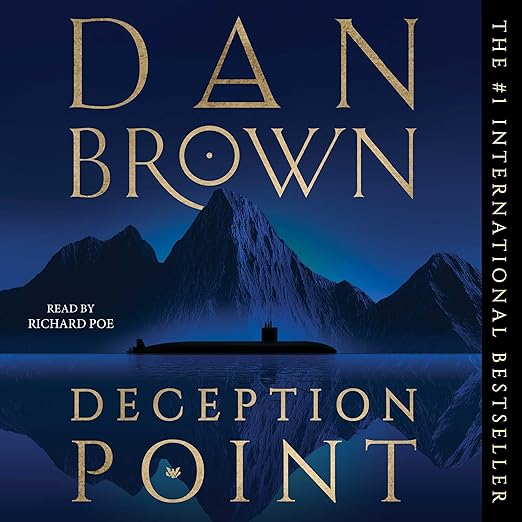
Somewhere around hour four of Deception Point, I realized I had stopped thinking about the book and started thinking about what was actually going to happen next, which is the reliable sign that a thriller is working. Dan Brown released this novel in 2001, before The Da Vinci Code turned him into a global phenomenon, and it shows in the best possible way. The plot machinery here is familiar Brown: an institution with secrets, a protagonist dropped into danger mid-mission, a conspiracy that reaches higher than anyone suspected. But the scale feels appropriately contained. No ancient secret societies, no cryptographic art history, just NASA, a meteorite in the Arctic, and a government willing to kill to protect a very large lie.
The setup is efficient. NASA has discovered what appears to be an extraordinarily rare meteorite embedded in Arctic ice, a discovery that would vindicate the agency and potentially reshape US space policy ahead of a presidential election. Intelligence analyst Rachel Sexton is dispatched to verify the find alongside scientist Michael Tolland. Within hours of arriving, she has uncovered evidence of scientific fraud and is being hunted across the ice by a team of professional killers. What follows is seventeen hours of pursuit, revelation, and escalating conspiracy.
What We Made of It
Brown's structural instincts are at their sharpest here. The short chapters, often two to four minutes in audio, create a rhythm that makes it nearly impossible to identify a natural stopping point. The science is handled with confidence: the meteorite discovery is plausible enough that non-specialist listeners will not feel condescended to, and Brown weaves in enough genuine NASA and oceanography detail to give the thriller's outlandish plot a grounding it needs. The political dimension, the presidential election backdrop, the relationship between the intelligence community and elected officials, adds a layer that Brown does not always develop in his later work.
The critical note worth acknowledging: one reviewer correctly observes that the book requires suspension of disbelief on certain practical points. Characters operate in the Arctic under physical conditions that real human beings could not sustain without the story acknowledging it. Brown's early novels share this quality, the logic of the thriller plot takes precedence over strict physical realism. If that kind of gap pulls you out of fiction, note it going in. If you can surrender to the premise, it does not become a problem.
Richard Poe's narration suits Brown's fast-chapter structure. He delivers the short, punchy chapters with the right urgency and handles the ensemble cast, Rachel, Tolland, the various antagonists and political figures, with enough vocal differentiation to keep characters distinct across a seventeen-hour listen. Poe was a go-to narrator for this style of commercial thriller in the early 2000s, and you can hear why: he understands that his job is to keep the momentum Brown builds rather than to impose his own interpretation on it.
Weak Spots in Deception Point: A Novel
Deception Point is a standalone, it is not part of the Robert Langdon series, so listeners expecting symbology, European settings, or Langdon's academic heroism will find this a different kind of book. It is faster, more physically propulsive, and less architecturally intricate than The Da Vinci Code. The book was also published in 2001, and some of the political and institutional landscape it depicts, NASA's public standing, the intelligence community's post-Cold War posture, reflects that specific moment. It does not date the book, but it contextualizes it for listeners arriving with more recent reference points.
Best Suited For
Readers who have exhausted the Langdon series and want more Brown will find this satisfying. It also works as an introduction to Brown's style for listeners who have heard the reputation but not yet tried the books, the smaller scale and contained plot make it a more manageable entry point than The Da Vinci Code for some readers. Political thriller fans who enjoy conspiracies rooted in real institutions rather than religious history will find the NASA-White House premise particularly engaging. Listeners who need their thrillers to pass strict logical scrutiny should be cautious going in.
Frequently Asked Questions
Is Deception Point part of the Robert Langdon series?
No. Deception Point is a standalone novel with entirely different characters and setting. It predates The Da Vinci Code and features Rachel Sexton, a White House intelligence analyst, rather than Langdon.
Richard Poe narrated this in 2004, does the production quality hold up?
Yes. Poe's narration is clean and well-paced, and while the production is older than more recent audiobook releases, there are no significant audio quality issues that interfere with the listening experience.