
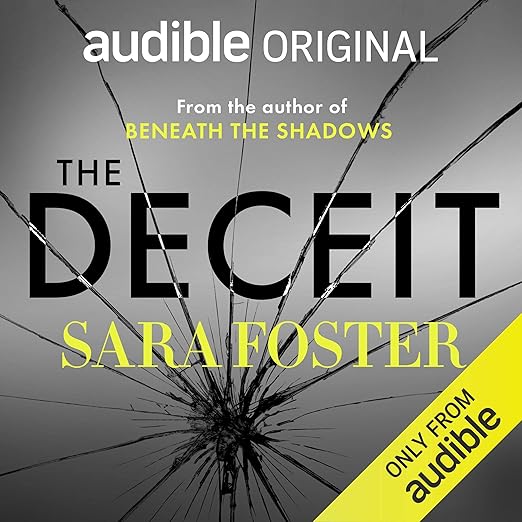
Deceit arrived at a useful moment for me: I was between longer, more demanding listens and wanted something that would carry me through an afternoon without requiring the kind of sustained analytical attention that some audiobooks demand. At five hours and thirteen minutes, Katelyn Taylor's Audible Original delivers exactly that: a brisk, efficiently constructed domestic thriller that has a strong final act and a somewhat uneven path to get there.
The setup is clean. Lenny has always believed his marriage to Claire is solid, until anonymous text messages begin arriving telling him that his wife is a liar and that he does not know who she really is. Claire, meanwhile, is carrying something from her past that she has never told him, something she is terrified is now closing in on both of them. New neighbors arrive. A client becomes threatening. The suburban surface begins to develop fracture lines.
The Verdict, Briefly
The Kirkus Reviews quote included in the synopsis captures the book's structure accurately: the fast-moving flow from placid family life to a deeply disturbing secret drives the suspense. That framing points to both the book's strength and its constraint. The disturbing secret is doing most of the work. Claire's past, when it is eventually revealed, is genuinely dark and the revelation gives the narrative the charge it needs. The problem is that the setup section, the anonymous texts, the strange neighbors, the growing unease, takes longer to reach that revelation than the pacing fully supports.
Reviewer Chuck Cardinal described the experience precisely: very interesting plot, but getting to the end was a slog, with the characters difficult to care about until the final third. That is an honest account of the book's rhythm. The reader who gets to the end of Deceit will find it satisfying in ways the middle section does not promise.
Why Deceit Works as an Audiobook
Tim Potter's narration is well-matched to the material. Domestic thrillers require a narrator who can sustain low-key menace without tipping into overwrought drama too early, and Potter manages that calibration throughout. The Audible Original production quality is clean, and at just over five hours the listen does not overstay its welcome even when the plot is moving slowly.
Reviewer Francisca made an argument worth taking seriously: that Claire's decision not to confide in Lenny is easier to judge harshly than to understand from outside, and that the novel is actually doing something thoughtful about the way people try to contain their pasts rather than share them. That defense of Claire is a useful lens for the middle section in particular: the choices that frustrate the reader are also what the book is examining rather than endorsing.
Points to Consider
The character depth is uneven. Claire's situation generates more psychological texture than Lenny's, whose experience of the anonymous texts and the unraveling of his domestic certainties is rendered with less specificity than the narrative requires to fully invest the reader. Reviewer Peter Karabin, calling it quite impressive with well-defined characters that gain strength as things progress, is not wrong exactly, but the progression he describes does not begin until relatively late in the five-hour runtime. For a short-form thriller, this is a meaningful pacing challenge.
The anonymous text device, which is how the thriller's central tension is introduced, also feels more mechanics than menace for much of the first half. The texts are designed to create dramatic irony, the listener understands that Claire has a secret before Lenny does, but the device requires the secret itself to be compelling enough to sustain interest until the reveal, and Taylor takes longer to get there than ideal.
Who Should Listen to Deceit
Domestic thriller listeners who enjoy the slow-burn model and are willing to stay patient through a deliberate setup for a payoff that the ending does deliver. Also suitable as a short, contained listen for a plane trip, as one reviewer suggested, where the contained runtime and the escalating tension serve the format well. Skip it if you need consistent narrative momentum or strongly drawn characters from the opening pages.
Common Questions
Is Deceit by Katelyn Taylor a standalone novel or part of a series?
It is a standalone domestic thriller. The synopsis mentions Taylor is also the author of Beneath the Shadows and The Hush, which are separate books rather than connected series entries.
How dark does Deceit get, and is it suitable for listeners sensitive to trauma-adjacent content?
The novel involves a significant past trauma that is central to Claire's secret and to the resolution. The content is handled with restraint rather than graphically, but listeners sensitive to content involving abuse or sustained threat should know that these elements are part of the story.
Does Tim Potter's narration differentiate clearly between Lenny's and Claire's perspectives?
He handles both POVs cleanly, maintaining the tonal distinction between Lenny's confusion and Claire's fear without making the perspective shifts disorienting. The production does not use separate narrators for each character, but the shifts are clear.







