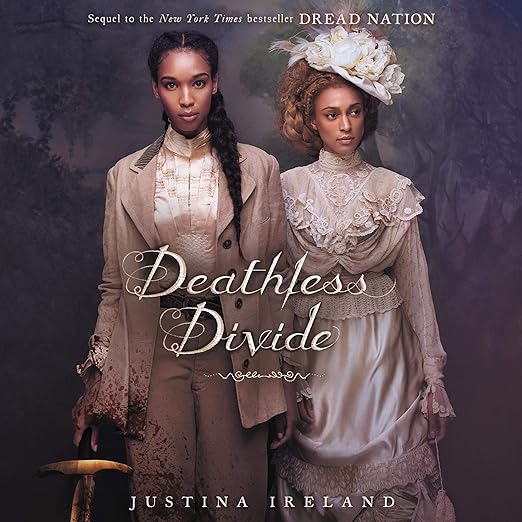
Jane McKeene tells part of this story and Katherine Deveraux tells the rest. The jacket copy moves between them openly: Jane heading west and questioning everything she thought she knew about surviving in 1880s America, and then Katherine, who never expected to be allied with Jane and who ends up the one holding hope open. One reader is credited on this audiobook, Bahni Turpin, and fourteen hours and thirty-four minutes divided between two first-person voices is precisely the assignment a single-narrator credit invites you to think hard about before buying.
Where This One Lands
Bahni Turpin has the entire book, and on a novel built this way that is a genuine load. Two narrating characters means two vocabularies, two temperaments and two relationships to the same events, and the handover has to register instantly or a listener loses the thread. None of the five responses posted here says anything about how that lands. The silence is worth naming on this title in particular, because the structural choice the jacket copy advertises is exactly the choice a recording either solves or fumbles.
Both women are running from Summerland, and the jacket copy is candid that escaping simplifies nothing. Jane wanted the plan to stay small: get out of town, stay alive, head west to California, find her mother. What she gets instead is a devastating loss on the road, a protected village called Nicodemus that is not what it appears, familiar faces from Summerland surfacing inside it, and a path of blood and violence that the copy says threatens to consume her before anyone can stop it.
Ireland is doing something specific with the period, and one response here names it precisely: connecting biting social commentary with historical fiction, pun acknowledged. The restless dead are the premise and 1880s America is the subject, which is why a History and Culture tag on a teen listing turns out to be more apt than it first looks. Another entry regrets how little time the book spends in San Francisco and how little it examines the hierarchy it hints at, a complaint only an engaged reader bothers to make.
The Best Parts of Deathless Divide
Katherine is the half that surprises people. The jacket copy hands her the second movement of the pitch and the final emotional beat: watching Jane's back proves to be more than she bargained for, and when both of them hit a breaking point it falls to Katherine to keep hope alive, even as she starts to fear that no happily-ever-after exists for girls like her. One reader singles the pair out as fantastically complex characters you cannot help wishing an easier life on.
Summerland and Nicodemus, the fall of one and the false promise of the other, give the book its shape, and that is where a newcomer walks into trouble. The very first response on the page states it without hedging: if you have not read Dread Nation, you really must, or the events and characters here will not make sense. Another notes that the story opens with a prologue to the first book before picking up where it left off, which is a courtesy rather than a substitute for having read it.
Fourteen hours and thirty-four minutes is a substantial second volume, and the only structural complaint in the column concerns compression rather than length. A reader who still graded it five stars regrets the time-skip in the middle, understands why it exists, and wants the missing material anyway, observing that Jane recovers most of her gap through flashback while Katherine merely hints at shenanigans nobody gets to see. For a listener that is a useful warning, since a gap you cannot flip back and reread is a gap you feel harder.
What Gives Us Pause
Sequels attract a particular kind of response and this page holds the full set. One entry carries its own spoiler warning and then delivers a careful assessment of world-building and consequence. One calls this the conclusion to the story that began with Dread Nation while another calls it a sequel, and the metadata says only Dread Nation Series without indicating whether anything follows. A buyer wanting to know whether the story finishes here will not find out from this record.
Since we are on the subject of what the record cannot tell you, the star badge is the worst offender. It reads 4.6 above a counter showing 1, while five graded responses sit visibly beneath it: four fives and a four. Round a lone whole-star vote however you please and it lands on a whole number, never on 4.6, so badge and tally are plainly describing different populations. The written grades are the only figures on this page that correspond to something a buyer can actually read, and even those five disagree with the counter by a margin of four.
Readers should also brace for the entry that grades a parcel. Fast shipping, it says, daughter loved it, and that is the whole thing: five words on delivery plus a secondhand verdict from somebody who did not write the review. Posted in February 2026 against a February 2020 release, it sits alongside considered assessments from 2020, 2021 and 2022 and carries exactly the same weight in the arithmetic as any of them. Nothing about it is dishonest, and nothing about it helps. It is the clearest illustration on this listing of why the star line and the written column need to be read as two separate sources rather than one.
Who Should Listen to Deathless Divide
Historical horror readers who finished Dread Nation are the audience this was built for, and it treats them generously: the political argument sharpens, the narration splits between two leads, and the consequences of book one arrive with interest attached. Listeners who enjoy a protagonist who is competent, furious and wrong in interesting ways will find Jane worth fourteen hours. Anyone who loved the first book's voice specifically should register that this one operates with two of them.
Anyone new to this series should start one book earlier. Every reader here who got as far as discussing the plot reaches that conclusion, the jacket copy opens by naming it the sequel, and the novel itself begins with a recap its own readers describe as a prologue rather than a door in. Ignore the star badge as well, since it cannot be assembled from the votes it claims to summarize. Anyone starting here will spend the opening hours reconstructing a book they could simply have listened to first.
Can I start the Deathless Divide audiobook without reading Dread Nation first?
Not comfortably. The first response on the page says outright that the events and characters will not make sense otherwise, and the publisher's own pitch introduces the book as a sequel in its very first clause. A prologue recapping the first book exists, but readers describe it as a refresher rather than an entry point.
Does one narrator handle both Jane and Katherine in this audiobook?
The credit names Bahni Turpin and nobody else across fourteen hours and thirty-four minutes, so one performer covers both first-person voices. Nothing in the five written responses describes how the handover between them sounds, which leaves the most consequential production question on this listing unanswered.
Why does the rating show 4.6 when the counter says one vote?
Because the two figures come from different sources. A lone whole-star vote lands on a whole number, never on 4.6, and five graded responses sit visible on the page, four of them fives and one a four. Read those five rather than trusting the badge above them.