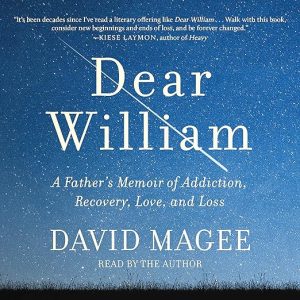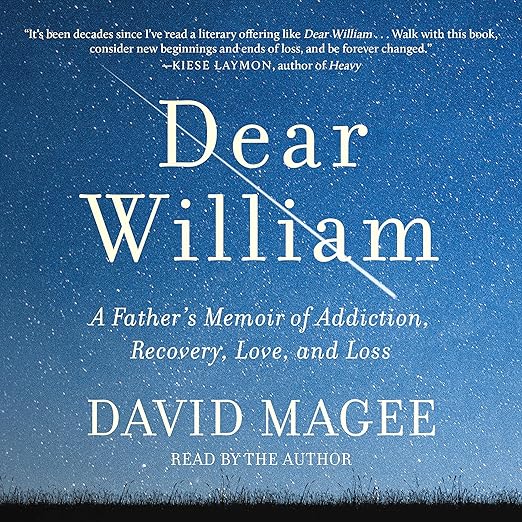
Writing a memoir about your own dead son requires a kind of craft discipline most authors never have to test, and David Magee built Dear William around the last thing his son William asked him to do: tell their family's story so it might help someone else. Days after that conversation, William was gone, an accidental drug overdose, and Magee spent the years afterward turning that instruction into this audiobook, which he narrates himself across eight hours and thirty-one minutes.
Magee Implicates Himself Alongside His Whole Family
The publisher's own comparison, a memoir suggestive of Augusten Burroughs meeting Glennon Doyle, is a reasonable shorthand for what Magee is attempting: Burroughs' unflinching willingness to implicate himself alongside everyone else in the story, paired with Doyle's instinct for turning private wreckage into something a stranger can use. Magee mostly earns the comparison. He does not position himself as the wise father processing a tragedy from a safe distance. The book confronts his own early substance use, the adoptive family secrets he spent decades avoiding, and the uncomfortable fact that he watched destructive patterns repeat in his own children before William's death forced a full reckoning.
What separates this from a more conventional grief memoir is the intergenerational structure. Magee is not simply telling William's story, he is tracing substance misuse and unresolved trauma backward through his own adoptive parents and forward into his surviving children, which turns a single tragedy into a study of how these patterns actually propagate inside a family across decades rather than treating William's death as an isolated event.
The Burroughs-meets-Doyle comparison holds up on closer inspection because each half is doing different work. Burroughs' influence shows in Magee's willingness to implicate himself and his own family's dysfunction without flattering anyone involved, himself included, while the Doyle-adjacent quality shows up in the book's forward motion, its insistence that naming the wreckage honestly is itself a form of liberation rather than just an act of confession. Few memoirs manage both registers convincingly in the same book, and this one largely does.
Titling This as a Letter to William
Titling a memoir as a direct letter to its subject, in this case a father addressing his own dead son by name, sets different expectations than a conventional third-person memoir title would. Every chapter carries at least an implicit second person underneath it, William as the intended reader even though he will never hear it, which gives Magee's prose an urgency and intimacy a more distanced retrospective title would not have earned as naturally.
Ending on Hope After the Hardest Material
Self-narration is close to essential for a book built this specifically around one father's direct address to William, and by extension to every family quietly carrying the same struggle. An outside narrator, however skilled, would add a layer of performance between the listener and material that depends entirely on sounding like an actual confession rather than a polished retelling. Magee has authored close to a dozen previous books as an award-winning columnist, so this is not an amateur reading, but craft experience and personal stakes together are what make the narration convincing.
Reviewer Spencer references seeing Bono on a television morning show say he 'sings to survive', and adds a related observation of their own, that some people 'write to survive'. It is a fair description of what this book is doing structurally: Magee is not writing a policy argument about addiction treatment, he is working through his own survival in real time, on the page and in his own recorded voice, which gives the material an urgency a more clinical treatment of the same subject would lack entirely.
Despite its subject matter, the synopsis is explicit that this closes on 'a poignant and uplifting message of hope' rather than leaving listeners in the wreckage of William's death. Magee's founding of the William Magee Institute for Student Wellbeing gives the book's final movement a concrete, ongoing purpose beyond personal catharsis, which matters for anyone worried this eight and a half hours will be unrelentingly bleak from start to finish. It is not. The hardest material sits early and centrally, with real forward motion by the closing chapters.
Timeline Jumps Across Three Generations Demand Attention
Reviewer Jacqueline Guida, who lost her own adult daughter, writes about carrying that loss for over a decade, and her response signals something important about who this book reaches hardest. This is not a comfortable listen, and Magee does not soften the details of finding William, or the years of family dysfunction that preceded it, for the sake of an easier eight hours.
The book's larger mission work, the William Magee Institute for Student Wellbeing that Magee founded at the University of Mississippi, gets meaningful attention in the synopsis, and the memoir widens accordingly from personal confession into advocacy and practical framing aimed at high school and college audiences specifically. That shift in register, from raw personal account to institution-building mission, is a deliberate structural choice rather than a loss of focus, but it does change the book's shape partway through.
Structurally, the book moves across at least three generations at once, Magee's adoptive parents' secrets, his own adolescence and substance use, and his children's inherited struggles, which means listeners should expect timeline jumps rather than a single linear account of William's life and death. That layered structure is the book's whole argument, patterns repeat across generations until someone names them, but it does ask more of a listener's attention than a chronological memoir would.
Magee's long career as a columnist and prolific author shows up less in polished literary flourish and more in structural discipline: even at eight and a half hours covering three generations of family history, the book rarely loses its thread or wanders into tangents that do not serve the larger argument. That kind of pacing control is a genuine craft skill, not an accident, and it is worth crediting explicitly given how easily material this personally overwhelming could have sprawled.
Family Therapists and Grieving Parents Will Recognize This
This belongs with parents navigating a child's substance misuse, adult children processing inherited family dysfunction, and anyone working in addiction treatment or student wellbeing who wants the family-side account rather than a clinical one. Readers of memoirs like those by Burroughs or Doyle, drawn to unsparing personal honesty over polished narrative arcs, will recognize the register immediately.
Addiction counselors and family therapists working with multi-generational substance misuse patterns specifically will find the intergenerational framing more clinically useful than most memoirs in this category attempt to be.
Skip it if you are not currently in a place to sit with a detailed account of a child's fatal overdose, since Magee does not write around the hardest details for the listener's comfort. This is a book that asks something of you emotionally in exchange for what it offers, and that trade will not suit every moment in every listener's life.
Common Questions
Does David Magee narrate this audiobook himself?
Yes, and self-narration suits a memoir built as a direct address to his late son, giving the audiobook a rawness a professional narrator would likely soften.
How graphic is this audiobook about the details of William's overdose and death?
Magee does not write around the hardest details for the listener's comfort, so anyone not currently able to sit with a detailed account of a child's fatal overdose should wait for a better moment.