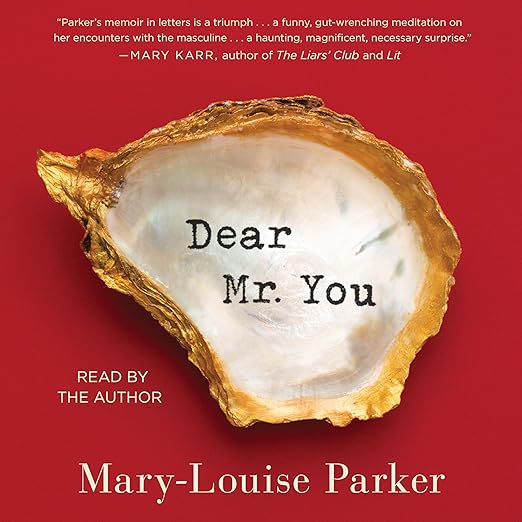
Craft is the right word for what Mary-Louise Parker does in Dear Mr. You. Not craft as a polite compliment for competence, but craft as the specific evidence of a writer who has thought long and hard about what form her material should take before committing a single sentence. The audiobook, which Parker herself narrates across 5 hours and 44 minutes, was a finalist for the 2017 Audie Award for Narration by the Author, and anyone who spends a few minutes with it will understand why. The letters are addressed to men, named and unnamed, real and imagined, beginning with a grandfather Parker never knew, moving through beloved childhood priests, former lovers, a firefighter she encountered briefly, and the uncle of the infant daughter she adopted. Together they compose something more interesting than a conventional memoir: they compose the story of how a woman understands herself through the men who were present and absent in her formation.
Reviewers describe it as "warmly conspiratorial," "funny, heartbreaking and profound," and "brilliant, poignant, and masterful." One early reader sat down and ordered five copies for gifts after ten pages, a gesture of conviction that says more than a five-star rating. Another came to it skeptically, found the unconventional form strange at first, and then could not stop. That arc, initial strangeness giving way to absorption, tracks the experience of most readers who engage with the book honestly. The book carries a 4.3 rating across nearly 880 listeners, a meaningful signal given how unconventional its structure is.
Self-Narrated and Read as Gift, Never Obligation
What Parker achieves here is difficult to name in the vocabulary of conventional memoir because the book does not work the way conventional memoir works. It is not chronological. It does not build toward revelation. It does not arrive at a tidy personal reckoning. Instead it accumulates, letter by letter, a portrait of a life that gains its dimensionality not from narrative momentum but from the quality of attention Parker brings to each relationship, however brief. A letter to a firefighter she observed for a few minutes on a New York street is as fully inhabited as a letter to a former lover who occupied years of her life. That evenness of attention, the refusal to rank relationships by their duration or their apparent significance, is one of the book's defining formal choices and its most resonant ethical position.
Parker the narrator is inseparable from Parker the writer here, and that inseparability is the audiobook's central argument for itself. Her voice is dry and warm in equal measure, with precise comedic timing that keeps the more painful letters from tipping into sentimentality. She reads as though she is telling you something for the first time rather than performing something she has rehearsed, which is the hardest thing a narrator of their own work can achieve. The Audie nomination recognizes exactly this quality: there are self-narrated audiobooks that feel like obligation, and there are ones that feel like gift, and Dear Mr. You is unambiguously the latter.
Her Hesitations and Pauses Are Part of the Text
The audiobook of Dear Mr. You is the version to choose because of what Parker's self-narration adds to the already substantial pleasures of the prose. Reading the text on the page, you encounter a writer of unusual precision and formal daring. Listening to Parker perform her own letters, you encounter something closer to the lived experience she is describing. Her hesitations and emphases are part of the text. Her comedic pauses land in ways that a skilled third-party narrator could approximate but not replicate. This is one of those cases where the audio format is not simply a convenient alternative to print but a distinct artistic experience.
At 5 hours and 44 minutes, the collection is also the right length for immersive listening. The letters vary in tone and register enough to prevent monotony while maintaining the unifying thread of Parker's distinctive voice. Some are formally elaborate. Some are devastatingly brief. The variation is deliberate, and it keeps the listening experience alive across the full runtime. There is no padding here: every letter earns its place, and the cumulative effect is of a life rendered in unusual depth through what, on the surface, is an unusual constraint.
Connection Out of Absence, Starting With Her Grandfather
The structure asks something of the listener that chronological narrative does not. Because the book is organized by relationship rather than by time, there is no conventional plot to follow, no single arc that carries you forward. Some listeners who need narrative momentum to remain engaged may find themselves doing more work than they expect. The rewards are real, but they require a kind of lateral attention rather than forward motion. Parker is a writer who trusts that the depth of a single letter justifies stopping there, and listening at that pace takes some adjustment if you are accustomed to story-driven memoirs.
The letter to the grandfather she never knew, which opens the collection, is worth particular attention as an example of what Parker does throughout: she addresses someone across an unbridgeable gap without self-pity, creating connection out of absence. If that letter grips you, the rest will too. If it leaves you unmoved, the book may not be your frequency. The letter to the uncle of her adopted daughter is among the most structurally daring, and the letters to former lovers are notable for their refusal to settle accounts or perform forgiveness neatly. Parker is interested in the truth of what these relationships were rather than in the satisfaction of resolving them.
For Readers of Jo Ann Beard and Maggie Nelson
This audiobook will find its ideal listeners among people who value literary prose as much as personal revelation in memoir, who have some tolerance for unconventional structures, and who find the question of how the men in a woman's life shape her self-perception genuinely interesting rather than merely polemical. Fans of Parker's acting work who are curious about her as a writer will find the transition disorienting in the best way: this is not a celebrity memoir. It is a serious literary document by someone who happens to also be a well-known actress. Readers who loved Jo Ann Beard's The Boys of My Youth or appreciated Maggie Nelson's more formally experimental memoirs are the most natural audience for what Parker has made here.
At a Glance
- Read by: Mary-Louise Parker reading her own letters is the entire point and the entire achievement. Her voice carries decades of hard-won self-knowledge, and no other narrator could have served this material.
- At its heart: Memory and identity, the men who shape women's lives, grief and gratitude
- Vibe: Intimate and literary, by turns funny and devastating
- Short version: A memoir structured as correspondence that achieves genuine literary distinction, particularly in the audio format where Parker's voice makes every letter feel like a confidence shared in person.