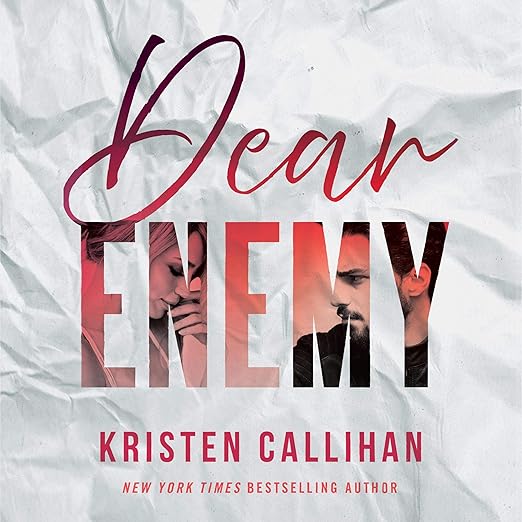
Macon Saint's name is a deliberate irony, and Kristen Callihan introduces it early. In this audiobook of Dear Enemy, narrated by Maxine Mitchell across nearly twelve hours, the antagonist of Delilah Baker's childhood grows up to become a rising Hollywood star, and Callihan uses that transformation not as a romantic shortcut but as genuine narrative pressure. The setup is familiar enough: enemies-to-lovers, childhood history, a contrived domestic arrangement. What distinguishes the execution is that Callihan is genuinely interested in why these two people disliked each other, not merely in the obstacles between them and a satisfying resolution.
Is Dear Enemy Worth Your Time?
The catalyst is deliberately unglamorous. Delilah's sister Samantha has stolen a valuable heirloom from Macon, a man Samantha once dated and who already has reason to distrust the family. Rather than a grand romantic collision, the reunion is built on theft, obligation, and a class dynamic that neither character can entirely ignore. Macon's wealth and fame place him in a position of structural power regardless of how their personal history reads, and Callihan handles this honestly. She does not pretend that the power imbalance vanishes because the attraction is real, and Delilah's insistence on maintaining the terms of their arrangement even as the emotional temperature rises is written with psychological consistency that the genre does not always bother to provide.
One reviewer notes that they typically avoid storylines where the hero has been in a relationship with the heroine's family member, and found themselves surprised by how effectively Callihan sidestepped the usual awkwardness. The Samantha connection is backstory, not active plot, and Callihan uses it primarily to establish why trust is the actual obstacle rather than simple attraction. Another reviewer finished the book in one sitting despite not usually having patience for slow burns, which is a reasonable gauge: if you can tolerate deferred payoff when the character writing is strong enough to fill the space, this holds sustained attention. The relationship between Delilah's personal dignity and her financial desperation is particularly well-handled - she needs Macon's money, and the novel acknowledges that tension without resolving it through convenient plot turns that would let both characters off the hook.
The Best Parts of Dear Enemy
Maxine Mitchell's performance is the primary reason to choose the audiobook over text. Delilah's voice on the page is dry and self-deprecating in ways that can read as deflection, but Mitchell's timing converts those qualities into a specific kind of emotional intelligence: you understand that Delilah knows exactly how much she is protecting herself, and why. The kitchen sequences, where Delilah works as Macon's personal chef, are the novel's best-written material and Mitchell's delivery in those scenes carries the intimacy that Callihan is building toward without rushing it.
At eleven hours and fifty-two minutes, the pacing requires patience from the listener. The couple does not get together until roughly the eighty percent mark, and that delay is real. For listeners who need narrative momentum maintained through constant incident, this may read as slack. For listeners who want character study with romance as the destination rather than the engine, the proportion is correct and the extended setup pays off fully. The audiobook format suits this material particularly well because Mitchell's vocal performance keeps you emotionally present even in the quieter chapters where Callihan is laying groundwork rather than advancing the central relationship. The transition when Macon's defenses finally come down registers as earned rather than convenient because Mitchell has tracked his resistance across nearly nine hours before it changes.
Before You Commit to Dear Enemy
Pay close attention to the scenes involving Macon's relationship with fame. Callihan is careful to show that the Hollywood success is recent and still unfamiliar to him - he has not yet learned how to let it define him, which is part of why Delilah's complete indifference to his status reads as revelatory rather than performative. The heirloom subplot, which initiates the entire arrangement, resolves in a way that rewards the listener who paid attention to what the object means to Macon beyond its monetary value. Callihan plants that information early and returns to it with purpose, and the resolution lands differently depending on how closely you tracked its significance in the early chapters.
The family dynamics on Delilah's side deserve attention too. Her mother's fragile health and her complicated relationship with the absent Samantha provide the genuine stakes that motivate Delilah's choices throughout, and the novel is careful not to resolve those complications neatly alongside the romance. The ending satisfies the romance expectations but does not pretend the family history has been healed, which is a sign of craft rather than incompletion.
Who Should Pick Up Dear Enemy
Romance listeners who want enemies-to-lovers with psychological texture rather than pure banter mechanics will find this rewarding. If slow burns with strong character foundations rather than constant will-they-won't-they incident are your preferred mode, the pacing is correct for you. Callihan's New York Times bestselling track record means the craft is reliable - the dialogue is sharp and the emotional beats are properly sequenced. Skip it if you need faster romantic payoff or if you find the setup of the chef-employer arrangement too contrived to sustain over nearly twelve hours. This is not a comedic romp despite its witty surface; it takes both characters seriously, which is its real appeal and the source of both its strengths and its deliberate pace. Mitchell's performance earns the length, and Callihan's resolution respects the work that preceded it.
Before You Listen
Is Dear Enemy a standalone audiobook, or do I need to read other Kristen Callihan books first?
It is fully standalone. Delilah Baker and Macon Saint are self-contained characters with no required prior series reading, so you can start here without any existing Callihan context.
Does Maxine Mitchell narrate the entire audiobook, or does it switch between male and female narrators?
Maxine Mitchell handles the full audiobook as a single narrator. The story is told from Delilah's first-person perspective, so the single-narrator format fits the material naturally and Mitchell maintains it consistently across nearly twelve hours.
What makes this audiobook different from other enemies-to-lovers romance titles?
Callihan grounds the enmity in a specific family dynamic rather than a vague shared history - Macon dated Delilah's sister, there is a theft involved, and the power imbalance created by his Hollywood success is acknowledged rather than ignored. The emotional work is done through character consistency rather than manufactured obstacles, and the resolution respects the complications it set up.