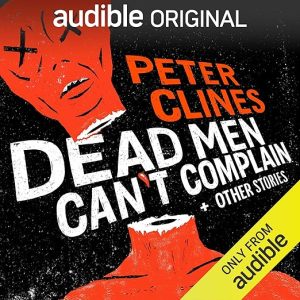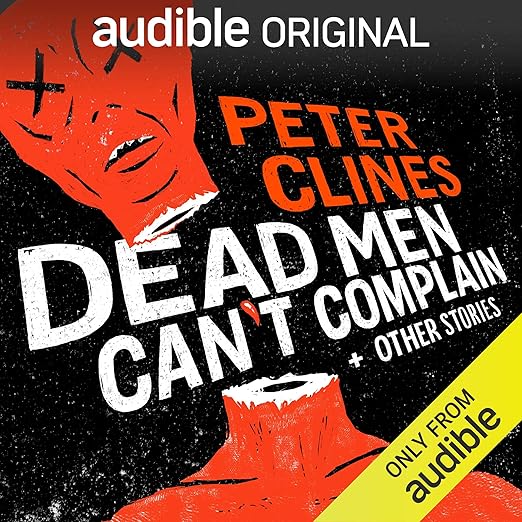
A suspect in a lizard costume sits across an interrogation table insisting the scales are real, and the detective on the other side isn't sure he's wrong. That opening scenario belongs to just one of the stories packed into this audiobook, Peter Clines' first collection of short fiction after more than a decade of novels including 14 and The Fold. At four hours and fifty-four minutes, it's a compact listen, but Clines uses the space efficiently, cycling through an all-powerful superhero managing a city that both needs and resents him, an ordinary man discovering that being undead comes with none of the perks folklore promised, and several other premises built on the same geek-culture instincts that made his longer books memorable.
What holds the collection together isn't tone consistency, since Clines swings from horror to comedy to something closer to melancholy within a single story, but a recognizable sensibility: a writer who treats genre conventions as raw material to be picked apart rather than reproduced. Three of the stories here have never been published before, which gives longtime readers a real reason to listen even if they already own his novels, and the shorter format works to the book's advantage. A weak premise in a Clines novel has four hundred pages to wear out its welcome; here, if a concept doesn't land, the next story is only minutes away.
The tradition Clines is working in here has real precedent. Stephen King's Night Shift and Skeleton Crew proved decades ago that a novelist's short fiction can function as a kind of writer's laboratory, a place to test ideas too strange or too small for a full novel, and Dead Men Can't Complain reads the same way. The superhero story in particular stands out for how little interest it has in origin-story mechanics; it drops listeners straight into the exhausting logistics of managing a city that alternately worships and resents its protector, which is a more interesting question than how he got his powers in the first place.
What Peter Clines Gets Right
Ralph Lister narrates the full set, and the range required is bigger than it looks on paper. He has to sell a jaded cop's interrogation-room skepticism, then pivot to a superhero's public-facing authority, then find the specific deadpan confusion of a man who wakes up undead and has to figure out the logistics before he can process the existential part. Lister keeps a dry, slightly weathered voice as his baseline across all of it, which suits Clines' sense of humor better than a narrator who tried to differentiate the stories with big vocal swings would. The comedy in these stories works because it's delivered straight, and Lister understands that instinctively.
Reviewers single out 'Skin Trade' and 'The Contraption' as favorites, and both benefit from Lister's pacing, which never rushes a punchline or lingers on a twist longer than it needs to. For listeners who've read Clines' novels, hearing his voice compressed into short fiction is its own pleasure, since the ideas that might get a full subplot in 14 show up here as a complete story in twenty minutes. For anyone new to him, this collection works as a low-commitment audition, four and a half stars from a small but consistent group of raters suggesting the experiment paid off.
The format also suits how a lot of people actually listen. Individual stories run short enough to fit a single commute or a lunch break, which makes this a practical pick for listeners who struggle to find hour-long blocks for a novel but can regularly find twenty minutes. That structural flexibility is easy to undersell, but it's a real point in the collection's favor for anyone whose listening habits are more fragmented than a single sustained novel accommodates.
Where Peter Clines Loses Some Ground
Short story collections ask something different of a listener than a novel does, and it's worth being honest about that going in. No single arc carries you from the first story to the last, so if you're the kind of listener who needs momentum built across hours rather than delivered fresh every twenty minutes, this format may feel choppier than you'd like. One reviewer, posting from Fantasy Literature, notes that no print edition of this collection existed at the time of writing, which means audio is currently the only way in for some of these stories. That's a plus for audiobook-first listeners and a minor frustration for anyone who prefers to reread favorites on the page.
The tonal whiplash mentioned above cuts both ways. If you came for the horror premise about the interrogation-room suspect, the next story's superhero-management comedy might feel like a hard turn, and the story after that leans into something closer to pathos around the undead protagonist's disappointment. None of this is a flaw exactly, since variety is the entire premise of a short story collection, but listeners expecting the sustained, single-genre commitment of a Clines novel should recalibrate their expectations before pressing play.
A practical value question is also worth raising directly. At under five hours, this audiobook costs roughly the same as many full-length novels on a per-hour basis, which may give budget-conscious listeners pause even though the density of ideas per minute is genuinely high. Listeners who track cost against runtime closely might want to wait for a sale rather than treating this as an obvious day-one purchase, even as fans of the author will likely find the previously unpublished material worth the price on its own.
Who Should Pick Up Dead Men Can't Complain and Other Stories
This audiobook is built for two overlapping audiences: readers already invested in Peter Clines who want new material while waiting on his next novel, and curious newcomers who'd rather sample his sensibility in small doses than commit to a full-length book first. Both groups get real value here, especially the three previously unpublished stories that even completists haven't encountered elsewhere.
Listeners who want a traditional narrative arc, or who find short fiction inherently less satisfying than a novel's slow-building payoff, may want to start with 14 or The Fold instead and treat this collection as a supplement rather than an entry point. But for anyone who enjoys genre fiction that mixes horror, humor, and superhero conventions without picking one lane, and who has under five hours to spare, Dead Men Can't Complain and Other Stories delivers exactly what it promises, with Ralph Lister's narration holding the whole patchwork together.
In Brief
- Narrator: Ralph Lister shifts fluidly between deadpan horror, superhero bombast, and confused undead comedy without losing Clines' dry wit.
- Subjects: genre-blending short fiction, superheroes and horror-comedy, the undead as reluctant everyman
- Tone: Playful and a little macabre
- Bottom line: A tight, funny introduction to Peter Clines for new listeners and a treat for longtime fans missing his novels.