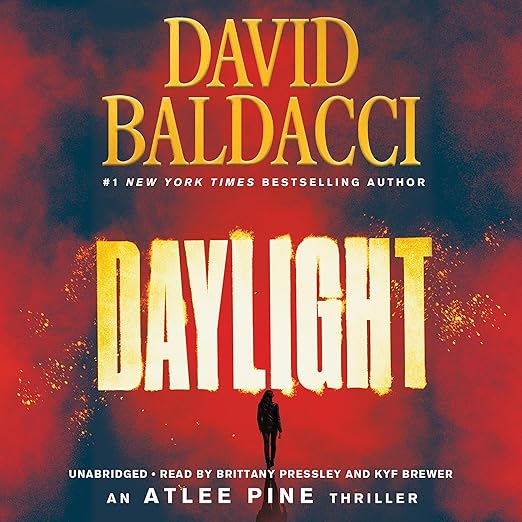
I came to Daylight having listened to the first two Atlee Pine books back to back during a particularly long week of travel, which turned out to be the right way to consume what is essentially an extended serial. David Baldacci builds his series the way a showrunner builds a prestige drama: each installment solves a case while advancing a longer arc, and the longer arc is the thing that keeps you coming back. By the end of A Minute to Midnight, the second book, I was genuinely invested in Pine's search for her sister Mercy. Daylight is where that investment starts to pay off.
The setup here is compact and clever. Atlee Pine, FBI Special Agent, has been pursuing leads on her twin sister Mercy's childhood kidnapping for two previous books. Just as she is pressured to close the investigation, she gets her most promising lead yet: the identity of the kidnapper, a man named Ito Vincenzo. She and her assistant Carol Blum track him to Trenton, New Jersey, where they accidentally blow the arrest of John Puller, a military criminal investigator from Baldacci's other series, who is working a drug ring case involving a military installation. The two investigations turn out to be connected, through Vincenzo's family and a conspiracy that reaches into the machinery of global democracy.
The crossover structure between the Atlee Pine and John Puller series is a bold move that could easily feel like a marketing exercise but actually serves the story. Puller and Pine are both driven, methodical investigators with their own obsessions, and the collision of their cases creates genuine narrative friction. Baldacci is good at designing conspiracies that start local and end global without the scale shift feeling unearned, and Daylight is a strong example of that skill. The drug ring that Puller is investigating connects to the kidnapping that defines Pine's life in a way that feels like craft rather than convenience.
One reviewer praised the book as "phenomenal" and broke down its achievements across plot, character development, and pacing. Another offered a more measured assessment: three books in, Mercy still has not been found, and the series requires patience. Both reviews are honest about what the book delivers and what it withholds. Daylight does move the Mercy investigation significantly, the reviewer who called it frustrating acknowledges that it provides the most promising breakthrough yet, but it does not provide complete resolution. The truth about Mercy that Pine discovers at the end is described as shocking. It lands hardest for listeners who have been with the series from the beginning.
The Best Parts of Daylight
Brittany Pressley has been the narrator for the Atlee Pine series throughout, and her consistency is an asset. She has found Pine's voice, determined, controlled, occasionally furious, and maintained it across three books. The emotional work in Daylight is heavier than in the previous installments, because Pine is closer to the truth she has been chasing for decades, and Pressley handles that weight without melodrama. She also manages the Puller sections without losing Pine's register, which requires some flexibility given that Puller operates with a different kind of authority.
At 11 hours and 37 minutes, Daylight is a substantial listen, but Baldacci's plotting keeps the pace tight. There is very little here that does not serve the story. Reviewers who encourage readers to start with Long Road to Mercy and work forward are correct, the accumulated emotional weight that makes Daylight's revelations hit properly is built across two prior audiobooks.
Before You Commit to Daylight
The global conspiracy element, the scheme that "strikes at the very heart of global democracy," in the synopsis's language, is deliberately vague in promotional material, and that vagueness is probably appropriate. It involves political institutions and reaches beyond the localized crimes that open the book. For some listeners this scaling ambition is part of what makes Baldacci exciting; for others it is the moment a thriller starts to feel like it is working too hard to justify its own scope. The conspiracy here is more plausible than most, and Baldacci does not use it to overwhelm the personal story that actually matters.
This is genuinely a series in which reading order matters. A reviewer notes that readers are encouraged to start with Long Road to Mercy to "fully appreciate the developing tale of Atlee Pine." The Puller series crossover adds another layer, familiarity with that series is not required but enriches the Puller sections considerably.
Should You Listen to Daylight?
This is for listeners already committed to the Atlee Pine series who want the next chapter. It is also accessible to Puller series fans who are curious about the crossover, though they will be coming in mid-arc on Pine's story. New Baldacci readers should start with Long Road to Mercy, Daylight's emotional payoff is built on investment that requires those earlier books. For existing fans, this is the installment the series has been building toward, and Brittany Pressley's narration delivers its revelations with the gravity they deserve.
Before You Press Play
- Read by: Brittany Pressley is a reliable anchor for the Atlee Pine series, managing the cross-series intersection with Puller's storyline without losing Pine's specific emotional register.
- At its heart: Obsessive search for a missing twin, the intersection of personal trauma and institutional power, global conspiracies behind small-town crimes
- Vibe: Relentless and plot-driven, with emotional stakes built across three books
- Short version: A satisfying third-series installment that finally moves the Mercy search meaningfully forward, though the payoff is most meaningful for listeners who have done the prior work.
Do I need to read the John Puller series to understand Daylight, or is the crossover self-contained within this book?
Familiarity with the Puller series is helpful but not required. Baldacci introduces Puller adequately for new readers. The crossover is self-contained enough that Pine series fans who have not read the Puller books will follow the story without major gaps, though they will miss some of the resonance in Puller's specific character history.
Does Daylight finally resolve the question of what happened to Mercy, or does it end without full closure?
Daylight provides the most significant revelation yet about Mercy's fate and represents a genuine turning point in the search. The synopsis promises a truth that shocks Pine to her core. However, full closure is not reached, the series continues in subsequent books. The payoff here is substantial but not final.
Is Brittany Pressley's narration consistent with the previous Atlee Pine audiobooks?
Yes. Pressley has narrated the Atlee Pine series from the beginning, and she returns for Daylight with the same established voice for Pine. This consistency is frequently praised by series listeners as one of the reasons the audio format works particularly well for this series.
What is the global conspiracy in Daylight about, and does it overwhelm the personal Pine storyline?
The conspiracy involves Vincenzo's family and a scheme with far-reaching political implications, though the specifics are intentionally not revealed in advance promotional material. Reviewers who praise the book consistently note that Baldacci keeps the personal story, Pine's search for Mercy, primary, with the global threat serving as the structural frame rather than the emotional center.