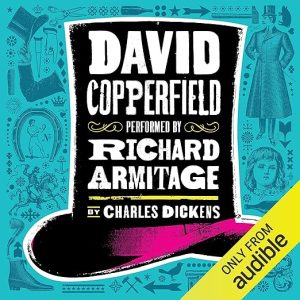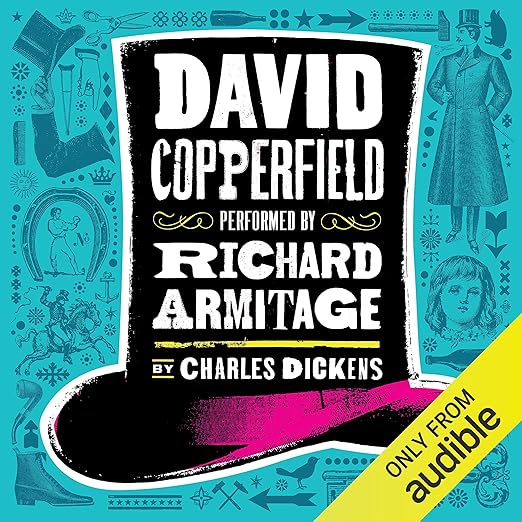
Before You Press Play
- Narrator: Richard Armitage inhabits each character with a distinctiveness and physical commitment that sets this recording apart from virtually every other available version of Dickens's semi-autobiographical novel.
- Subjects: The formation of character through suffering and observation, the comic grotesque as moral indicator, memory as the medium through which identity is constructed
- Tone: Epic and emotionally expansive, with Dickens's full tonal range from broad comedy to genuine grief given equal weight
- Bottom line: The definitive audiobook recording of David Copperfield, earning its thirty-six-plus hours through a performance that makes every chapter feel essential.
Richard Armitage's performance of Charles Dickens's David Copperfield is one of those audiobook recordings that functions as a genuine artistic argument: not simply a competent rendering of a canonical text but a reinterpretation that reveals dimensions of Dickens's prose that even close readers may not have fully accessed on the page. This audiobook runs thirty-six hours and thirty minutes, and Armitage, best known to many listeners from his roles in The Hobbit and Hannibal, brings the same physical commitment to his vocal performance that a film actor brings to a role. His reputation among audiobook listeners was established through his 2014 recording of Hamlet, Prince of Denmark, recognized as one of Audible's most celebrated narrator performances of that year, and this Dickens recording demonstrates the full range of what that approach can achieve across an epic prose fiction.
Dickens described David Copperfield as his favorite child among his novels, and the semi-autobiographical nature of the book makes that preference legible on every page. The novel chronicles David's journey from an abused child in the Murdstone household through a series of formative encounters, with Peggotty's fierce loyalty, with the eccentric grandeur of Aunt Betsey Trotwood, with Micawber's magnificent improvidence, and with the odious Uriah Heep's calculated abasement. These are among the most fully realized characters in English fiction, and Armitage differentiates each of them with a specificity that goes well beyond the vocal variety most narrators provide. His Uriah Heep is genuinely unsettling, a character rendered in a register of insinuating softness that makes the malice underneath it more disturbing than theatrical villainy would. His Micawber captures the magnificent self-delusion of a man always waiting for something to turn up without tipping into caricature, preserving the dignity that makes Micawber comic in Dickens's sense rather than merely ridiculous. Virginia Woolf called David Copperfield the most perfect of all Dickens's novels, and one reviewer who tackled the book in a week described reading through the middle of the night willing David's success and happiness. That response speaks to the novel's particular power: it is the rare Dickens in which the protagonist's growth is the central organizing intelligence rather than the plot machinery. Armitage understands this and plays David at every age with appropriate interiority, so the novel's movement from childhood suffering to adult self-knowledge feels like a genuine bildungsroman rather than a sequence of picaresque episodes connected by shared incident. The emotional range the performance demands across thirty-six hours is extraordinary, from the genuinely funny Micawber scenes to the devastating turns involving the Peggotty family, and Armitage meets each register fully.
Why Listen to David Copperfield
The case for listening to this novel rather than reading it is the same case that applies to all of Dickens: his prose was serialized for an audience that received it in installments, read aloud in many households, and designed with performative qualities that the human voice reveals more completely than silent reading. The comedy of Micawber, the grotesquerie of Heep, the warmth of Peggotty: these effects are better in performance because Dickens calibrated them for a listening audience. Armitage does not simplify that complexity; he amplifies it. At thirty-six and a half hours, this is not a casual commitment, but the structure of the novel rewards long listening over multiple sessions rather than marathon consumption, and each return to the audiobook carries the pleasure of rejoining a world that feels more real than most fiction achieves. Listeners who have read the novel in print and wondered whether the audio version adds anything should know that Armitage's character work in particular will reveal dimensions of Heep and Micawber that silent reading tends to flatten. The comparison to his Hamlet recording is instructive: where the Hamlet demonstrates Armitage's command of verse, this Copperfield shows what he can do with Dickens's highly rhetorical prose, sustaining the performative quality of the original across a runtime more than six times the length of that earlier work. The longevity of his engagement with the material never flags, and the later sections of the novel, particularly the chapters following David's marriage and his professional emergence, sustain the same energy as the celebrated childhood passages.
What to Watch For in David Copperfield
Armitage's management of the comic grotesque is the most technically demanding aspect of the performance and the most rewarding to follow. The challenge with Dickens's grotesque characters is that they become cartoons if over-performed, losing the human texture that makes them morally resonant rather than merely funny. Armitage resists that temptation throughout. His Micawber never loses his dignity even at his most absurd; his Heep never becomes simply evil when he is also clearly afraid. The Dora chapters, which some readers find the weakest section of the novel, are handled with enough tenderness that Dora's limitations land as a genuine loss rather than an authorial convenience. The Agnes subplot, which has divided critical opinion since the novel's publication, is treated respectfully; Armitage does not editorialize toward any critical consensus about her. The Peggotty sequences, particularly the devastation of Emily's story, are where Armitage's emotional range is most fully tested and most fully realized.
Who Should Listen to David Copperfield
Anyone who has been waiting for the right way into Dickens's longest and most personal novel will find this audiobook the most compelling available entry point. Readers who loved the novel in print and want to encounter it again through performance will find Armitage's interpretation adds rather than substitutes. Those who have found Dickens's prose density difficult on the page may find that Armitage's vocal guidance through the novel's tonal shifts makes the material considerably more accessible. The thirty-six-hour commitment distributes naturally over many sessions; this is a novel that rewards long-term listening rather than binge consumption. Skip this recording only if you have a strong prior attachment to another specific narrator's version; for anyone open to Armitage's approach, this is the recording against which others should be measured.