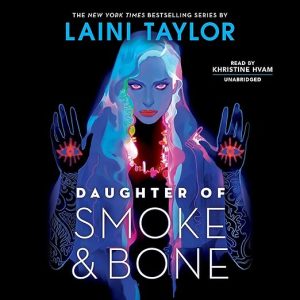
At a Glance
- Read by: Khristine Hvam's performance is the backbone of this audiobook, her voice for Karou has a wry, restless energy that perfectly captures a girl who has always known she doesn't fully belong anywhere.
- At its heart: Identity and origin, forbidden love across enemy lines, the cost of war on both human and chimera alike
- Vibe: Strange and luminous, with a slow-burn dread underneath
- Short version: Laini Taylor's writing is ornate and unrepentant about it, and Hvam's narration honors every sentence without tipping into melodrama.
Prague itself felt like a character the first time I heard this audiobook, the cobblestones, the archways, the sense that something old and dangerous breathes behind the city's beauty. Laini Taylor uses the city not as backdrop but as atmosphere, and Khristine Hvam delivers it all with a voice that carries weight without announcing itself. I was twenty minutes in before I realized I'd stopped reading the screen and was simply somewhere else. This is what the audiobook format can do at its best: place you so completely inside a fictional world that the transition from everyday life to Prague feels seamless.
The series opens with a deceptively simple image, black handprints scorched onto doorways around the world, left by winged strangers passing through a crack in reality. Taylor plants this image quietly, then builds outward from it with patience. The reveal of what Karou actually is doesn't come cheap or fast, and the audiobook rewards listeners who don't rush. The first third of the book is essentially a love letter to strangeness, to the idea that a girl can grow up in a shop built of bone and shadow, speaking languages not spoken by humans, and still have homework, a jealous ex-boyfriend, and a best friend who asks no inconvenient questions. That combination of the mundane and the impossible is what Taylor manages with unusual precision.
Why Listen to Daughter of Smoke & Bone
Karou is not a passive protagonist who discovers she's special and waits for others to explain it to her. She speaks multiple languages, including some that aren't human. She sketches chimeras in sketchbooks that blend observation and memory. She runs errands for Brimstone, the chimaera who raised her in his shop of teeth and bone, and she doesn't flinch at the strangeness of it because strangeness is all she's ever known. This self-sufficiency is what makes her compelling rather than merely sympathetic.
What Taylor does with the angel-and-devil premise is refuse to make it allegorical. Akiva and Karou don't represent good and evil, they represent two peoples with centuries of blood between them, and the love that forms between them isn't redemptive so much as it is complicated. The backstory, when it arrives, is genuinely earned. Hvam handles the shift in emotional register from the Prague chapters to the revealed history with real skill, modulating pace and tone without losing coherence. The war between seraphim and chimaera has causes that the book traces with care, and the personal history that connects Karou and Akiva to that war is structured so that each revelation deepens what came before rather than contradicting it.
Readers familiar with Tolkien's approach to secondary-world building, establishing rules for how magic and biology interact before deploying them for plot payoff, will find Taylor operating in that same spirit. The taxonomy of seraphim and chimaera feels internally consistent in ways that matter when consequences arrive. Nothing is hand-waved. The tooth trade has an economic logic. The war has causes. The suffering is legible. Hvam's narration carries the lore sections with a naturalness that keeps exposition from feeling like obligation, a considerable achievement in a book this densely constructed.
What to Watch For in Daughter of Smoke & Bone
The prose is ornate. Taylor is not a minimalist, and if you come to this expecting clean, functional sentences, you will either adjust or resist. Hvam's delivery helps, she reads the more lavish passages with conviction rather than irony, which is the correct call. The writing earns its floridity because the world it describes genuinely requires it. A shop built from bone and shadow in a city between worlds needs a certain density of language.
The pacing in the first third is genuinely leisurely. Taylor is world-building, character-establishing, and atmosphere-laying before anything violent happens. Listeners expecting genre-standard action beats in the opening act will have to sit with the slower rhythms of Karou's strange, wandering life. This is not a weakness, it is a deliberate structural choice that makes the pivot to war feel earned rather than sudden, but it is something to account for before you begin. If your patience runs out in the first two hours, the book is probably not for you. If it holds, you will find that everything Taylor established in those opening hours becomes load-bearing later.
One reviewer described the book as leaving traces even after it ends, which is the right description. The ending of this first volume is not a resolution, it is a detonation. Taylor sets up the next book not through cliff-hanger contrivance but through revelations that genuinely reframe everything that came before. On audio, Hvam sells the final emotional beats with restraint, which makes them land harder than they might with a more demonstrative performance.
Who Should Listen to Daughter of Smoke & Bone
Listeners who love fantasy that builds its worlds from the inside out rather than borrowing from familiar templates will find Daughter of Smoke & Bone rewarding at the audiobook format's full 12 hours and 33 minutes. This is a book for readers who don't mind waiting for the central mystery to open up, who trust ornamentation when it serves the material, and who want a love story with actual geopolitical stakes rather than a simple romantic arc. Skip it if prose density frustrates you or if you need narrative momentum from page one. The payoff is real, but it requires investment. This is the first book in a complete trilogy, and the commitment pays compounding returns across all three volumes, something worth knowing before you start the clock.
Questions Listeners Ask
Does the romance dominate the audiobook, or does the fantasy world get equal space?
The world-building holds its own. Taylor is as interested in the mechanics of the chimaera shop, the politics of the war, and the anthropology of how seraphim and chimera societies function as she is in the central relationship. The love story is significant but not the only thing happening.
How does the Daughter of Smoke & Bone audiobook hold up for adult listeners, given that it is shelved as young adult?
Very well. The YA designation applies to the age of the protagonist and the absence of explicit content, not to the complexity of the themes. The book deals with genocide, cultural erasure, and the morality of war with seriousness. Multiple adult reviewers have noted that the trilogy reads more like adult fantasy with a young protagonist than genre YA.