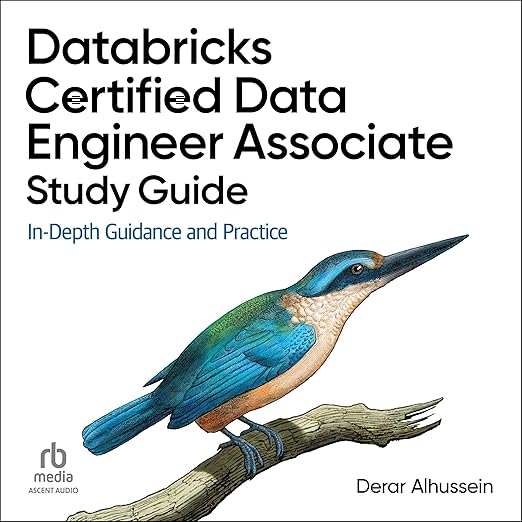
Setting up a Databricks workspace and carrying that skill all the way through to deploying production pipelines is the arc this audiobook promises, and author Derar Alhussein builds it as a direct route to the Databricks Certified Data Engineer Associate exam. Ray Greenley narrates eight hours and thirty minutes covering the Databricks Lakehouse, ETL pipeline development across both batch and streaming workloads, workflow orchestration, and data governance, with a companion PDF available alongside the audio for exercises and mock tests. This is squarely a certification study guide, not a general Databricks overview.
Databricks Traces Back to the Apache Spark Team
The synopsis is specific about scope, and the content follows through on that specificity. Alhussein doesn't just explain what Databricks does conceptually; the book walks through hands-on exercises meant to reinforce each concept, moving from foundational ideas all the way to, in the synopsis's own words, ‘the finer points of exactly what's on the exam’ and how best to prepare for it. That exam-first framing shows up clearly in listener response too. One reviewer, Muhammad Ahsan, praises how the book ‘breaks down complex concepts into digestible, real-world explanations and goes deep where it matters.’ That's precisely the promise a study guide has to keep to justify existing alongside Databricks' own documentation.
Greenley's narration is steady and professional throughout, handling platform-specific terminology, Lakehouse architecture, pipeline orchestration vocabulary, without stumbling over jargon that could easily trip up a less careful reader. His register stays fairly flat and measured, which is the right choice for exam-prep material where clarity matters more than personality. It won't be a memorable performance in the way a narrative audiobook aims for, but that's not really the job here; the job is getting dense technical content across cleanly, and it does that reliably across the full eight and a half hours.
Some industry context helps explain why this specific certification carries weight. Databricks grew out of the team behind Apache Spark, the open-source engine that reshaped large-scale data processing over the last decade, and the platform's own ‘Lakehouse’ architecture, combining the flexibility of a data lake with the structure of a data warehouse, has become a genuinely influential model that competitors have had to respond to. An Associate-level certification in that ecosystem isn't a vanity credential; it signals real, currently marketable platform fluency to employers hiring for data engineering roles. Alhussein's study guide treats that context as given rather than explaining it from scratch, which is appropriate for a book aimed at people already working toward a specific professional credential rather than newcomers exploring the field.
Structure Mirrors the Actual Certification Domains
Another reviewer, posting as astalavista, calls it a ‘very good starting point to learn databricks.’ The same review adds that ‘all code is running properly’ while working through the material. That's a meaningfully specific endorsement for a technical study guide, since broken or outdated code examples are a common complaint in this category. The same reviewer notes the material covers fundamentals clearly even while acknowledging it's ‘just the basics,’ which is a fair, honest description of what an Associate-level certification guide should actually cover.
The book's structure, moving from workspace setup through the Lakehouse, ETL development, orchestration, governance, and finally exam-specific preparation with mock tests, mirrors how the certification itself is likely to test candidates, domain by domain. For listeners already working in or around data engineering who need a structured refresher rather than a first introduction to the field, that domain-by-domain organization makes it easy to jump to a specific weak area rather than needing to work through the whole thing linearly.
The book's own structural promise, moving from an initial environment setup through to a fully deployed pipeline, mirrors the actual on-the-job arc a working data engineer follows, not just an exam syllabus. That's a meaningful distinction for certification content specifically, since guides that only teach to the test without grounding concepts in real deployment workflows tend to produce candidates who can pass an exam but struggle with the actual job. Whether Alhussein's guide closes that gap fully is hard to verify from listener reviews alone, but the stated chapter arc at least reflects awareness that the certification and the job it credentials aren't quite the same thing.
Real Practice Lives Inside the Companion PDF
The companion PDF isn't optional supplementary material here, it's where the hands-on exercises and mock tests actually live. Anyone planning to use this purely as audio, without ever opening the accompanying document, will get the conceptual overview but miss the practice component that turns passive listening into exam readiness. Certification prep specifically benefits from active recall and mock testing, neither of which audio alone can deliver.
It's also worth setting expectations around depth. One reviewer's honest assessment, that it's ‘just the basics,’ is accurate and not a knock against the book so much as a description of what Associate-level content is supposed to be. Data engineers with substantial existing Databricks experience looking for advanced material, deep performance tuning, complex governance edge cases, may find this too foundational, since it's built to get a newer practitioner through a specific entry-level certification rather than to serve as an advanced reference.
Certification Alone Won't Replace Portfolio Work
It's worth remembering, too, that a certification badge alone doesn't guarantee the high demand the synopsis promises translates directly into an offer. Employers hiring for Databricks-specific roles typically want to see the certification paired with actual portfolio work or job experience, not as a substitute for either. This guide is honest about being exam-focused rather than portfolio-building material, which means listeners serious about breaking into data engineering should treat this as one piece of a larger preparation plan rather than the whole plan itself.
Greenley's Unhurried Pace Suits a Commute
Data professionals actively studying for the Associate exam, PDF open on a second screen, are exactly who this is built for. It particularly suits listeners who learn better hearing concepts explained aloud before or after working through the companion exercises, using the audio as a first pass through each domain and the PDF for the actual hands-on reinforcement. Greenley's clear, unhurried pace makes it realistic to listen during a commute and then sit down separately with the practice material.
It's a weaker fit for two different kinds of listeners: total beginners with no data background at all, since the pace assumes some existing technical fluency even while staying at an introductory certification level, and advanced practitioners hunting for material beyond what an Associate-level exam actually covers. For the specific, narrower goal it's built around, passing this particular certification, it's a well-organized, reliably accurate audio companion rather than a general Databricks masterclass.
A Few Questions About Databricks Certified Data Engineer Associate Study Guide
Does this audiobook match the actual Databricks Certified Data Engineer Associate exam content?
According to a reviewer working through the exam prep, the book aligns closely with the real certification domains, moving through the same topic areas the exam itself covers.
Is this audiobook useful for experienced data engineers, or just beginners preparing for certification?
It's built primarily for certification prep at the Associate level, so experienced engineers looking for advanced, beyond-the-exam material may find the coverage more foundational than they need.