The Short Version
- Narration: Virtual Voice AI narration delivers the technical content clearly, though the absence of human inflection makes the drier explanatory passages feel flat in audio format.
- Themes: AI applications in data pipelines, data governance and compliance, practical tooling for beginners
- Mood: Informative and earnest, with broad coverage that trades depth for accessibility
- Verdict: William Leeson's introductory guide gives curious beginners a solid orientation to the data engineering and AI landscape, though experienced practitioners will need to look elsewhere for technical depth.
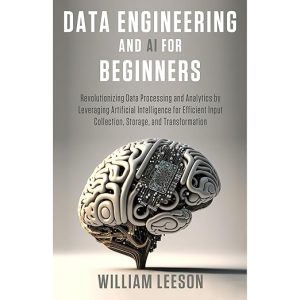
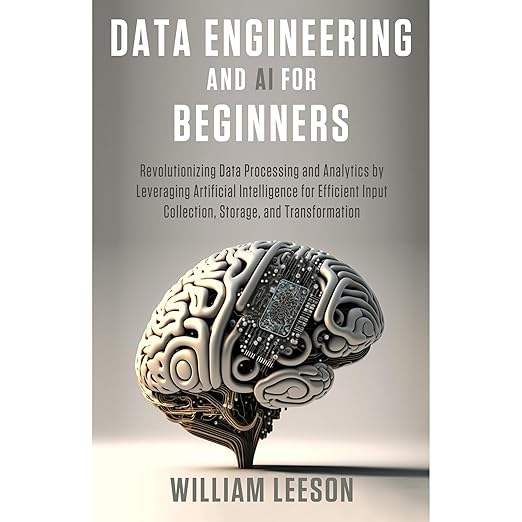
DATA ENGINEERING AND AI FOR BEGINNERS by William Leeson is an audiobook that opens with a premise both strength and limitation: it is genuinely written for people who do not yet know what data engineering is. Part of the World of AI series, narrated by Virtual Voice, and running three hours and fifty-three minutes, the title addresses this directly in its structure, moving from fundamental definitions through to more advanced topics like AI-driven data governance and compliance in a sequence designed to build comprehension rather than assume it. Leeson positions the book as a starting point for learners who want to understand how data and artificial intelligence intersect in real business environments without first needing a computer science degree.
The reviewer Jared captured something important: data engineering in this context is not about creating data or fabricating information. It is about culling, grooming, and preparing existing data so that AI systems can consume it usefully. That distinction, between raw data and data that has been structured for machine learning, is the conceptual core of the book, and Leeson returns to it throughout. He explains data pipelines, data visualization tools, analytics workflows, and governance frameworks in terms accessible to someone approaching the field for the first time, and the audiobook structure follows a pedagogical logic that moves from simpler concepts to more complex ones without demanding prior technical literacy from the listener.
Leeson Writes an Orientation, Skips the Tutorial
The audiobook's approach to its subject is high-level and deliberately broad. Reviewer SojuTX described it as a comprehensive, high-level take that covers AI as it relates to data mining at the conceptual level rather than the technical one. That is accurate, and it is not a criticism so much as a categorization. Leeson is not writing a hands-on tutorial. He is writing an orientation, and for that purpose the audiobook performs its function. If you finish these four hours without knowing precisely how to build a data pipeline but with a clear mental model of what data engineers actually do and how AI fits into that work, the book has done what it set out to do.
The Virtual Voice narration creates a consistent flatness that is worth naming honestly. Technical introductory content benefits from a narrator who can signal to the listener which pieces of information are the structural ones and which are supplementary, through pace, emphasis, and tonal variation. AI narration tends to apply consistent delivery across all levels of information, which means this audiobook requires slightly more active attention from the listener to organize the material internally. Readers who find themselves losing track of the book's argument at certain points may find the narration partly responsible for that slippage.
Leeson's Framing Maps a Terminology-Heavy Field
The strongest argument for this audiobook is its role as a navigational aid. The data engineering and AI space is vast, terminology-heavy, and full of resources that assume significant prior knowledge. For a student, a career-changer, or a professional in an adjacent field who needs to understand what their data team is actually doing, Leeson's introductory framing provides a map of the territory. Reviewer Theodore Faison noted that the book shows how AI can streamline data processing, analytics, and workflow automation in a way that makes complex ideas easier to understand, which is a fair description of what a good introductory text should accomplish for its target reader.
The three-hour-fifty-three-minute runtime is also an asset in this context. A comprehensive technical education in data engineering requires months or years of study. An orientation that helps you ask better questions, understand documentation more readily, and communicate with practitioners more effectively can be accomplished in a few focused hours of audio. That is the realistic value proposition of this audiobook, and it is a legitimate one for the audience it is specifically designed to serve.
Wide Coverage, Shallow on Any One Topic
The book's breadth is its most consistent limitation. Leeson covers a wide range of topics, from data governance and compliance to AI-powered visualization and storytelling, but the treatment of each topic is necessarily shallow given the runtime and the introductory framing. Reviewers with existing technical backgrounds found the book useful as a high-level survey but noted that it does not offer the depth needed to actually implement any of the tools or approaches it describes. If your goal is to write code, design a pipeline, or make technical architecture decisions, this audiobook will introduce the vocabulary but not equip you with operational skills.
True beginners in technology may also find that the book occasionally assumes slightly more baseline familiarity with computing concepts than a complete newcomer might have. Terms like API, data lake, and machine learning pipeline appear in context but are not always fully unpacked before being used in argument. Supplementing the audiobook with additional introductory reading on computing fundamentals may help bridge any gaps for listeners who encounter unfamiliar terminology without sufficient context in the audio itself.
Newcomers Get a Serviceable Four-Hour Investment
This audiobook is well-matched to professionals in non-technical roles who need to understand what their data and AI teams are working on, to students exploring careers in the technology sector, and to curious learners who have heard terms like machine learning and data pipeline and want a coherent explanation of how they connect. Practicing data engineers, ML engineers, or anyone with existing technical experience in the field will find the material too introductory to be useful. The Virtual Voice narration makes it serviceable rather than immersive, so listeners who find AI narration actively distracting should factor that into their decision before committing to the four-hour investment.
Does this audiobook require any prior experience in data science or programming to follow?
Not formally, though some familiarity with basic computing concepts helps. Leeson writes for beginners, but the book does use technical terminology that true beginners in technology may need to look up occasionally. It is best suited to someone who is technology-adjacent rather than completely unfamiliar with digital tools.
Is this audiobook sufficient preparation for a career in data engineering?
No. This is an orientation and survey, not a technical training program. It provides a conceptual framework and vocabulary for the field but does not teach the hands-on skills, programming languages, or platform knowledge that professional data engineering requires. It is a starting point, not a complete curriculum.
How does the audiobook handle the distinction between data engineering and data science?
Leeson addresses this distinction directly, framing data engineering as the infrastructure work of preparing and managing data so that AI and data science applications can use it effectively. The audiobook is clearer on the data engineering side than on the fine-grained distinctions within AI subfields, which it covers more broadly.
Does the accompanying PDF mentioned in the synopsis add significant value to the audiobook?
The synopsis notes that a PDF is available in your Audible Library alongside the audio. For a technical subject like this, the PDF likely provides reference material, diagrams, or supplementary content that would be difficult to convey in audio alone. Accessing it alongside the audio is recommended for learners who want the complete package.