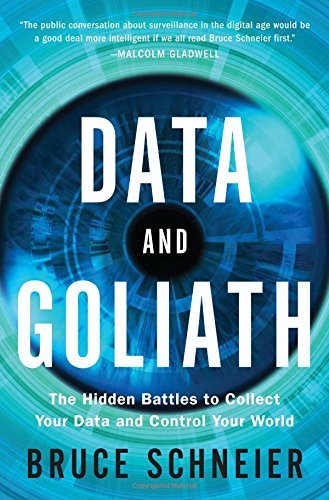
Data and Goliath spends its first chapters resisting the urge to editorialize, letting the sheer accumulation of concrete detail make the case that abstraction alone rarely manages. That patience turns out to be the audiobook's biggest asset: by the time Bruce Schneier pivots from documenting mass surveillance to arguing about what should be done about it, the argument feels earned rather than assumed.
Schneier Structures His Argument Like a Courtroom Lawyer
Bruce Schneier structures his surveillance argument like a courtroom lawyer, starting with evidence pulled straight from your own pocket before he ever mentions policy. This audiobook opens with your cell phone provider tracking your location, your purchase history quietly revealing whether you're unemployed, sick, or pregnant, your emails and texts mapping your entire social circle, before widening out into the corporate and government systems built on exactly that kind of granular personal data. Schneier is a genuinely well-established security technologist, and that credibility shows in how methodically the case builds across nine and a half hours, personal example first, systemic argument second, policy proposal last.
One detail on this listing needs flagging directly: the credited narrator reads 'over 250,' which doesn't resemble an actual person's name at all, more a stray fragment of unrelated text than a genuine production credit, and no way exists to know from here how it ended up attached to this specific title. I won't guess at who actually narrates this edition, since nothing about this particular listing confirms an identity one way or another beyond that garbled credit; if narrator matters to your purchase decision, it's worth checking the listing directly before buying rather than trusting the credit exactly as printed.
A 4.3 average across just over a thousand ratings suggests a solidly well-regarded, if not universally beloved, entry in the privacy and security nonfiction space. That reception sits alongside a text that reads less like a first-time author's untested take on surveillance and more like a specialist's considered synthesis of years of professional expertise, aimed squarely at general readers rather than a narrow technical audience.
Schneier's credibility in this specific field runs deeper than a single book. He co-designed encryption algorithms still used in real security systems, wrote Applied Cryptography, a foundational technical text still referenced decades after publication, and holds a research fellowship at Harvard's Berkman Klein Center for Internet and Society. That background matters for a book making sweeping claims about corporate and government surveillance capability, since Schneier isn't speculating from outside the field about what's technically possible; he's reporting on mechanisms he understands at an architectural level.
How Small Daily Trade-offs Built Mass Surveillance
The specificity is what makes this land harder than a more abstract privacy book would. Facebook inferring sexual orientation without you ever stating it directly, search engines effectively knowing your private thoughts because you've typed them into a box you assumed was neutral, data brokers assembling profiles detailed enough to predict major life events before you've announced them: these aren't hypothetical dangers, they're documented capabilities Schneier walks through methodically, which makes the eventual argument about systemic reform feel earned rather than alarmist.
Schneier's insistence on covering both institutional reform and everyday personal tips is a real structural strength, not just a hedge to please every kind of reader. He argues that mass surveillance is a system built from millions of individual, seemingly reasonable trade-offs, convenience for corporations, protection for governments, and that meaningfully addressing it requires action on both the policy level and the individual level simultaneously. Listeners who want either pure policy argument or pure practical privacy tips will get both here rather than having to choose one book over another.
The book's central reframe, that we've built a mass surveillance society largely through our own accumulated small compromises rather than any single dramatic imposition, is genuinely useful for understanding how normalized this has become. Schneier doesn't let either corporations or governments off easily, but he's equally uninterested in simply blaming users for wanting convenience or safety; that balanced accountability, spread across every actor in the system rather than concentrated on one villain, is part of what keeps the argument feeling honest rather than one-sided.
Arriving After Snowden, Read Before Zuboff
The book's timing also deserves credit on its own terms. Data and Goliath arrived in the wake of Edward Snowden's 2013 disclosures about government surveillance programs, when public appetite for exactly this kind of systemic accounting was at a genuine peak, and Schneier uses that moment productively, treating the Snowden revelations as a starting evidentiary point rather than the whole story, then building outward into the much larger, less headline-grabbing architecture of corporate data collection that receives comparatively little sustained public attention even now.
This book also functions well as an accessible entry point into a conversation that later became more academic and more widely discussed; Shoshana Zuboff's The Age of Surveillance Capitalism arrived several years afterward and covers overlapping territory in far denser, more theoretical terms. Listeners who eventually want that deeper academic treatment will find Schneier's book a genuinely useful on-ramp first, since it establishes the same basic vocabulary and stakes in a more approachable, general-audience register before tackling something more demanding. Schneier's own instinct throughout favors actionable clarity over theoretical elaboration, which is exactly the right register for a first, general-audience encounter with these ideas.
Dated Before Major Privacy Laws, Still Foundational
This book's publication predates a significant stretch of surveillance-technology and policy development; Schneier wrote Data and Goliath in the mid-2010s, well before several major data-privacy regulations and a wave of new surveillance capabilities entered wide use. The core argument, that convenience and security both quietly erode privacy through accumulated small trade-offs, holds up conceptually, but listeners wanting coverage of the current landscape specifically should treat this as a foundational text rather than an up-to-date account of where things stand today.
Beyond the narrator-credit oddity already flagged, this is dense, policy-adjacent nonfiction that assumes some baseline comfort with how digital systems generally work, though not necessarily deep technical expertise. The prose itself stays accessible rather than jargon-heavy throughout, but listeners with zero familiarity with how data brokers, targeted advertising, or basic encryption function may want to look up a few concepts alongside listening, simply because the argument moves quickly once the foundational examples are established.
9 Hours Best Suited to Privacy-Conscious Listeners
This audiobook is a strong match for privacy-conscious listeners, technology policy readers, and anyone who wants a clear-eyed, well-argued case for surveillance reform that doesn't require a computer science background to follow. It also suits readers who appreciate a book willing to offer both systemic critique and concrete personal action rather than leaving you either paralyzed by scale or stuck with only individual-level fixes.
Skip this one if you specifically want coverage of the current surveillance and privacy landscape rather than its mid-2010s foundations, or if the unclear narrator credit on this listing is a dealbreaker for your purchase. Readers wanting a narrower, purely practical guide to personal digital privacy without the systemic policy argument attached should also look for a more specialized, recent title instead.
Good to Know
Is the narrator credit for this audiobook accurate, since the listed name isn't a real name?
No, that credited value does not read like a real name in any recognizable sense. The credit as shown, 'over 250,' looks more like a formatting glitch than an actual narrator's name, so this narrator's identity should be considered unconfirmed until verified directly on the listing.
Is this audiobook still relevant today, given how much surveillance technology has changed?
Its core argument still holds up conceptually, but it was written in the mid-2010s, before several major privacy regulations and newer surveillance technologies existed, so treat it as a foundational text rather than a current-events account.