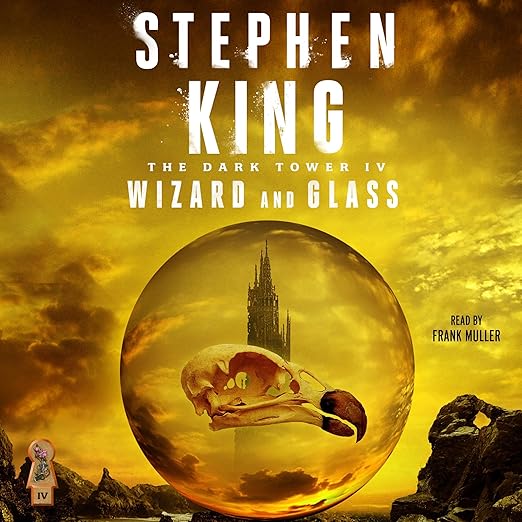
- Voice: Frank Muller inhabits Roland's worn cadence and differentiates a large Hambry cast with the skill that made his early Dark Tower work legendary.
- Big ideas: Doomed first love, destiny and free will, found family under strain
- Atmosphere: Elegiac and romantic, with flashes of Western-inflected political intrigue
- Worth it?: Essential for listeners already three books into the series, even though the extended Hambry flashback will test patience for plot-first fans.
Roland's Hambry Flashback Eats Most Runtime
Wizard and Glass is the book where Stephen King's Dark Tower saga stops moving forward and starts explaining why Roland Deschain can never simply put down his guns. Picking up seconds after Blaine the Mono's riddle contest ends in a fiery crash, Roland, Eddie, Susannah, and Jake find themselves stranded on an alternate-world Interstate 70 outside a Topeka, Kansas devastated by the same superflu that levels civilization in King's The Stand. That crossover is a genuine treat for longtime King readers, but it turns out to be a frame for something else: this audiobook spends nearly two-thirds of its twenty-seven and a half hours on Roland's own telling of his first, doomed love, decades earlier in the seaside town of Hambry.
That structural choice, an epic-length flashback nested inside the ongoing quest, is exactly what divides listener opinion on this entry, and the three reviews attached to this edition capture the split well. One calls it the best in the series so far, another calls it essential backstory for understanding who Roland became, and a third admits the pacing drags even while insisting the book is worth finishing. All three reactions are reasonable responses to the same structural gamble: King trusts his readers to want the tragedy of young Roland and Susan Delgado as much as they want Mid-World's central quest to continue, and that trust pays off unevenly depending on what a given listener came for.
Muller Makes Hambry's Crowded Cast Distinct
Frank Muller narrates, and for listeners who started this series with him, that continuity alone is a significant part of the experience. Muller was among the finest American audiobook narrators of his generation before a 2001 motorcycle accident ended his career, and his work on the early Dark Tower books, this one included, is frequently cited as some of the finest series narration in the genre. He does not perform Roland so much as inhabit the gunslinger's clipped, worn-down cadence, and he differentiates Hambry's ensemble, Susan, Sheriff Avery, the Coffin Hunters, Rhea of the Coos, clearly enough that a genuinely large cast never blurs together across the long runtime.
The Susan Delgado material, once a listener settles into it, is genuinely some of King's best romantic writing: a forbidden courtship complicated by Susan's promised marriage to Mayor Thorin, political conspiracy involving John Farson's rebellion, and the seeing-sphere called Maerlyn's Grapefruit that gives the book its title through the Wizard of Oz echoes running underneath the whole Mejis sequence. Listeners who enjoy King's small-town political intrigue, the kind found in Needful Things or Under the Dome, will recognize the same instinct for petty local corruption metastasizing into something worse, transplanted here into a fantasy-Western setting.
The Wizard of Oz parallels running through the Mejis sequence, the glass palace, the wizard behind the curtain, Maerlyn's Grapefruit standing in for the ruby slippers as an object of both wonder and danger, reward listeners who catch them without requiring that knowledge to follow the plot. King layers his influences the way he does throughout the series, openly and without condescension, trusting readers to enjoy the recognition rather than needing it explained. It is the kind of detail that rewards a second listen more than a first, once the emotional outcome of Susan's story is already known to the listener.
Later Books Swap Muller for Guidall
This is not an entry point. Wizard and Glass assumes a listener already invested in Roland's ka-tet after three prior audiobooks, The Gunslinger, The Drawing of the Three, and The Wastelands, and it opens mid-crisis with Blaine's riddle contest resolution, offering almost no reorientation for anyone arriving cold. Starting here would strip both the emotional stakes of the frame story and the payoff of finally learning why Roland is the man he is. Series order matters more for this volume than almost any other in the saga.
The pacing critique in the reviews is fair and worth naming directly: the Hambry flashback runs long, and listeners eager to return to Roland, Eddie, Susannah, and Jake's present-day quest will feel the delay. King telegraphs Susan's fate early, which drains some suspense from the middle stretch even as it deepens the tragedy's inevitability. Listeners who found The Wastelands' momentum thrilling should brace for a markedly different rhythm here, closer to elegiac historical romance than the pursuit-driven fantasy of the earlier volumes in the series.
Listeners continuing the series afterward should know that later Dark Tower installments were narrated by other voices after Muller's accident, most notably George Guidall, so the transition in the sound of Roland's world is a real adjustment worth anticipating rather than a surprise partway through book five. That is not a criticism of either narrator, but continuity-sensitive listeners sometimes find the shift jarring after four books of Muller's specific interpretation. Knowing that change is coming ahead of time makes it easier to appreciate Guidall's later work on its own terms rather than measuring it purely against what came before it.
Essential for Anyone Already Three Books In
Existing Dark Tower listeners who have finished the first three books should absolutely continue here; this is where the series' emotional architecture locks into place, and skipping it would leave Roland's later choices underexplained. Fans of King's genre-blending instincts, Western tropes threaded through epic fantasy with horror-novel political corruption, will find this the most purely enjoyable structural experiment in the saga. Anyone who loved the Blaine the Mono riddle sequence and wants more of King at his most playful should know that playfulness returns in force once the Topeka framing resolves.
Skip ahead, or skip this one, if unresolved cliffhangers and slow-burn tragedy frustrate you more than they intrigue you; the Hambry material asks for patience its predecessors did not. Listeners exclusively chasing plot momentum toward the Tower itself may find themselves impatient here in a way the first three books never provoked. For nearly everyone else already this deep into Roland's ka-tet, though, Wizard and Glass, Muller's narration included, is close to essential listening.