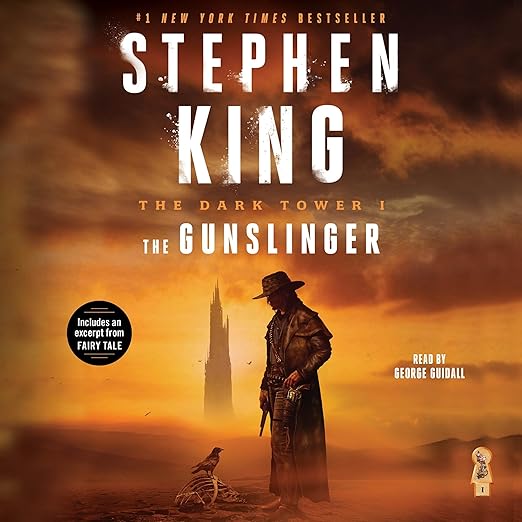
Stephen King is one of the most famous writers alive and one of the most reliably miscategorized, a point the oldest posting on this page makes more efficiently than most criticism manages. Written in April 2012, it notes that King gets called the Master of Horror while very few of the books can actually be classified as horror at all. This listing tags the audiobook Horror. The book underneath that tag is a lean seven-hour quest novel about a gunslinger crossing a desert in pursuit of a man in black, and anyone arriving for scares will spend the first hour recalibrating.
Roland's Quest Borrows Browning's Poem Title
Roland of Gilead is the last gunslinger, and the copy calls him a haunting figure, a loner on a journey into good and evil through a desolate world that mirrors our own in frightening ways. What the description leaves out is the register. This is a Western built in the shape of a grail quest, far more interested in withholding than in explaining, and a listener is expected to work out the rules of the place by inference. Roland tracks the man in black, meets a woman named Alice, and falls in with a boy from New York called Jake. That is close to the whole of the plot, and it occupies seven hours and twenty minutes.
Browning supplies the title. The description names the source outright, the Robert Browning narrative poem Childe Roland to the Dark Tower Came, and the debt is not decoration: King took that poem's title and its shape and stretched both across a series. A December 2025 posting opens by quoting the novel's first sentence apparently from memory, the man in black fled across the desert and the gunslinger followed, and that instinct says something true about the book. The line is metrical. It breaks in the middle and falls at the end, and it was made to be spoken, which is a rarer quality in a bestseller than it ought to be. The same posting calls the series an epic that spans genres, which is the fairest one-line description of what begins here.
Guidall Narrates, but No One Reviews It
Seven hours and twenty minutes is short, and on this title the brevity works as a feature rather than a compromise. King's reputation rests partly on length, on very long books that earn their sprawl. This one is compressed, elliptical and faintly hallucinatory, moving in scenes rather than chapters, and that compression pays in audio. Nothing sags. A listener can hold the entire architecture in mind from first minute to last, which matters more than it sounds given how much later material is built on top of it. The Simon and Schuster Audio edition went up on the first of January 2016.
George Guidall takes the reading, and not one of the five written postings here says a word about it. The dates explain why. The two oldest of them, both dating from 2012, predate this edition by close to four years, and the praise quoted in the description comes from two newspapers and a trade journal, all of it written about the novel. Thirty-three ratings sit behind an average of 4.3 and the column attached to them is a conversation about a book rather than about a recording. Anyone for whom the voice is decisive should sample the opening minutes, because nothing on this page will settle the question for them.
Same Seven Hours, Two Different Titles
Tull is where the September 2024 posting stalled the first time around, roughly ten percent in, and stopped reading. A lifelong King reader by their own account, they returned years later, worked past that stretch and rated the book four stars under a headline containing the word intrigued. Take that as the honest shape of the experience rather than as a complaint. The opening movement is deliberately alienating: minimal context, a hero whose motives stay offstage, a world explained to nobody. A reader can flick ahead to see whether it improves. In a linear listen you cannot, and the first ninety minutes are the ones that decide whether the rest of it works at all.
Tolkien is the comparison the August 2012 three-star reaches for, and it remains the single most useful thing on the page for setting expectations. That posting describes King as enamored of The Lord of the Rings and wanting a fantasy quest as epic in scope as the mission to destroy the Ring, calling the series what its author considers his magnum opus. Whether this first volume carries that scale is precisely where the three-star hesitates. Worth noticing beside it: the title shown here is Dark Tower I, and the description never once uses that phrase. It calls the book The Gunslinger, three separate times. Buyers hunting under either name are looking at the same seven hours.
Newcomers Have the Cleanest Way In
Newcomers get the cleanest available entry point, and one five-star from the Netherlands, dated February 2026, makes the case in a single line, calling this the first installment in a King fantasy series and a sight for sore reading eyes. The series field agrees: The Dark Tower, book one. Anyone wanting to discover whether the larger structure suits them can find out across seven hours and twenty minutes, which is a small commitment for a decision this consequential. Fantasy listeners who prefer their worldbuilding withheld rather than explained will settle fastest, and so will anyone who enjoys a Western that never quite admits to being one.
Completists and horror readers should adjust their expectations before pressing play. Nothing here behaves the way King's horror reputation implies, and the pacing is deliberate to the point of stubbornness. A listener who needs momentum from minute one will be tested through the desert stretch. Anyone who bounced off the printed novel years ago is unlikely to be converted by hearing it, since the difficulty lives in the storytelling rather than in the typography. Everyone else has the beginning of the strangest project in the King bibliography waiting, at a length that makes the experiment almost free.
How long is the Dark Tower I audiobook, and where does it fall in the series?
Seven hours and twenty minutes, released by Simon and Schuster Audio on January 1, 2016. The series field marks it as book one of The Dark Tower, so it is the intended starting point rather than a companion volume or a prequel slotted in later.
Does this audiobook stand on its own, or does it require the later volumes?
It closes its own movement and can be left there. The description sells it as an opening volume in an epic series, and nothing on the listing bundles the sequels, so treat it as a self-contained seven hours that also functions as an invitation you are free to decline.
Who is Jake, and does the book explain the world he comes from?
The description introduces him as a boy from New York whom Roland befriends, in a world it says mirrors our own in frightening ways. That mirroring is left unexplained on purpose. Expect the connection between the two places to be implied rather than laid out.
Will this work for a listener who does not usually read fantasy?
Quite possibly. The furniture here is closer to a Western than to conventional epic fantasy: a desert, a pursuit, a small cast, no map to memorize. Seven hours is also a low-risk trial compared with most fantasy openers, which tend to run twice that.