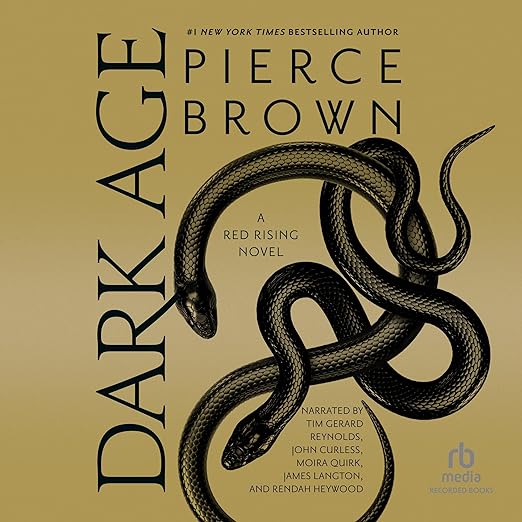
Dark Age is the fifth book in Pierce Brown's Red Rising series and, per reviewer Fantasy Geek, the second entry in what fans are calling its second trilogy. At thirty-three hours and fifty-eight minutes, this audiobook asks a real commitment of anyone picking it up. Darrow has spent a decade leading a revolution against the Society, and now finds himself outlawed by the very Republic he founded, waging what the synopsis calls a rogue war on Mercury to salvage what is left of Eo's dream.
Five POVs Ask if Darrow Is Still the Hero
The synopsis spreads its weight across several storylines rather than following Darrow alone. Lysander au Lune, the heir in exile, returns to the Core trying to unite the treacherous Gold families before facing Darrow over the skies of a war-torn Mercury. On Luna, Mustang, Sovereign of the Republic, campaigns to hold the Republic together behind her husband while political and criminal enemies close in. Lyria, once a Red refugee, stands accused of treason and has to engineer a desperate escape with allies she cannot fully trust, and Darrow and Sevro's children, Pax and Electra, get abducted by a new threat, leaving them dependent on a thief named Ephraim, who is looking for his own redemption in protecting them. Reviewer Thomas Hixson counts five character perspectives carried over from the previous book, Darrow, Lyria, Ephraim, Virginia, and Lysander, using Mustang's given name, while Goose16 describes the structure as four distinct POVs. Either way, this is a book built to juggle multiple fronts of the same war at once rather than track a single hero's arc, and the central question the synopsis poses, whether Darrow is still the hero who broke the chains or whether another legend is about to take his place, hangs over every thread. That question alone gives even the quieter political chapters a sense of consequence most midseries entries struggle to sustain. The title itself works as a warning built into the plot: the synopsis frames the entire conflict as a game of conquest that could turn the Rising, the revolution Darrow spent a decade building, into a new Dark Age instead of the freer future it was meant to secure, which reframes every character's choices as part of that larger risk rather than isolated personal drama.
Reynolds Carries Five Perspectives Across Thirty-Four Hours
Reviewer opinion here is close to unanimous that this entry recovers ground lost in the previous book. Thomas Hixson calls book four, Iron Gold, the weakest in the series and says Dark Age's return to the same five-perspective format works far better the second time around. Bryan Desmond makes a similar case from the other direction, arguing that Iron Gold reads, in hindsight, like a lead-in to this book rather than a complete story on its own, and calls Dark Age one of Pierce Brown's best outings in the series to date. Fantasy Geek goes further still, crediting Brown's consistency across entries rather than any single flashy twist, ranking Brown among a handful of favorite authors even before this book cemented that standing. Hixson's review specifically praises the book's range: loss, sacrifice, redemption, heartbreak, political maneuvering, and tyranny all get worked through across the runtime. On the audio side, narrator Tim Gerard Reynolds is the one constant voicing all of it, carrying five named perspectives, Darrow, Lyria, Ephraim, Virginia, and Lysander, across nearly thirty-four hours without a rotating cast of narrators to split the load. That is a demanding assignment for a single reader, and Goose16 separately calls out the pacing and character development as genuine strengths, which suggests the audio edition has real material to work with across that many storylines.
Predictability Is a Minor, Not Fatal, Flaw
Goose16 gives the book four stars rather than five and flags predictability in some sections as the main issue, though they are careful to call it a minor complaint rather than a dealbreaker. That review also notes a great deal happening across four different perspectives, which listeners who want a tighter, single-POV epic should weigh against the ensemble approach the series has settled into by book five. Fantasy Geek is blunt that this is not the place to start if you have not already been reading the series, since it assumes familiarity with Darrow's decade-long revolution and the fallout from the previous four books. One review on file, from Hafsa, rates the book a single star, but it is worth reading closely: the complaint is entirely about a damaged physical copy and a replacement that took nearly three months to arrive without a refund, not about the story or the audio content at all, so it should not be read as a verdict on the book itself. Listeners should also know the story splits attention across at least four and arguably five points of view depending on which reviewer's count you trust, so anyone who prefers to stay locked into one protagonist's head for over thirty hours may find the structure asks more of their attention than a single-narrator epic focused on Darrow alone would. Given the runtime, it is also worth planning for the audiobook as a multi-week listen rather than something to finish over a single weekend, especially for anyone tracking five storylines that only intermittently intersect.
Committed Red Rising Fans Get Their Payoff
Committed Red Rising listeners, ideally ones who have already made it through Iron Gold, are the clear audience, since Fantasy Geek and Hixson both frame this book as a direct payoff for that fourth book's setup. If you want a war story that tracks political maneuvering across multiple fronts, Mercury, the Core, and Luna all at once, rather than a single battlefield, the five-perspective structure delivers exactly that, and Tim Gerard Reynolds carries the full ensemble solo across nearly thirty-four hours. Fans who found Iron Gold slower than the original trilogy should take real encouragement from how consistently reviewers here describe this as a course correction. New listeners, on the other hand, have no business starting here; nothing about this entry is designed to work as an introduction, and it assumes the decade of history the earlier books spent building. Tightly focused, single-narrator storytelling is also not what this delivers, so anyone who generally prefers that over sprawling multi-perspective epics should adjust expectations, since even the more critical review here points to the sheer amount happening across the cast as a real feature of the book, not a flaw waiting to be fixed. Listeners weighing whether to continue past Iron Gold at all should treat the reviewers' consensus here as a genuine incentive to push forward rather than abandon the second trilogy early.
Do I need to listen to Iron Gold before starting the Dark Age audiobook?
Effectively yes. Reviewers Fantasy Geek and Thomas Hixson both frame Dark Age as a direct continuation of Iron Gold's setup, and the synopsis assumes you already know Darrow's decade of revolution and the Republic that outlawed him before the story even begins.
How many character perspectives does the Dark Age audiobook follow, and does one narrator voice all of them?
Reviewers count either four or five perspectives, including Darrow, Lyria, Ephraim, Virginia, and Lysander. Tim Gerard Reynolds narrates the entire audiobook solo, voicing every perspective alone across the full thirty-three hour and fifty-eight minute runtime without a second reader stepping in.
Is the one-star review on the Dark Age audiobook listing about the story or the narration?
Neither. That review, from Hafsa, is a fulfillment complaint: a copy arrived broken and the wait for a working replacement dragged on for months with no refund offered. It does not comment on the plot, the writing, or Tim Gerard Reynolds's narration at any point.
How long is the Dark Age audiobook, and do reviewers consider the pacing slow?
It runs thirty-three hours and fifty-eight minutes. Reviewer Goose16 calls the pacing excellent overall, with only some plot beats feeling predictable, which they describe as a fairly minor issue rather than a real drag across such a long, multi-storyline listen.