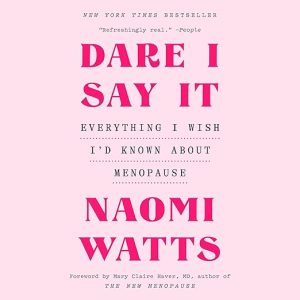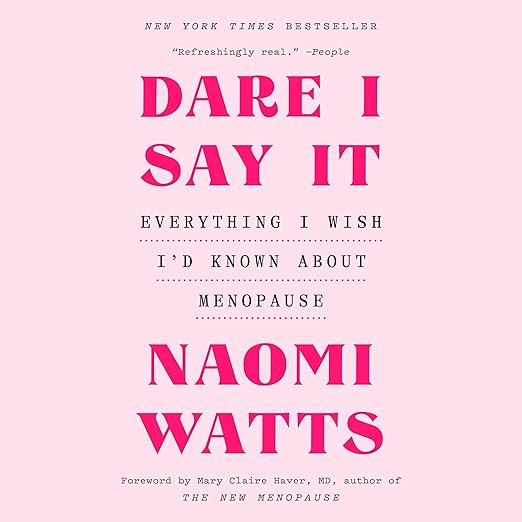
Naomi Watts was in the middle of promoting King Kong when her body started sending signals she wasn't supposed to receive at 36. The perimenopause diagnosis that followed, premature and poorly explained, became the hinge point that eventually produced Dare I Say It, this audiobook memoir-meets-resource guide that Watts narrates herself, bringing to the material an intimacy that print cannot replicate and that a hired voice would dilute. The book's formal structure sits somewhere between a personal essay collection and a reference guide, and that hybrid quality is both its greatest asset and its occasional liability.
The craft choice that shapes everything here is Watts's decision not to write a traditional memoir. She doesn't trace her career or her personal history in any sequential way. Instead, the book is organized around the symptoms, the questions, the gaps in medical knowledge, and the social stigma that surround menopause. Readers looking for Hollywood anecdotes will find them only in service of a larger argument: that seventy-five million women in the US alone are navigating this transition with inadequate information and considerable shame, and that the shame itself is a medical problem.
Hormone Experts Ground Watts's Personal Story
What separates Dare I Say It from the crowded field of celebrity wellness books is the degree to which Watts defers to medical expertise while still centering her own embodied experience. The foreword by Dr. Mary Claire Haver, author of The New Menopause, signals from the opening that this is not a book of anecdotes dressed as advice. Watts interviews hormone experts, nutritionists, and physicians, and she reports their findings with the kind of engaged curiosity that distinguishes a subject who has done real research from one who has simply collected blurbs. The questions the book addresses, from hormone therapy to libido to sleep loss to skin changes, are specific and the answers are current.
The liability in the hybrid structure is the pacing issue one reviewer flagged: the book can drag when the personal narrative recedes and the informational content takes over. These transitions sometimes feel unsmooth in audio format. Watts's conversational delivery carries the personal sections with ease, but when the material becomes more list-like or catalogue-like, her narration sounds slightly less naturally at home. That said, the audiobook format has a genuine advantage over the print edition for content like this: hearing Watts speak about hormone therapy, night sweats, and libido in her own voice, with her own cadence and her own occasional humor, strips away the clinical distance that might make the print version feel more medicalized.
Watts's Flat Delivery Reveals More Than Polish
Watts narrates at six hours and fifty minutes, which is brisk for a book of this scope. The pacing reflects the book's refusal to be meditative or ruminative: it moves, it covers ground, it doesn't dwell. That efficiency is unusual in this genre, which tends toward emotional elongation. Listeners who have found other menopause memoirs too focused on feelings at the expense of practicality will appreciate that Dare I Say It consistently asks the next question rather than sitting with the previous one.
The self-narration is the book's primary audio asset. Lin-Manuel Miranda's jacket blurb praises Watts's ability to excavate honest sentences, and that quality surfaces in the narration as a kind of reluctance to perform the emotions she's describing. She talks about her diagnosis with the slight flatness of someone who is still a little angry about how it happened, and that flatness is more revealing than polish would be. One reviewer noted the book touches on elements not generally discussed, and those sections, particularly the material on libido and on the psychological dimensions of hormonal change, are handled with the same directness rather than deflection.
Haver's Foreword Sets Up the Hard Questions
The question framework the book uses, asking things like whether you will ever sleep again and what happened to your libido, is not rhetorical decoration but an organizing principle. Each question gets a substantive response that combines Watts's personal experience with expert input and current research. Listeners who are in perimenopause now will find the most immediate value here, but the broader case the book makes for why menopause requires more cultural attention and better medical education is accessible regardless of where a listener is in their own timeline.
The foreword by Dr. Haver is worth staying for rather than skipping in audio form. It frames the book's medical credibility before Watts begins, and that framing changes how you hear the personal sections that follow. Without it, the transition from celebrity voice to medical content might feel more abrupt. The book also exists in an interesting relationship to Watts's public advocacy work, and listeners who follow her menopause awareness campaigns will recognize arguments here that have been part of her public statements, now expanded and given the context they deserve.
Perimenopausal Women Get the Most From This
Women in perimenopause or approaching it who want a resource that takes the medical seriously without abandoning the personal will find this genuinely useful. Younger women who want to understand what their bodies will eventually do will get the most from the research-forward sections. Listeners who want exclusively personal memoir without informational content will find the hybrid structure frustrating. Men who want to understand what the women in their lives are navigating will find Watts's clarity helpful; she writes without the assumption that everyone already knows the vocabulary.
Before You Press Play
- Read by: Naomi Watts narrates her own book and brings genuine warmth and specificity to the material; her voice carries the kind of hard-won candor that a professional narrator reading someone else's words would struggle to replicate.
- At its heart: menopause stigma and medical neglect, perimenopause as a life transition rather than an ending, women's health advocacy
- Vibe: Frank, occasionally funny, and practically grounded
- Short version: Watts turns her own perimenopause diagnosis at 36 into a resource that is more medically substantive than a celebrity memoir has any obligation to be, and that makes it genuinely worth the listening time.
Frequently Asked Questions
Does the Dare I Say It audiobook work as a medical resource or is it primarily a personal memoir?
It is genuinely both. Watts integrates interviews with doctors, hormone specialists, and nutritionists throughout the book, and the medical content is current and specific. But the organizing voice is always her own lived experience, which keeps the medical sections from feeling clinical or detached.
Is Dare I Say It audiobook relevant if I am not yet in perimenopause?
Yes. The book makes a sustained argument for why earlier awareness matters, and the research sections on what hormonal changes actually do to the body are informative regardless of where a listener is in their own cycle. Younger readers have specifically noted it as useful preparation.