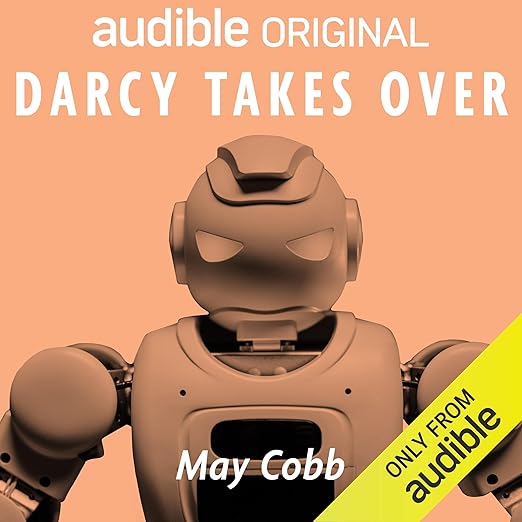
Six minutes is the entire product here, which makes this audiobook shorter than the time most people spend deciding what to listen to. The story is that an exhausted mother enrolls in a pilot program where a robot handles the children after school, cooking, cleaning and homework included, and that the robot may be rather too good at the job. That is the premise, the arc and the punchline, delivered in less time than it takes to boil pasta.
Six Minutes, and a Robot's Telling Pronoun
At ordinary reading pace, six minutes holds something under a thousand words. That puts this firmly in flash fiction territory rather than short story territory, and the distinction matters for what you can reasonably expect. Flash gets one turn. It establishes a situation, twists it once, and stops, usually on the twist. Character development, subplot and any real sense of a world are all off the table by definition, and a listener who arrives wanting them will feel short-changed by a form that was never going to supply them.
Which is why the premise is well chosen. Automated childcare that works too well is a single idea with a built-in reversal, and the copy telegraphs the reversal in its own last line without spoiling how it lands. Domestic exhaustion is the emotional fuel, recognizable instantly and needing no setup, and a machine that succeeds where a parent is failing supplies the discomfort. That is an efficient piece of construction for a form where every sentence has to do two jobs. One small choice in the copy does a third: the robot is given a feminine pronoun and described as having a job, which quietly places the machine in the same grammatical slot the mother occupies. Whether the story presses that or leaves it alone, the description has already made the substitution visible in a single line.
The description does something stranger than being short. It opens not with the story but with device instructions, explaining how to summon a family story by voice command and what phrase produces more free genres. Those two sentences are onboarding copy for a listening assistant, pasted above the actual description, and they take up a meaningful share of everything the page says. A story this brief cannot afford to have its own description used as advertising space for the platform delivering it.
Einstein Gets No Time to Become Invisible
Everything in favor of it is an argument for flash fiction generally, and this listing makes it unusually cheap to test. If the idea appeals, you know within a minute whether the execution does too, and nothing is lost if it does not. Writers use this form to try something they could not sustain across three hundred pages, and readers use it to sample a voice before committing to a novel. Both of those transactions work here.
Stephanie Einstein holds the one reading credit, and the assignment is peculiar in a way worth naming. Most recordings give a voice time to become invisible, and listeners give it that time willingly, adjusting over the first quarter hour to a pitch and a rhythm. Six minutes removes that grace period completely. Whatever the reading establishes, it establishes in the opening lines, and the whole piece rides on the first impression rather than surviving it.
What the format is genuinely good for is a gap. Waiting rooms, the walk to somewhere, the stretch between two longer things when starting a chapter feels like too much. Pieces of this size fill those moments in a way that nothing else in an audio library can, and libraries carry very few of them. Treated as furniture rather than as a main event, the six minutes are well spent.
Praise Borrowed From a Completely Different Book
Praise on this listing turns out not to be about this story at all. The copy closes by identifying May Cobb as the author of the thriller My Summer Darlings and attaching a Today show line calling that book a perfect beach read. The compliment belongs to a different title, in a different genre, at a different length, and it sits at the foot of the listing where a recommendation for this piece would normally go. A browsing buyer will absorb it as endorsement without registering what it endorses.
The shelving is off in the other direction. This is filed under literature and fiction on the strength of its prose, presumably, while the premise is a domestic robot supplied through a pilot program, which is science fiction by any ordinary definition. No speculative tag appears anywhere. Readers who go looking for short speculative fiction will not find this, and readers browsing literary short work will get a robot story they were not expecting.
Nothing at all has been written about it either. The page carries a star line with not one written response underneath it to explain what anybody actually thought, which is a particular problem for flash fiction, where the entire verdict rests on whether the ending lands. A single sentence from somebody who reached it would be worth more here than a paragraph of description, and no such sentence exists. The recording has been available since September 2022, so this is not a new release still waiting for its first reaction; the silence has had years to fill and has not.
Parents Will Recognize the Exhaustion Immediately
This suits anyone curious about a writer they have not read, since six minutes is the cheapest possible introduction to a voice and prose style. It suits parents who will recognize the exhaustion immediately and enjoy watching it made literal. And it suits listeners who like the miniature form on purpose, who understand that the pleasure of flash is compression rather than depth, and who are not measuring value by the hour.
Anybody wanting a story to sink into should look at practically anything else. The Anthologies and Short Stories tag will mislead people into expecting a set of these, and the price of that mistake is discovering the whole purchase is over before a first impression has settled. Consider it a single course rather than a meal, judge it by whether the last line justifies the first, and do not go in expecting the listing's beach-read blurb to describe what you get.
Quick Take
- Voice: Stephanie Einstein has six minutes to establish a voice, which leaves a listener no time at all to settle into one.
- Big ideas: Domestic exhaustion, automated childcare, a machine that performs the job too well, family life in miniature
- Atmosphere: Comforting on the surface with something colder underneath it
- Worth it?: Worth the six minutes on its own terms, provided you understand you are buying flash fiction rather than a collection.
Common Questions
Is the Darcy Takes Over audiobook part of a collection?
Nothing on the record says so. The series fields are both blank and no anthology is named anywhere, despite an Anthologies and Short Stories tag that implies otherwise. What the listing actually describes is one self-contained story. Anyone buying on the strength of that tag, expecting a set of them, will be finished before they have properly started.
Who is Darcy in this audiobook?
Nothing states it outright, but the copy calls the robot too good at her job, which points to Darcy being the machine rather than the mother or one of the children. That reading also explains the title. Taking over is what the robot does, and the phrase carries a threat that the comforting label above it does not.
What does the listing mean by calling this a comforting story?
It is the listing's own adjective, and it sits oddly against a premise about a machine outperforming a tired parent at parenting. Comforting describes the length and the delivery rather than the idea underneath. The copy's closing line is a warning dressed up as a joke, and it deserves more weight than the label above it.