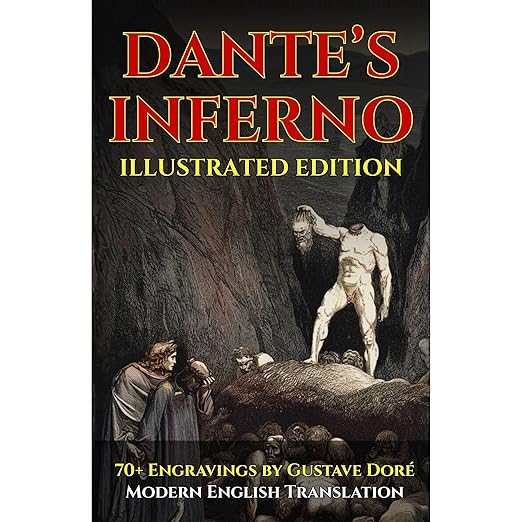
The whole pitch of this audiobook is a translation problem: how do you make a fourteenth-century Italian epic, filtered through Henry Francis Cary's dense 1814 English, sound like something a listener today can actually follow? The publisher sets the two versions side by side in the description itself. Cary's opening runs into archaic, comma-heavy syntax within a sentence or two: astray in a gloomy wood, gone from the direct path, phrasing that asks a reader to slow down and parse the grammar before the meaning lands. The modern version offered here opens plainly instead: Halfway through my life's journey, I was lost. Dante's Inferno - Fully Illustrated Edition, read via Virtual Voice's synthetic narration across seven hours and forty minutes, is built entirely around that gap between the two versions.
Seventy Doré Illustrations That Never Reach Audio
This edition pairs a modern English rendering of Dante Alighieri's descent through Hell with more than seventy illustrations by Gustave Doré, positioned throughout for what the publisher calls dramatic impact. The stated goal is to preserve the poetry and power of the original while stripping out the obsolete phrasing that trips up contemporary readers, making the journey immersive, immediate, and unforgettable rather than a homework assignment in translation. Whether that succeeds on audio specifically is a separate question from whether it succeeds on the page, since illustrations obviously do not carry over to a listening format at all; a listener gets the modernized language without the seventy-plus engravings the print or ebook edition is built around. The publisher's own framing describes the goal as a translation faithful to Dante's original meaning and structure, paired with historical and literary context meant to enhance understanding without overwhelming the reading, and on the strength of the text itself, judged apart from the marketing language around it, that description is not far off. The book positions itself for readers who bounced off Dante before, a large enough group that publishers keep producing new modern-English versions of Inferno specifically to reach them, and the sample passage in the listing reads more like plain narration than poetry straining against an old-fashioned translation.
Four Reviews Agree the Translation Is Clear
The four positive reviews on this listing agree on where the translation succeeds. One calls it a good translation that is clear and easy to read, praising the formatting and the illustrations even while noting the book includes a section of commentary after the main text, plus a famous sermon by an unnamed Englishman from around the 1700s tucked into the bonus material. Another, describing it as a true treasure for anyone exploring the journey through Hell, singles out the historical commentary sprinkled throughout for providing helpful context without overwhelming the poetic narrative, calling the balance respectful of the original while genuinely approachable for today's readers. A third calls it a feat worthy of praise for taking a classic masterwork and making it accessible, adding that the illustrations match the aesthetics of the writing and storytelling closely enough to recommend the edition outright. Even the shortest review on the listing, a quick note from a buyer who picked it up for a nephew fond of a game based on the book, points at how far Dante's Inferno has traveled past its original medieval audience, into pop culture references most fourteenth-century readers never anticipated.
Machine-Made Commentary Behind a Synthetic Narrator
Two things are worth flagging honestly here. First, the extended description attached to this listing reads less like a synopsis than a search-optimized list of audience categories, readers seeking modern translations, illustrated classics, homeschool material, Christian allegory, and comparisons to Seamus Heaney's Beowulf or Emily Wilson's Odyssey are all named explicitly as target readers rather than described organically. That distinction matters before you commit to a purchase: what you are reading in the store listing is closer to marketing copy than a description of the actual reading experience. It also makes it harder to tell what is a genuine editorial claim, that this preserves the poetry and power of the original, and what is simply a keyword aimed at a search engine rather than a listener.
Second, and more directly relevant to what you are actually getting: one reviewer who otherwise liked the translation specifically flags the post-text commentary as likely AI generated or AI assisted, calling it interesting but not university-level academic work. A separate one-star review, titled bluntly and giving the book its only negative rating on the listing, argues the listing should disclose that it is AI generated at all rather than let buyers assume otherwise. Combined with the fact that this audiobook itself is narrated by Virtual Voice rather than a human reader, a consistent pattern emerges across this release worth sitting with: multiple layers of it, the bonus commentary and the narration alike, appear to be machine-produced, and only the narrator credit discloses that plainly up front.
Buy Print Instead for the Full Illustration Set
This edition is built for listeners who want an accessible entry point into Dante without wrestling with Cary's nineteenth-century diction first, including students and general readers who have bounced off older translations before and want a second attempt without the archaic vocabulary getting in the way again. Readers drawn to illustrated classics or modern retellings of medieval literature, per the publisher's own stated audience, will find the translation genuinely readable, based on what these reviewers describe. Book clubs looking for a discussable classic without assigning members a semester's worth of footnotes might also get real mileage out of this edition, given how consistently reviewers describe the pacing as approachable rather than dense. Skip it if a scholarly, footnoted translation matters more to you than plain accessibility, or if AI-generated commentary and synthetic narration are dealbreakers regardless of how the underlying translation reads; nothing here confirms exactly how much of this edition, beyond the core text itself, was written or read by a person. Anyone who specifically wants the seventy-plus Doré illustrations as part of the experience should buy the print or ebook edition instead, since none of that artwork carries into the audio format no matter how the narration is handled.
Common Questions
Is the narration on this Dante's Inferno audiobook a human reader or an AI voice?
It is Virtual Voice, Amazon's synthetic text-to-speech narration, not a human narrator. That matters for a text built on translated verse and rhythm, and it lines up with a reviewer's separate concern that some of the supplementary commentary may also be AI generated.
How does the modern English translation in this audiobook compare to older versions of Dante's Inferno?
The listing itself contrasts the two directly: Henry Francis Cary's 1814 translation opens with dense, inverted period syntax, while this edition opens plainly, aiming for clarity over archaic phrasing. Reviewers consistently describe the modern version as more accessible without feeling watered down.