- Performance: Claton Butcher is credited; the text alternates quoted testimony with academic analysis, a seam audio has to signal by voice alone, and no review discusses the result.
- What it covers: Close air support doctrine, enlisted specialists as institutional outsiders, interservice rivalry, post-9/11 warfare.
- Feel: Sober, technical and quietly admiring.
- Our call: The definitive listen on tactical air control parties, provided acronyms do not defeat you.
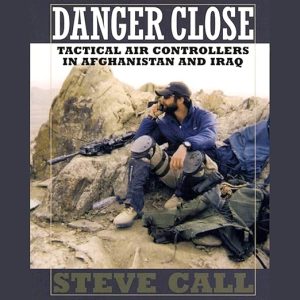
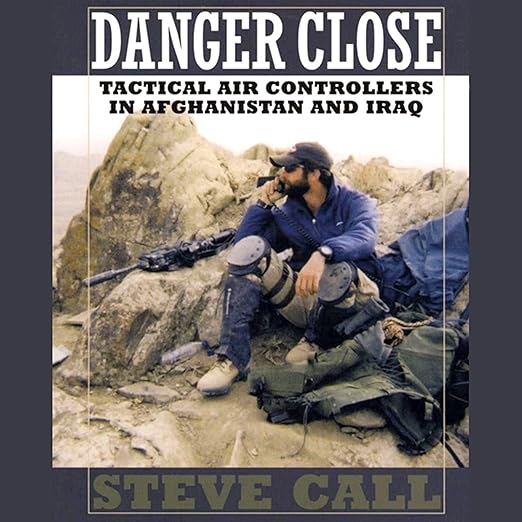
Steve Call made one governing decision in Danger Close and the entire audiobook follows from it: he lets the tactical air control party members speak for themselves, then builds the analysis around what they said. Eleven hours and thirteen minutes of first-hand battlefield testimony, threaded with an academic historian's account of how close air support doctrine actually developed, is a structure that could easily collapse into either war stories or a policy paper. It does neither, and the reason is that Call treats the two registers as arguments for each other rather than as decoration.
Enlisted Specialists Were the Secret Weapon
The subject is one of those pieces of recent military history that everybody half-knows and almost nobody can describe. In the weeks after September 11, 2001, small Special Forces teams trained in close air support went into Afghanistan alongside a loose federation of rebels opposed to the Taliban, and the results were sufficiently lopsided that planners started rebuilding assumptions around them. Call's own phrase for it, quoted in the description, is that “America had a secret weapon”. What that phrase actually describes is a handful of enlisted specialists with radios, and the gap between the drama of the result and the modesty of the mechanism is the book's real subject.
Steven Hildreth, Jr., five stars, identifies the throughline precisely, describing an education in “the evolution of the Tactical Air Control Party career field in the early days of the Global War on Terror” and praising how Call highlights “the challenges TACPs faced, how the TACPs were considered outsiders both to their own branch of se”, where the review is cut short. That outsider status is not a colorful detail. It sits at the center of the argument, alongside a rivalry between two services that the description says has at times complicated and even obstructed how these assets get employed.
Peter Monks, four stars, gives the most economical summary available: “a straightforward and clear look at the work of (largely) USAF Joint Terminal Air Controllers in the opening phases of the Afghanistan and Iraq campaigns”, adding that Call describes the day-to-day work of enlisted controllers embedded with special forces and conventional units. Note that Monks reaches for a different piece of terminology than the book's title does, which tells you something about how contested and evolving this career field's own vocabulary has been.
Claton Butcher Paces Testimony Without a Page
Testimony is the ideal material for audio, and this book is built on it. Oral history was spoken before it was written, and hearing an account of a controller talking aircraft onto a target under fire restores something that a page flattens. Call's method here, allowing the practitioners to narrate and then supplying the framework around them, produces a rhythm that suits a long listen: a stretch of individual experience, then a step back to explain why that experience happened the way it did, then back down again. Eleven hours of that alternation goes faster than the page count suggests.
The institutional history is the part you will remember, though. This is a book about people who were essential and unwanted at the same time, enlisted airmen embedded with ground units, belonging fully to neither service, whose value was proven in Afghanistan and then had to be argued for all over again in the planning for Iraq. Anyone interested in how military organizations absorb, resist and eventually institutionalize a capability that works will find this a case study of unusual clarity. The rivalry material is handled as analysis rather than as grievance, which is the correct choice and a harder one.
The reading falls to Claton Butcher, and the demand this text makes is structural rather than dramatic. A book that alternates between quoted first-person testimony and an academic historian's analysis relies in print on typography: block quotes, italics, indentation. A listener gets none of that, so the reader has to make that seam land through pace and register alone, dozens of times across eleven hours, without ever performing the veterans. Add the acronyms and the call signs and the job gets harder still. Nothing in the listener feedback touches the recording, which leaves that question open. What is clear is that this text asks a very particular thing of whoever reads it.
Acronyms Outrun a Listener's Ability to Flick Back
The plainest hazard gets named outright by a reviewer. PolarXpress, who otherwise calls it “an outstanding book for former military members”, warns that “For the everyday reader the book can be a bit overwhelming with the amount of military”, and there the review breaks off mid-word. Anyone who has read military history knows what is coming. TACP, CAS, SF, USAF, unit designations and aircraft types arrive thick and fast, and audio removes the one defense a print reader has, which is the ability to flick back to where a term was first defined. Expect to lose a few acronyms and to carry on regardless.
The register needs calibrating too. This comes from Texas A&M University Press as part of a military history series, and it reads like it: sourced, argued, and interested in doctrine as much as in combat. Peter Monks' word for it is straightforward, which in this context means unshowy. Anyone arriving from the memoir shelf hoping for a single controller's narrative arc will find instead a career field's collective story, told through many voices and interrupted regularly by analysis.
One more scoping note. The description positions Afghanistan as the origin and Iraq as the consequence, and does not say how the eleven hours divide between them, so a listener who came specifically for Operation Iraqi Freedom should know that the Afghan campaign carries the book's founding argument. Hildreth's framing of this as a career field in its earliest evolution points the same way. The Iraq material builds on ground the Afghanistan chapters establish.
Casual Listeners Should Think Twice About Acronyms
Serving and former military members are the obvious core, and both five-star reviewers come from that direction: PolarXpress recommends it explicitly to former members and to anyone thinking about how enlisted personnel across the services could be better used in this role. Beyond that, students of post-9/11 warfare, readers of institutional and organizational history, and anyone who has wondered how a close air support request actually travels from a man on a ridge to an aircraft overhead will find this the most detailed available answer.
Casual listeners should think twice, and PolarXpress has already told you why. Without some tolerance for acronyms and service culture, eleven hours of this will be heavy going, and the audio format offers no glossary to retreat to. Anyone looking for combat narrative without institutional argument, or for a critique of the wars themselves rather than of how one capability was employed within them, is reading the wrong book. Come for the machinery of how air power and ground forces learned to work together, and this rewards every hour.
A Few Questions About Danger Close
Do I need a military background to follow this audiobook?
It helps considerably. One reviewer warns that the everyday reader may find the volume of military terminology overwhelming, and audio removes the ability to flick back to a definition. A listener comfortable with acronyms and service culture will be fine; a newcomer should expect to lose some of it.
What is a tactical air control party and why does the book center on them?
They are the specialists who coordinate close air support between ground forces and aircraft. Call's argument is that these small teams produced unexpectedly decisive results in Afghanistan while being treated as outsiders within their own service, and that the institutional friction shaped how they were used afterwards.
Does the book cover Iraq as fully as Afghanistan?
The description frames Afghanistan as the origin story and Operation Iraqi Freedom as the campaign that inherited those lessons, without specifying how the runtime divides. Expect the Afghan chapters to carry the founding argument and the Iraq material to build on ground already established.
Is an audiobook a good format for this kind of military history?
For the testimony, yes, since oral history was spoken before it was written and these accounts regain something when heard. For the acronyms and unit designations, no, since nothing can be looked up mid-listen. The trade is worth making if the subject genuinely interests you.