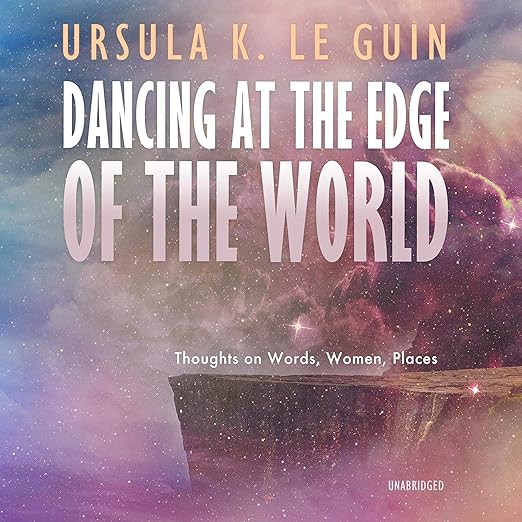
Ursula K. Le Guin wrote this collection in the late 1980s and called it Dancing at the Edge of the World. The title comes from a passage about celebration, about the dance that makes the world. I came to this audiobook after spending several months deep in Le Guin's fiction, wanting to hear her think aloud on the page, and what I found was something both fiercer and more personal than her novels tend to be. Le Guin the novelist is careful about the worlds she builds. Le Guin the essayist does not give the same courtesy to received opinion, institutional cowardice, or literary condescension. She is a different kind of demanding here, and Gabrielle de Cuir's narration understands that completely.
The audiobook runs over fourteen hours across essays, talks, reviews, and travel notes that range from modern literature to menopause, from utopian thought to rodeos. The breadth alone is striking. Le Guin roams across the intersecting arenas of literature, feminism, and social responsibility without ever feeling scattered, because the organizing intelligence beneath it all is coherent and relentlessly honest.
Talks and Readings That Stay Alive in Audio
The strength of this collection as an audiobook is precisely the strength of Le Guin's voice, and Gabrielle de Cuir's delivery of it. These are essays that were often originally spoken: talks given at universities, readings at literary festivals, occasional pieces written for an audience the author could visualize. That performative origin makes them unusually alive in audio form. The argument in each piece builds the way a spoken argument builds, with pauses for emphasis and a rhythmic quality that is almost entirely lost when read silently on a page.
Tolerating No Fools in Reviews or Feminism
Le Guin's literary reviews, which appear throughout the collection, are extraordinary examples of a form too often practiced as either flattery or dismissal. She is neither kind nor cruel in the conventional sense; she is precise. One reviewer described her as tolerating no fools in this register, and that is exactly right. But the precision is in service of something larger, a genuine belief that literature matters, that what gets written and published and celebrated shapes how people understand the world and their place in it.
The feminist essays are the other major current running through the collection. Le Guin writes about women's experience with the same intelligence and specificity she brings to her fiction, and the decades since the original publication have not diminished the force of the arguments. If anything, the questions she raises feel more rather than less urgent.
De Cuir Navigates Shifts From Acerbic to Tender
The fourteen-hour runtime is not something to approach casually. This is a collection that rewards active listening, the kind where you pause, rewind, sit with a paragraph before moving on. Le Guin makes arguments that require your full attention, and de Cuir's narration, as warm and precise as it is, cannot do the intellectual work for you. But for listeners who want to understand what Le Guin believed and how she thought about the relationship between writing and living, this audiobook is irreplaceable.
De Cuir's handling of the tonal range across the collection is one of the real achievements of the production. The essays shift from the acerbic to the tender without warning, and de Cuir navigates those shifts with genuine sensitivity. The travel notes that appear later in the collection, quieter and more personal than the formal essays, are given a different register that honors their intimacy rather than assimilating them to the more combative pieces.
Listeners who know Le Guin only through The Left Hand of Darkness or The Dispossessed will discover here the thinking that preceded and surrounded those novels, the arguments about language, gender, and power that animated the fiction without ever quite appearing directly in it.
Dated Framing, Questions That Remain Urgent
The collection is not structured for easy navigation. Essays from different periods and in different modes sit adjacent to each other without the kind of transitional scaffolding that might help orient a listener moving through fourteen hours of material. The audiobook rewards committed, sustained attention more than casual sampling.
Some of the literary reviews and occasional pieces will land differently for listeners who share Le Guin's specific reading history and differently again for those who do not. She engages with writers and critics from her era who are not universally known today, and those sections occasionally assume a familiarity that contemporary listeners may not bring. This is a minor friction rather than a genuine obstacle, but it is worth noting.
The book's feminist arguments are also firmly situated in their historical moment, which means some of the political framing will feel dated even as the underlying questions remain urgent. Le Guin is not writing for a contemporary audience in these pieces; she is writing for her own moment, and you read her there.
Literary Criticism Taken Seriously as Thought
This audiobook is for readers who love Le Guin's fiction and want to hear the mind behind it thinking in its own voice. It is for anyone who takes literary criticism seriously as a form of thought rather than merely a form of opinion. Listeners interested in feminist intellectual history and the specific texture of late twentieth-century debates about literature, language, and power will find the collection rich and rewarding.
Skip it if you need narrative momentum to stay engaged, this is an essay collection, not a story, and the listening requires a different kind of attention. And skip it if you are entirely new to Le Guin and want to understand her work: start with the fiction. But once you know what she made and want to understand why she made it, come here.
Before You Listen
Should I read Le Guin's novels before listening to this audiobook?
Familiarity with at least some of Le Guin's fiction enriches the experience considerably, since many of the essays illuminate the ideas behind her novels. That said, the collection stands on its own as a work of feminist literary thought.
At over fourteen hours, is the Dancing at the Edge of the World audiobook worth the full commitment?
For engaged listeners, yes. The length reflects breadth and depth rather than repetition. The essays accumulate into something larger than any individual piece, and the audiobook rewards the full investment of attention it asks for.