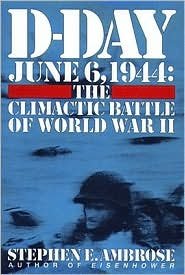
Stephen Ambrose's craft as a historian was always inseparable from his method: interview the men themselves. By the time D-Day the audiobook was assembled, Ambrose had conducted hundreds of conversations with the soldiers who waded ashore at Utah and Omaha, who parachuted into the darkness behind German lines, and who watched the men next to them die in the first minutes of June 6, 1944. The result is not a strategic analysis of Operation Overlord - it is a record of what that morning felt like from the water's edge. The prologue, quoted in the synopsis, frames the book's central argument with unusual directness: these were young men raised in the Depression who did not want war and fought it anyway.
At 7 hours and 22 minutes, the audiobook is proportional to its ambition. Ambrose is not trying to reconstruct the entire Normandy campaign - he has other books for that - but to render June 6 itself in as much human granularity as the sources allow. The strategic picture is present as context, but the book is most alive in its micro-scale moments: a soldier deciding in a split second to go over the seawall, a platoon leader improvising under fire from a position that was supposed to be cleared hours earlier. These are the moments that the interviews - gathered from veterans across five decades - uniquely preserve.
Ambrose's decision to concentrate on the rifle-carrying men rather than the commanders behind the lines is explicit and consequential. The book's emotional and historical weight comes from this choice. Eisenhower and Bradley appear as context; the men who were cold, seasick, and terrified in the landing craft are the narrative. Several reviewers have flagged this specifically - HEH's note that Ambrose "concentrated on the men carrying a rifle, coming ashore at Utah and Omaha" captures the book's organizing principle accurately. Ambrose understood, correctly, that the generals' accounts were already well documented. What was disappearing was the testimony of the privates and sergeants.
The sourcing methodology shows throughout. Ambrose does not speculate about internal states - he quotes from letters, diaries, and direct interviews. When he writes that a soldier felt fear or determination, he is working from that soldier's own account, often given decades after the event. This gives the book a texture of accumulated witness that military history written from documents alone cannot replicate. It also means the perspective is overwhelmingly American and Allied; German accounts are present but less prominent, which is a limitation worth noting for listeners expecting balanced coverage of both sides.
Boggs Keeps the Beaches Followable by Ear
Jesse Boggs narrates the material with a steady, undemonstrative approach that suits Ambrose's prose style. Ambrose wrote history at a level of clarity and momentum unusual among academic historians, and Boggs honors that by reading it as narrative rather than as recitation. The combat sequences, which could easily tip into chaos on the page, remain followable in audio - Boggs tracks the geography and movement with care, so the listener can hold a picture of the beaches and the units moving across them. For a book this dependent on spatial orientation, that is not a small thing.
The 4.8 rating across 268 reviews reflects a readership that includes both general listeners and veterans' families who approach the material with prior stakes in its accuracy. The repeated praise for its detail and for the sensation of being "right there" comes up consistently, which in audio history is the highest functional compliment - it means the narration is not creating distance between the listener and the source material. At under eight hours, this is also an accessible entry point for listeners new to World War II history who want something grounded in testimony rather than strategic overview.
Immediacy Now, but Memory Grows Unreliable
Ambrose's reputation was complicated in his later career by questions about attribution and sourcing practices in other works. Those controversies post-date this book's original publication and do not center on D-Day specifically, but listeners aware of the debate may encounter the text with additional scrutiny. What is verifiable is that Ambrose conducted a vast number of interviews with veterans over many years, and the granular soldier testimony throughout this book reflects that archive. The methodology is oral history, with all the strengths - immediacy, specificity, emotional weight - and limitations - subjectivity, memory's unreliability - that come with it.
The book also reflects its era in some of its framings. Published in 1994, it approaches the Greatest Generation with a reverence that later historiography has complicated. Ambrose is not uncritical - he documents failure, chaos, and poor decisions alongside the heroism - but the overall register is elegiac in a way that some contemporary historians would frame differently. For listeners approaching this as one perspective within a larger literature on Normandy rather than as the definitive account, those limitations are navigable. As a record of what the soldiers themselves experienced and said, it remains difficult to match.
Soldier's Perspective Over Strategic Analysis, Mostly
This audiobook is best suited for listeners drawn to military history told from the soldier's perspective rather than from the command level, and for those interested in oral history as a documentary method. It is an accessible, moving entry point for general listeners who have limited background in World War II and want a human-scale account rather than a strategic analysis. Scholars and specialists will already know the book and its limitations. Veterans' families who want to understand what the men who served that day actually experienced will find Ambrose's accumulated testimony more valuable than any strategic overview of the operation. Those expecting balanced Allied and Axis coverage, or wanting an account that interrogates rather than honors the collective memory of D-Day, will need to supplement this with other sources.
Is this audiobook primarily a military strategy account, or does it focus on individual soldier experiences?
It is emphatically a ground-level account. Ambrose explicitly chose to concentrate on the men carrying rifles rather than the commanders behind the lines, drawing on hundreds of interviews conducted over decades. Strategic context is present but secondary to the testimony of soldiers at Utah Beach, Omaha Beach, and the airborne drops behind enemy lines.
How does Jesse Boggs's narration handle the combat sequences, which could easily become disorienting in audio?
Boggs reads the battle sequences with spatial care, tracking unit movements and beach geography in a way that keeps the listener oriented even during the most chaotic passages. The narration is functional rather than theatrical, which suits Ambrose's clear, direct prose style and allows the testimony to carry the emotional weight.
Is this audiobook a good entry point for someone with little background in World War II history?
Yes. Ambrose writes at a level of clarity that does not assume prior knowledge, and the focus on individual soldiers rather than strategic planning makes the material accessible without requiring familiarity with the broader campaign. The 7-hour-plus runtime covers the day in sufficient depth without overwhelming a newcomer to the subject.
Does the audiobook cover both Allied and German perspectives on the invasion?
The primary perspective is American and Allied. German accounts appear as context and counterpoint, but the book is built on interviews with Allied veterans and reflects that asymmetry. Listeners wanting balanced treatment of both sides will need to supplement this with other sources focused on the German defense.