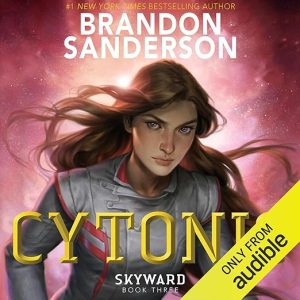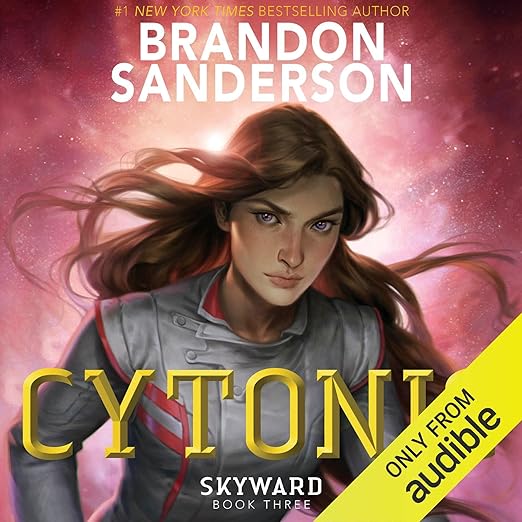
- Narrator: Suzy Jackson returns for book three, where the story strips away the ensemble and rests the whole run on one first-person voice.
- Subjects: Identity and self-discovery, war on a galactic scale, courage as facing fear.
- Tone: Disorienting, inventive, and propulsive.
- Bottom line: Essential once you are two books in, and a poor place to meet the series.
Spensa leaves behind every rule she has learned by the third book, and this audiobook follows her into a place called the Nowhere, which the description warns is somewhere few ever return from. Brandon Sanderson has now reset the setting three times across three entries. Whether that counts as the series' defining strength or its structural tic is the argument worth settling before committing thirteen hours to this one.
Every Book Resets the Rules on Purpose
Stakes here are genuinely high. The Superiority has started a galaxy-wide war and means to finish it using the Delvers, ancient forces the description credits with erasing entire planetary systems in an instant. Spensa has already faced one and recognized something unnervingly familiar inside it. The only route to understanding that recognition runs away from Detritus, away from the Defiant Defense Force, and away from everyone she has ever fought beside.
Harris states the objection precisely. Every book in this series arrives with a new setting, new rules, and new friends, and while that keeps the material fresh it is also disorienting to have the rules rewritten again and again. That is the fair read on this installment. The new world is appealing and crowded with ideas, and it is simultaneously the third consecutive occasion on which the ground has shifted under someone who had only just finished learning the previous arrangement.
The defense is that the resets are the design rather than a reflex. Spensa's arc concerns discovering what she is, and each book strips away another layer of the identity she assembled: first the enclave, then the enemy's own society, now every human structure remaining to her. Read that way, the disorientation is precisely the effect intended. Whether it arrives deliberately or merely repeatedly is a judgment most listeners will reach somewhere around hour four.
Suzy Jackson Narrates Spensa Nearly Alone
Christopher Blanco's summary is that Sanderson can write in any genre and that watching this one play out was a pleasure. That range is the genuine draw. This is young adult space opera behaving like a puzzle box, with a protagonist who solves her own problems instead of being rescued from them, and it never once condescends to the age bracket printed on the label.
Context from the description helps set expectations as well. The publisher introduces Sanderson by way of the Reckoners series, the Mistborn trilogy, and the Stormlight Archive, which is a great deal of epic machinery to invoke on behalf of a young adult space opera. The useful signal buried in that framing is scale: this is an author who builds systems and pays them off across volumes, so the rules being introduced inside the Nowhere are far likelier to matter later than to serve as scenery. Anyone who enjoys watching a structure assemble itself has plenty here to track.
That structural change also reshapes what the reading has to carry. The first two books placed Spensa inside a squadron and a society, which hands a performer an ensemble to play against. The Nowhere removes that by design. Holding a first-person voice across long stretches with far less to bounce off is harder work than running a crowded flight deck, and thirteen hours is a long time to sustain it. That is the specific quality to listen for in a sample.
Anyone already two books deep gets a simpler pull: this is where the central question finally gets addressed. The series has been asking what Spensa actually is since its opening pages, and this is the entry that goes looking for an answer. The description frames courage as facing fear and calls the mission terrifying, which is promotional language, but it does capture the shape: the book where the protagonist stops fighting and starts finding out.
Silent Dissent Behind a 4.5 Average
Noa Black liked the Nowhere while finding parts of it confusing, praised the character work and the twist near the end, and still landed below the first two books precisely because those were so strong. That is a useful calibration to carry in. This is not the series at its most legible, and anyone who found the earlier entries effortless should expect to work noticeably harder here.
Numbers on the page also want careful reading. The five written responses average well above the 4.5 displayed at the top, which means the rest of a twelve-vote tally is dragging the score down without leaving any written trace behind. Whatever that dissent consists of, nobody has spelled it out, so the visible reviews are a friendlier sample than the aggregate.
Finally, this is a middle volume and behaves like one. The galaxy-wide war the description establishes is not going to be settled inside thirteen hours, and the book's actual job is answering a question about its protagonist while leaving the larger conflict wide open. If unresolved endings frustrate you, wait until the following installment is within reach before starting this one.
Save This One for a Real Commute
The clearest audience is the listener who finished book two and still wants an answer to what Spensa actually is. This is the entry that goes hunting for one, and the series has circled that question from the beginning. If your investment sits with the character rather than with the flight sequences, this installment was built for you.
Readers who need each installment to consolidate rather than reinvent will struggle, because this one does the opposite and does it deliberately. Anyone returning specifically for the dogfighting that defined the earlier entries should temper expectations too, since the Nowhere is a fundamentally different kind of place and the appeal shifts from combat toward exploration and mystery.
Continue if you are already invested, but budget your attention as you go. Thirteen hours in an unfamiliar setting operating on unfamiliar rules asks more of a listener than a return to known ground would, and this is not a book to run at double speed while doing something else. Give it a commute rather than the dishes, and the payoff on the central question justifies the disorientation it takes to reach it.
A Few Questions About Cytonic
Why does one review mention a defective CD and a different publisher?
Neil describes an audio CD that failed and was replaced by Brilliance Audio after getting in touch with them, while this listing names Audible Studios as the publisher. Responses from separate physical and digital editions appear stacked under one page, so a complaint about a disc tells you nothing about the download.
How long is the audiobook, and does the Nowhere change the pacing?
Thirteen hours and change. Moving into the Nowhere trades the squadron flying of the earlier books for exploration and mystery, so the rhythm slows and the puzzle element expands. Anyone expecting continuous combat will find the middle stretch quieter and considerably more interior than the first book was.
Is this audiobook suitable for younger listeners?
One reviewer shares the series with a twelve-year-old, reports being a book behind that reader, and recommends it for preteens and teens, which matches the young adult classification. The threat level runs high and the stakes are galactic, but the treatment stays age-appropriate and the plotting never talks down.
Do I need to remember the earlier books in detail?
Enough to recall who the Krell are and why Detritus matters. The description leans on both without reintroducing either, and audio offers no easy way to flip back for a reminder. A quick refresher on book two before you start will save you a confused opening hour.