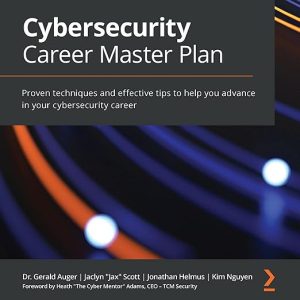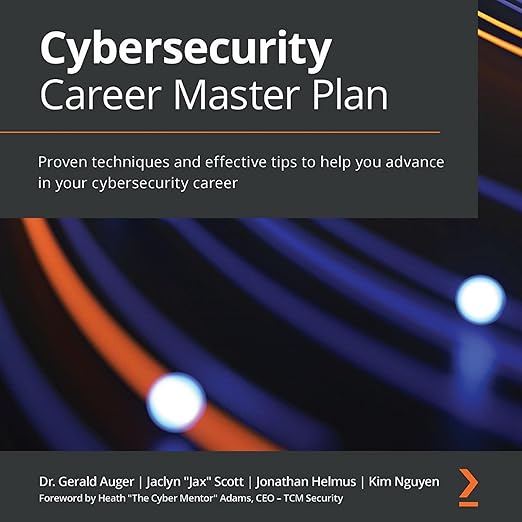
Cybersecurity keeps getting cited as one of the fastest-growing, best-paying tech fields available, yet the path into it remains genuinely confusing for newcomers who don't already know someone on the inside. Cybersecurity Career Master Plan, credited to Dr. Gerald Auger and built by what the synopsis describes as a team of leading industry experts, exists specifically to replace that confusion with a sequence, and this audiobook lays it out step by step: what to learn first, which certifications matter, and how to actually land the first job once the knowledge is there.
Logical Progression, Narrated in One Voice
The audiobook moves through a logical progression rather than a loose collection of tips. It opens with foundational grounding in cyber law, policy, and frameworks before narrowing into specific career tracks, security operations, penetration testing, and risk analysis among them, then works through the genuinely difficult question of formal college education versus certificate courses, before closing on personal branding and long-term career paths. That structure matters more than it might sound, since most competing guides either stay too abstract to act on or dive into technical specifics without ever addressing the career-navigation questions that actually stall newcomers.
The Voice Gallery narrates, and the delivery is exactly what this kind of reference-style career guide needs: clean, professional, and workmanlike rather than distinctive, smoothing over whatever stylistic differences exist between the book's multiple contributors so the material reads as a unified whole rather than a stitched-together committee project, even though committee production is essentially what it is.
Personal Branding Gets Its Own Chapter Here
The personal branding chapter is a less obvious inclusion than the certification and career-track material, but it addresses a real gap in most technical career guides: how to actually present accumulated skills and credentials to hiring managers and a professional network in a field that changes fast enough to make a static resume feel stale within a year or two of writing it.
Starting with the legal and regulatory grounding before any career-track specifics is a deliberate sequencing choice, and a defensible one: understanding the compliance landscape a cybersecurity professional will actually operate inside gives later chapters on specific career paths real context, rather than presenting security operations or penetration testing as abstract job titles disconnected from the legal environment governing how that work actually gets done in practice.
The synopsis does not clearly separate absolute beginners from IT professionals pivoting laterally into security, and the book's actual content seems to serve both without fully distinguishing which sections matter more for which starting point. Listeners already working in general IT roles may find the earliest foundational chapters move slower than they need, while true outsiders will want that grounding kept intact rather than skipped.
Certification Sequencing Wins Praise From Reviewers
Reviewer Christian Alberto Soto singles out the certification-sequencing guidance specifically, calling it 'one of the best books' on breaking into the field and praising the ordering advice for which certificates to pursue first. That kind of sequencing knowledge is exactly the thing newcomers cannot easily find elsewhere, since most individual certification bodies have obvious incentive to push their own credential regardless of whether it is the right first step for a given career path.
The chapter weighing formal college education against certificate courses appears to be the book's standout section based on how consistently it comes up in listener feedback, and that makes sense given how genuinely contested this question is across the industry. Reviewer Anthony describes becoming 'an avid follower' of Auger before the book even released, which speaks to an existing audience already primed to trust this specific guidance over generic career advice.
The book's decision to treat each specialization as a genuinely distinct career track, rather than treating cybersecurity as one undifferentiated job title, reflects how the field actually functions day to day. Each path demands a different mix of technical depth, communication skill, and temperament, and listeners genuinely undecided between them will get real, specific guidance for narrowing that choice rather than a generic 'find your passion' framing.
Cybersecurity demand now extends well past traditional technology companies into finance, healthcare, government, and manufacturing, essentially any organization running digital infrastructure worth protecting, and the book's career-track breakdown reflects that reality by treating the field as genuinely cross-industry rather than assuming every listener is aiming for a seat at a software company specifically. That breadth of framing matters for career changers coming from outside conventional tech backgrounds.
The Companion PDF Holds the Charts and Roadmaps
The hiring-market observations lean noticeably American, discussing certification value, salary expectations, and job-search tactics through the lens of the US tech employment landscape specifically. Reviewer JiYoung Seo, writing from Korea and describing a two-week wait to receive the physical product, still found the early material valuable, but international listeners should expect to do some translation work when the guide's market-specific advice does not map cleanly onto their local hiring landscape.
This is a companion PDF book, meaning charts, certification roadmaps, and reference material exist outside the audio track entirely. The listing notes the PDF becomes available in your library alongside the audio, and for a book this focused on concrete sequencing and comparison tables, skipping that companion document would mean losing real practical value the audio narration alone cannot fully replace.
Because multiple named and unnamed contributors shape this material rather than a single consistent authorial voice, listeners should expect some unevenness in emphasis and tone chapter to chapter, even though The Voice Gallery's narration smooths the surface-level delivery into something consistent. The underlying expertise is broad rather than singular, which is a genuine strength for coverage and a mild cost to narrative unity.
Newcomers wrestling with confidence as much as knowledge gaps will find the book's practical, sequential structure itself functions as a kind of reassurance: breaking an intimidating field into a concrete, ordered checklist tends to lower the anxiety of not knowing where to start nearly as much as any specific piece of advice inside any individual chapter.
Career Counselors Use This as a Teaching Tool
This is built for genuine newcomers standing at the entry point of a cybersecurity career, unsure whether to pursue a degree, a bootcamp, or a stack of certifications, and unsure which of the field's many specializations actually fits their interests. Career changers coming from adjacent IT roles will also find the framework useful for translating existing experience into cybersecurity-specific credentials.
Career counselors and bootcamp instructors advising students on cybersecurity pathways specifically will find the certification-sequencing framework useful as a teaching tool in its own right, not just for individual listeners navigating the decision alone.
Skip it if you are already several years into a cybersecurity career and past the entry-level sequencing questions this book is built to answer, or if you need guidance specific to a non-US hiring market, since the book's practical advice assumes an American job search context throughout.
Questions Listeners Ask
Is this audiobook useful for listeners outside the United States?
The hiring-market observations lean noticeably American, so international listeners should expect to adapt the job-search and salary guidance to their own local market rather than applying it directly.
Do I need the companion PDF to get full value from this audiobook?
For the charts, certification roadmaps, and comparison material specifically, yes, the PDF adds practical value the audio narration alone does not fully replace.